Scale
The Operator's Personal Brand (Or Strategic Lack Thereof)
Operators do not need guru audiences. They need quiet discoverability with partners, allies, and referrers who know why they matter.
September 10, 2026 · 6 min read
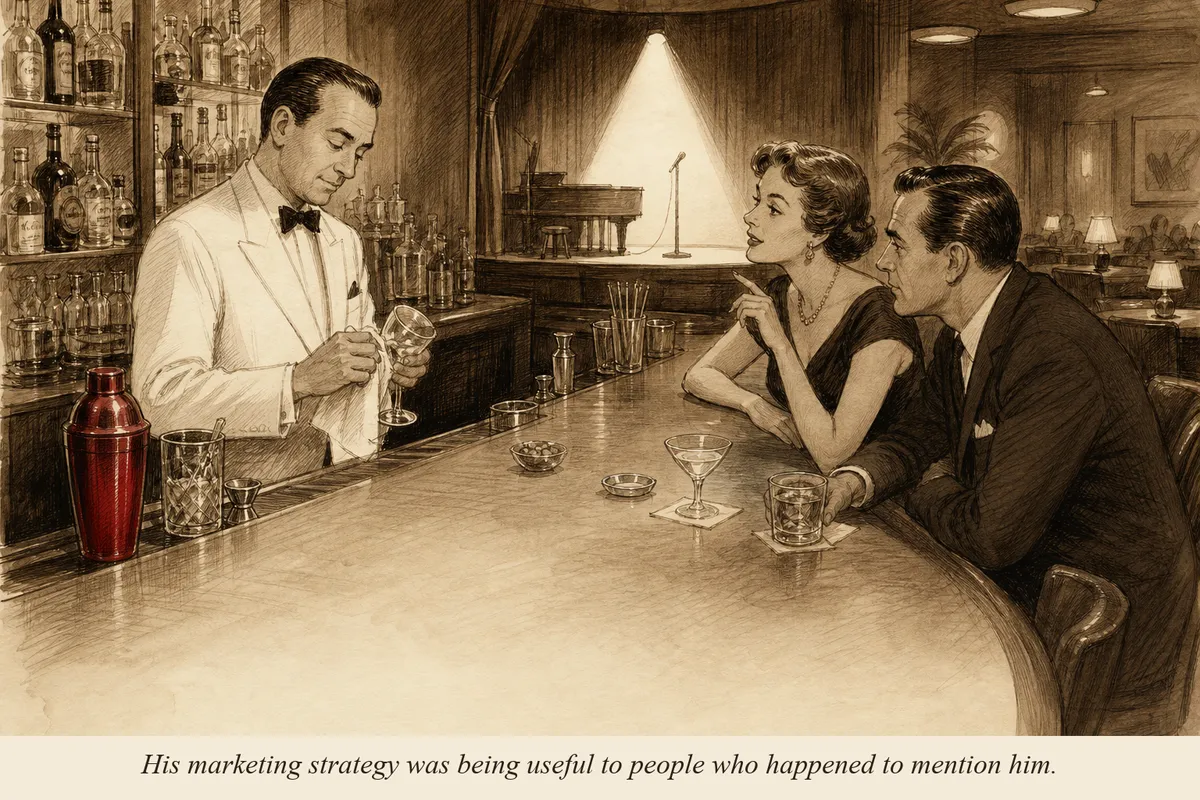
There’s a bartender in my neighborhood who knows everyone’s name, remembers everyone’s drink, and has been working the same bar for 22 years. He doesn’t own the bar. He doesn’t have Instagram. He doesn’t have a “personal brand.”
But if you need a plumber at midnight, he knows one. If you need a lawyer who actually returns calls, he’s got a name. If you need a caterer for sixty people on two days’ notice — he’s your guy. Not because he’s any of those things. Because he’s connected to all of them.
His “brand” — if you want to call it that — is being reliably useful in ways that have nothing to do with self-promotion. People seek him out not because he broadcasts, but because everyone who meets him tells two other people: “Talk to Tony.”
That’s the operator’s version of personal brand. Not the guru version. Not the “build an audience” version. The “be so quietly useful that people can’t help mentioning you” version.
The visibility paradox
Toll positions work because you don’t need an audience. That’s the foundational insight — build inside proven traffic, don’t start from scratch.
So why would you build a personal brand? Isn’t that the thing you designed the model to avoid?
Yes — if “personal brand” means “build an audience of 50,000 followers who consume your content.” That’s a full-time job. That’s exactly what you’re not doing.
No — if “personal brand” means “be discoverable by the right people at the right time.” Discoverability is different from fame. You don’t need 50,000 followers. You need 200 people in your industry to know what you do. Specifically: potential partners, potential allies, and people who might refer either.
The guru builds an audience. Their income depends on attention. More followers = more revenue. They optimize for reach.
The operator builds a reputation. Their income depends on partnerships. More credibility with the right 200 people = more partnerships. They optimize for trust density, not reach.
The strategic minimum
Here’s what “enough personal brand” looks like for a toll position operator:
One place to be found. A website, a newsletter archive, a LinkedIn profile with substance — one destination where someone who hears your name can go and quickly understand: this person builds monetization infrastructure for creators. They’re credible. Their methodology is real.
One proof artifact. A published article, a case study (anonymized), a tool, or a framework that demonstrates expertise without revealing proprietary details. Something shareable — something your existing partners can forward when someone asks “who does this for you?”
Enough activity to stay current. Not daily posts. Not weekly vlogs. Maybe a monthly article. Maybe quarterly insights shared in a community. Enough that when someone finds you, the most recent thing isn’t from 2023.
That’s it. One place, one proof, minimal activity. The 20-30% visibility zone on the spectrum.
When more visibility helps
There are exactly three moments where increasing visibility pays off:
1. Before partner #1. Cold-pitching is harder when you’re completely invisible. A creator who googles you and finds nothing will hesitate. A creator who finds a professional website, one solid article about the model, and evidence that you understand their world will take the meeting. The visibility investment before partner #1 is the highest-ROI marketing you’ll do.
2. When launching the licensing play. If you’re going to teach other operators, they need to find you. The licensing audience — aspiring operators — discovers you through content, communities, and referrals. Moderate visibility (a newsletter, a few published frameworks, presence in relevant communities) is necessary for the licensing layer to produce revenue.
3. When building the operator network. Other operators need to know you exist before they can cooperate with you. Visibility in operator-specific communities (not public platforms) makes alliance-building possible.
When more visibility hurts
When it attracts the wrong partners. High visibility attracts everyone — including creators who are wrong for the model. If your content goes viral, you’ll spend more time saying no to unqualified inquiries than saying yes to good ones.
When it reveals your operations. The more you share publicly, the more specific you get, the closer you get to violating the vagueness protocol. A guru needs to show results publicly. An operator needs to keep them private. These are contradictory requirements.
When it becomes a time sink. Content creation for brand-building is a full-time job if you let it be. Every hour spent building your audience is an hour not spent optimizing your positions. If your positions earn $200/hour in optimization time and your content earns $20/hour in brand equity — the math is clear.
When it makes you a target. Visible operators attract competitors, copycats, and people who want to reverse-engineer their partnerships. Strategic invisibility is a competitive moat in its own right.
The operator’s brand statement
If you do build a minimal presence, what does it say?
Not: “I’m an affiliate marketing expert.” Not: “I build passive income online.” Not: “I help creators monetize.”
This: “I build and operate revenue infrastructure inside established businesses. I’m the technical partner who installs systems that make existing traffic more valuable — without requiring additional content, effort, or risk from the business owner.”
That statement signals: technical capability, partnership orientation, low-maintenance for the creator, and clear methodology. It attracts the right people (creators looking for exactly this) and repels the wrong ones (creators who want an audience-builder or a social media manager).
The content strategy for operators
If you choose to publish — for discovery, for licensing, or for network-building — here’s what to publish and what to keep private:
Publish:
- Frameworks and methodology (how the model works in general)
- Anonymized case studies (results without names)
- Industry analysis (what’s happening in the creator economy that creates opportunity)
- Tools and calculators (the lead magnets that attract qualified leads)
- Philosophy and principles (what you stand for as an operator)
Keep private:
- Partner names and relationships
- Specific revenue numbers
- Active deal terms
- CCI data and cross-network intelligence
- Experiment results that give you a live competitive edge
The published layer builds credibility without compromising operations. The private layer protects your moat.
The anti-brand brand
Here’s the thing about Tony the bartender: his lack of “brand” IS his brand. The fact that he doesn’t self-promote is why people trust his recommendations. He’s not trying to sell anything. He just knows things and helps people.
The operators who attract the best partners, the strongest alliances, and the highest-quality licensees share this quality: they don’t look like they’re selling. They look like they’re doing. Their credibility comes from the work itself, not from talking about the work.
That’s the operator’s personal brand in one sentence: be so good at the work that the work speaks for you — and just visible enough that the right people can hear it.
Not more. Not less. The 20-30% zone. Where your reputation precedes you by exactly one conversation — someone mentions your name to someone who needs you, and that’s all the marketing that’s required.
The rest is silence. And the silence is the signal.
Scale
Ready to go from one position to a portfolio?
This article explored scaling. The newsletter delivers portfolio expansion patterns and operational frameworks weekly.
Unsubscribe in one click. Useful operator material only. Promotions, sponsors, and partner links will be disclosed.