Partner
The Bottlenecker Trap: What Happens When Operators Try to Control Too Much
The operator who makes themselves essential to every decision is one vacation away from collapse. Build the bridge, not the bottleneck.
May 23, 2026 · 7 min read
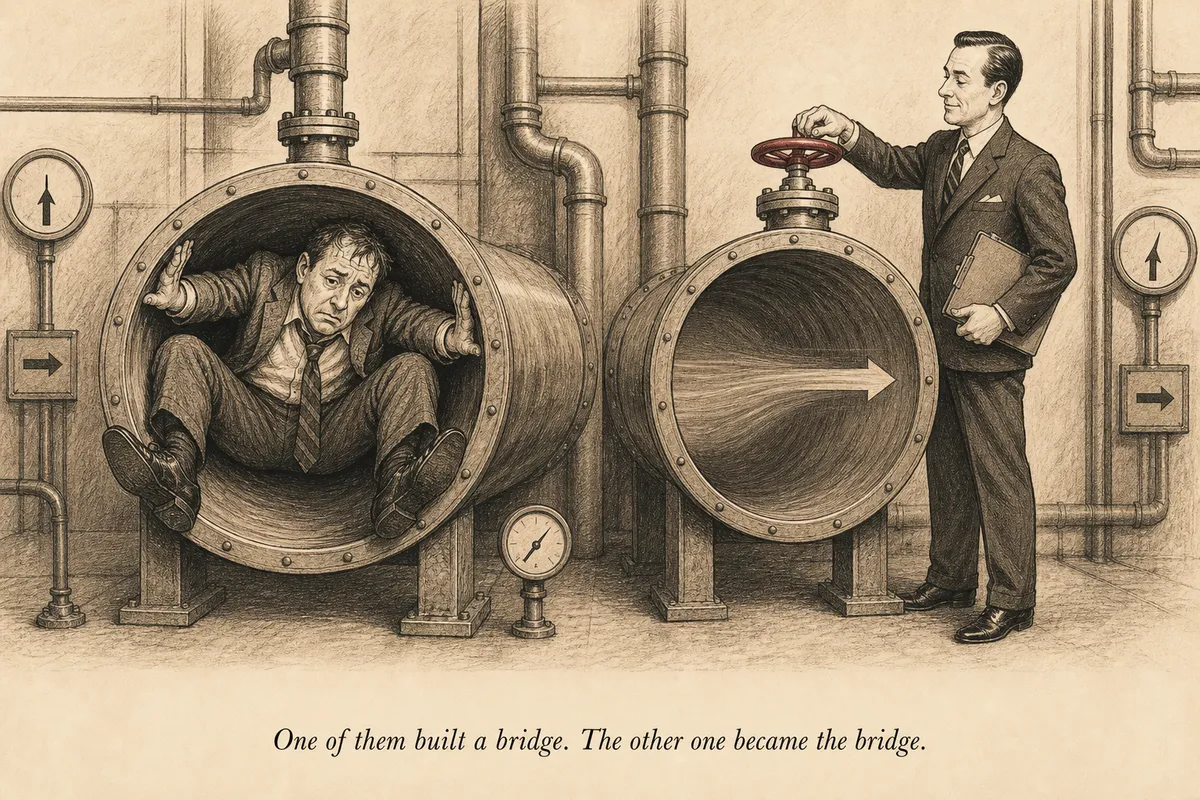
A finder — the old-school kind, before the internet, matching buyers and sellers for a fee — once had a $250,000 deal on his desk.
He’d done everything right. Found a business owner who wanted to sell. Found a buyer who wanted to buy. Secured a written agreement confirming his fee. All he had to do was introduce the two principals and step back while they negotiated their deal.
Instead, he sent the buyer a purchase offer to fill out. He demanded financial statements. He tried to pre-negotiate the deal terms. When the buyer hesitated, the finder told him, “Contact me if you ever decide to do anything.”
The buyer — who genuinely wanted the business — spent weeks tracking down the seller on his own. They negotiated directly. They closed the deal.
When the finder found out, he demanded to be included in the negotiations. Then he threatened legal action. Then he actually sued for the full fee plus damages.
He lost. The court ruled that by trying to control the transaction — acting as an unauthorized broker instead of a finder — he’d forfeited his claim to the fee.
The worst part? The seller had been prepared to pay the full $250,000. He’d told colleagues afterward that if the finder’s attorney had sent the demand letter three days later — after the seller had finalized the paperwork — the check would have already been in the mail.
A quarter million dollars, lost to the need for control.
The operator’s version of this story
The toll position model is structurally identical to the finder’s model. You build infrastructure between a creator’s traffic and a merchant’s checkout. You capture the data. You optimize the conversion path. You collect a toll on every transaction.
What you don’t do: manage the creator’s content, dictate which products the merchant sells, negotiate the terms between creator and merchant, or insert yourself into decisions that belong to the principals.
The moment you cross that line, you become a bottlenecker — and you trigger the same cascade that cost the finder his fee.
Here’s how it plays out in the digital version:
Stage 1: Helpful suggestions. You notice the creator’s video descriptions could be structured better. You suggest reordering the affiliate links. You draft a better product recommendation script. This feels helpful. The creator appreciates it. You feel like you’re adding value beyond the infrastructure.
Stage 2: Scope creep. The creator starts asking your opinion on which products to recommend. You start weighing in on their content calendar. You suggest they promote a specific merchant more heavily because the commission is higher. You’re now influencing the creator’s business decisions — decisions that should be theirs.
Stage 3: Control. You’re sending the creator a weekly email with “optimization recommendations” that are really instructions. You’re approaching merchants on the creator’s behalf to negotiate deals the creator didn’t ask for. You’re sitting in the middle of every conversation between creator and merchant, filtering information, shaping terms, “protecting your position.”
Stage 4: Collapse. The creator feels managed instead of supported. The merchant feels like they can’t reach the creator directly. One of them routes around you — sends a direct message, makes a side deal, cuts you out of a conversation. You find out and feel betrayed. You push harder for control. The relationship fractures.
The finder’s story, replayed in pixels instead of paper.
Why operators bottleneck
The finder who lost $250,000 wasn’t greedy. He was insecure.
He assumed that if he let the buyer and seller talk directly, they’d cut him out. So he tried to make himself indispensable by controlling the flow of information between them. The irony is devastating: by trying to prevent being cut out, he guaranteed it.
Operators bottleneck for the same reason. The toll position creates real value, but the infrastructure is replicable. A creator could, theoretically, build their own landing pages and email sequences. A merchant could, theoretically, approach the creator directly. If the operator’s only value is the technology, the technology can be replaced.
That fear — they’ll figure out they don’t need me — drives operators to expand their role beyond the infrastructure. To make themselves “indispensable” by inserting themselves into every decision. To justify their toll by demonstrating involvement rather than results.
It’s exactly backward. The more you insert yourself, the more you create the friction that makes people want to route around you. The less you insert yourself — the more you build the bridge, optimize the bridge, improve the bridge, and let the traffic flow — the more indispensable you become. Not because they can’t replace the technology, but because the data, the optimization history, and the cross-network intelligence are irreplaceable.
The strict role definition
Here’s what a toll operator IS and ISN’T:
IS:
- A builder of infrastructure (landing pages, email sequences, redirect layers)
- An optimizer of conversion paths (A/B tests, sequence improvements, pre-sell copy)
- A curator of products worth recommending (identifying what to place in the inventory)
- A custodian of subscriber data (behavioral tracking, segmentation, intelligence)
- A facilitator who makes it easy for traffic to find the right products
IS NOT:
- A content manager for the creator
- A sales agent for the merchant
- A negotiator between creator and merchant
- A gatekeeper who controls information flow between principals
- A decision-maker for anyone else’s business
The finder’s two absolute laws translate directly:
First: “Put it in writing. Get it in writing.” Your partnership terms, your revenue splits, your scope of work — documented, signed, clear. Not because your partner will cheat you, but because ambiguity is where bottlenecking starts. When the scope is fuzzy, every new request feels like it could be in scope. When the scope is documented, you can say “that’s outside our agreement” without it feeling like a confrontation.
Second: “When you give away your contacts without an agreement, nobody owes you anything.” Your subscriber database, your behavioral data, your optimization history — these are the toll. Give them away without a structure that captures value and you’ve given away the only thing that was yours.
The test: would the deal happen without you in the room?
Here’s a simple diagnostic for bottlenecking:
If you stepped away from a specific creator-merchant relationship for 30 days, would the existing infrastructure continue to generate revenue?
If yes — if the landing pages still capture, the emails still send, the links still track, and the commissions still flow — you’re an operator. The infrastructure is working. You can step away and the toll position produces value without your daily involvement.
If no — if the relationship requires your continuous mediation, your ongoing negotiation, your presence in every conversation — you’re a bottleneck. You haven’t built infrastructure. You’ve built a dependency on yourself. And dependencies, unlike infrastructure, don’t compound. They scale linearly with your time, which means they don’t scale at all.
The operator who passes this test can run five positions simultaneously. The bottlenecker can barely run two — because they’re personally embedded in every conversation, every decision, every adjustment.
The ego thing
There’s a subtler version of bottlenecking that doesn’t look like control. It looks like generosity.
An experienced matchmaker noticed that people love to feel important. When you ask someone for a referral, they’ll often give you not just the name but the private phone number, the inside story, the personal introduction — all because referring you to someone important makes them feel important. He called it “the ego thing.”
The ego thing works wonders for building your network. It’s how 75% of new partnerships come from referrals rather than cold outreach.
But it’s lethal when it infects the operator. The operator’s ego thing sounds like this:
“I’m the one who set up this whole deal. The creator was leaving $50,000 on the table before I showed up. The merchant had no idea this audience existed until I made the introduction. Both of them should know that none of this works without me.”
Every word of that might be true. And saying it — or worse, acting on it by inserting yourself into conversations where you don’t belong — is the fastest path to becoming a bottlenecker.
The matchmaker’s advice was blunt: let the ego thing work for you by getting referrals and building relationships. Don’t let it work against you by making you need to be seen as the center of every deal. The toll position generates revenue whether anyone credits you or not. The revenue is the point. The credit is the trap.
What the bridge operator actually does
The 18th-century bridge operator didn’t stand on the bridge directing traffic. He didn’t tell the merchants which goods to sell on the other side. He didn’t advise the travelers which town to visit. He maintained the bridge, kept it in good repair, occasionally widened it or added a lane when traffic warranted.
The bridge worked because the operator stayed out of the way.
Your toll position works the same. Build it. Optimize it. Improve it over time as the data directs you. Let the creators create and the merchants sell. Your job is the bridge — not the traffic, not the goods, not the negotiations.
The $250,000 finder could tell you: the toll is more than enough. If you let it be.
Partner
Want to find better partners?
This article explored the partner dimension. The newsletter delivers qualification frameworks and outreach patterns weekly.
Unsubscribe in one click. Useful operator material only. Promotions, sponsors, and partner links will be disclosed.