Scale
The Daisy Chain: The Silent Killer of Every Middleman Business
Every intermediary between you and the merchant compresses your margin and breaks your data loop. Cut the chain. Go direct.
May 26, 2026 · 9 min read
In the 1970s, a professional finder saw a classified ad: “WANTED — Polystyrene plastic for injection molding. Finder’s fees paid.”
Polystyrene was in short supply — the oil embargo had squeezed petrochemical production. If you could find inventory, the fee would be substantial.
He thought creatively. If manufacturers were rationed and couldn’t spare inventory, maybe a company that used polystyrene but had gone out of business still had some sitting in a warehouse. He searched. He found a bankrupt company in Mississippi with a sizable inventory and secured a letter from the bankruptcy trustee confirming availability.
Now he had the supply side. He wrote to every company advertising for polystyrene — a dozen or more — attaching a redacted copy of the trustee’s letter to prove he had real inventory.
Every single respondent was another finder.
Each one, in turn, referred him to another finder. Many of them unknowingly referred him to finders he’d already contacted. The chain looped back on itself. Finders referring finders referring finders, with nobody actually connected to a company that wanted to buy polystyrene.
He was in a daisy chain.
He stopped responding to the ads and went directly to the chemical manufacturers — the actual buyers. One of them purchased the inventory immediately. The others offered to pay him if he could find more.
Two years later, he answered another “Polystyrene Available” ad. What he received was a photocopy of a photocopy of a photocopy of his own original letter from the bankruptcy trustee — with his name blanked out, passed through so many hands that nobody knew where it came from.
The daisy chain was still going. Two years after the inventory had been sold.
%%{init: {'theme': 'neutral'}}%%
flowchart LR
    A["Operator\n(sees 12%)"] --> B["Affiliate Network"]
    B --> C["Sub-Network"]
    C --> D["Aggregator"]
    D --> E["Brand Rep"]
    E --> F["Product Company\n(pays 40%)"]
    style A fill:#c2410c,color:#fff
    style F fill:#4a7c59,color:#fff
The digital daisy chain
You’d think the internet would kill daisy chains. Instant communication, searchable directories, direct access to every business on the planet. If anything, you’d expect chains of middlemen to dissolve when anyone can reach anyone.
The opposite happened. The internet made daisy chains easier to form, harder to detect, and more persistent than ever.
Here’s how it looks in the toll position world:
An operator wants to place a financial product in a creator’s audience. Instead of approaching the product company directly, they sign up for an affiliate network. The affiliate network connects them to a sub-network. The sub-network connects them to an aggregator. The aggregator has a relationship with a brand representative. The brand representative reports to the product company’s partnership team.
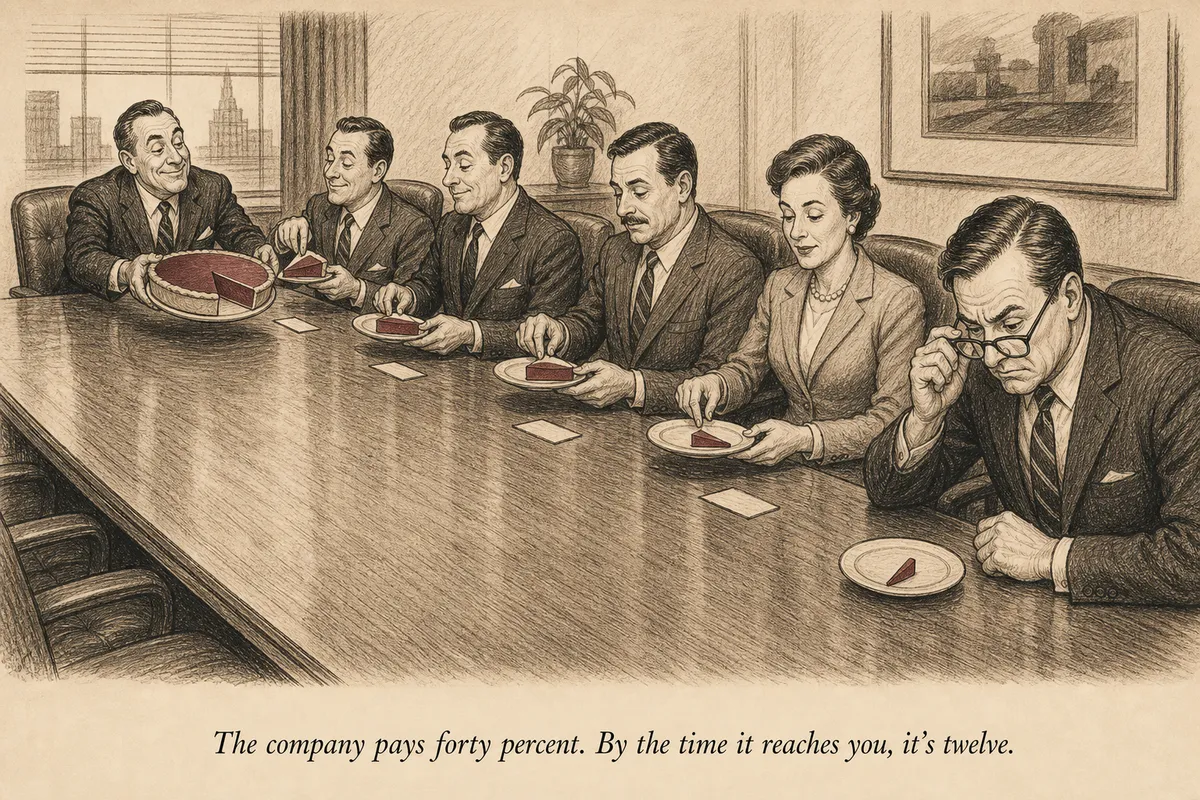
Between the operator and the actual product, there are four intermediaries. Each one takes a cut. The operator starts with what should be a 40% commission and ends up seeing 12%. The product company thinks they’re paying 40%, but most of it evaporates in the chain.
Nobody in the chain has a direct relationship with the product company. Nobody has a direct relationship with the operator. And critically — nobody has the data. Each intermediary sees their own slice: the network sees click volume, the aggregator sees conversion counts, the brand rep sees payout amounts. But the behavioral intelligence — who bought what, when, and why — is scattered across four databases that never talk to each other.
The toll position model works because the operator sits directly between traffic and merchant, owning the data at every step. A daisy chain decomposes that into fragments, with each fragment owned by a different middleman who adds cost without adding intelligence.
How to detect a chain
The finder had two rules for avoiding daisy chains. Both translate directly to digital operations:
Rule 1: Never give your client the name of another middleman. If the only “connection” you can offer is a referral to another network, another aggregator, another affiliate manager — you’re not adding value. You’re extending the chain.
Rule 2: Never accept a “connection” that turns out to be another middleman. If someone introduces you to what they claim is a product company, and the first thing that company does is redirect you to their “partnership platform” or “authorized reseller network” — you’re in a chain. The principal isn’t at the other end. Another middleman is.
In practice, the detection heuristic is straightforward: can the person you’re talking to say yes to a direct deal, or do they need to “check with” someone else?
If they can say yes — if they control the commission structure, the tracking, and the payout — you’re talking to a principal. If they need to route your request through another layer, you’re talking to a link in a chain.
Why chains form
Daisy chains aren’t malicious. They’re emergent. Nobody wakes up and decides to build a circular chain of middlemen who accomplish nothing. The chain forms because each participant is doing something locally rational:
The operator signs up for an affiliate network because it’s easy — one signup, access to hundreds of products. The alternative — finding and approaching product companies directly — requires research, qualification, and uncomfortable outreach.
The network aggregates operators because scale is their business model. More operators = more traffic = more leverage with product companies. The network doesn’t care if any individual operator has a direct relationship. They care about volume.
The sub-network exists because the primary network doesn’t cover every product category or geography. So intermediary networks form to fill gaps — adding another layer of abstraction between operator and product.
The product company works with networks because managing thousands of individual affiliate relationships is operationally painful. Outsourcing partner management to a network is the rational choice when you have hundreds of affiliates. But the outsourcing means the company loses direct contact with the operators who actually move their product.
Each actor’s decision makes sense in isolation. In aggregate, they produce a chain where nobody has a direct relationship, nobody owns the full data, and everyone’s margin gets compressed.
The cost isn’t just the commission
Lost commission is the obvious cost. If you’re earning 12% through a chain instead of 40% through a direct relationship, the math speaks for itself.
But the hidden costs are worse:
Data loss. Every intermediary in the chain is a data boundary. The affiliate network tracks clicks. The sub-network tracks conversions. The product company tracks revenue. But the behavioral intelligence — which subscriber segments convert best, which email sequences drive the most purchases, which products cross-sell with which other products — never makes it back to the operator because the chain fragments it.
The experiment log — the optimization data that constitutes the real moat — requires closed-loop data. You send an email, a subscriber clicks, they purchase, the purchase data feeds back into your segmentation. In a daisy chain, the loop is broken. You send the email and watch the click leave your system. Whether it converts, what the buyer purchased, how much they spent — that data lives in someone else’s dashboard.
Relationship loss. The product company doesn’t know you exist. They know the network that sends them traffic. If you want to negotiate a strategic partnership rate — the 40-50% direct deal that changes the economics — you need a direct relationship. In a chain, there’s no relationship to negotiate from.
Stability loss. Chains are fragile. If any single intermediary changes their terms, restructures their program, or goes out of business, every operator downstream is affected. In 2024, a major affiliate network restructured their commission tiers overnight. Operators who’d built their entire operation on that network — with no direct merchant relationships — saw their revenue drop 30-40% with no recourse and no negotiation leverage.
The operator with direct relationships renegotiates. The operator in a chain gets an email notification.
Worked example with default numbers:
A product company pays 40% commission. Through a network chain (network → sub-network → aggregator → you), the rate compresses to 12%. Going direct to the top 5 products — which drive 80% of your revenue — lifts the effective rate to 35-40%.
On $8,000/month in product sales, the chain costs you $2,240/month in commission compression. Going direct on your top 5 recovers most of that.
Run it with your own numbers: Revenue Calculator
interactive calculator
Commission Chain Erosion Calculator
See how each intermediary in the chain erodes your commission from the product company's payout.
Results
Commission without intermediaries
$80.00
Commission after chain
$33.75
Revenue lost to chain
$46.25
Your effective commission rate
16.9%
Revenue lost to the chain:
$46.25
Breaking the chain
The finder who discovered the polystyrene daisy chain didn’t try to fix the chain. He went around it. He stopped responding to intermediary ads and found the actual manufacturers — the principals who would buy the inventory.
The digital equivalent: go direct.
For any product that generates meaningful revenue through your toll position, identify the actual company behind the affiliate link. Not the network. Not the sub-affiliate program. The company.
Then approach them directly with the same Flipped JV logic that works for creator partnerships: “I have X subscribers who buy your product. Here are the numbers. Let me sell your product to them directly, at a negotiated commission, with data sharing between us.”
You don’t need to leave the affiliate network for every product in your inventory. Most products — the long tail of low-volume placements — are fine running through a network. The economics don’t justify the effort of a direct relationship for a product that generates $50/month.
But for your top 3-5 products — the ones that drive 80% of your revenue — a direct relationship replaces the chain with a bridge. Your bridge. With your data. At your commission rate.
The rule that prevents it
The finder’s framework was simple: only connect principals. If the person on the other end of the deal is another middleman, walk away.
The operator’s version: for your core revenue-driving products, only work with principals. Sign up for networks to discover products and test demand. But once a product proves itself — once you know it converts and your subscribers want it — break out of the chain and build the direct relationship.
The daisy chain is the default state of affiliate marketing. Breaking it is the work that separates an operator from an affiliate. The toll is there to be collected. But only if you own the bridge end to end.
Scale
Ready to go from one position to a portfolio?
This article explored scaling. The newsletter delivers portfolio expansion patterns and operational frameworks weekly.
Unsubscribe in one click. Useful operator material only. Promotions, sponsors, and partner links will be disclosed.