Partner
What Makes a Terrible First Partner (And Why You'll Be Tempted Anyway)
The worst first partner looks perfect on paper — big audience, high engagement, enthusiastic about the deal. Seven red flags to spot before signing.
May 17, 2026 · 7 min read
I almost made my first partner a friend’s cousin.
She had 180,000 YouTube subscribers in the home organization niche. She’d never put an affiliate link in a description. She responded to my DM in eleven minutes. She said “this sounds amazing, let’s do it” before I’d even explained the revenue split.
Every single one of those details felt like a green light. Every single one of them was a red flag.
I didn’t partner with her. Not because I was smart — because I got lucky. A more experienced operator saw my excitement and asked one question: “Has she ever monetized anything?” The answer was no. And that no would have cost me six months of building on a foundation that couldn’t hold weight.
Your first partner shapes everything downstream — your first case study, your first real data, your first answer when partner two asks “who else have you done this for?” Get it right and the next four get progressively easier. Get it wrong and you’re debugging a broken foundation while trying to build on top of it.
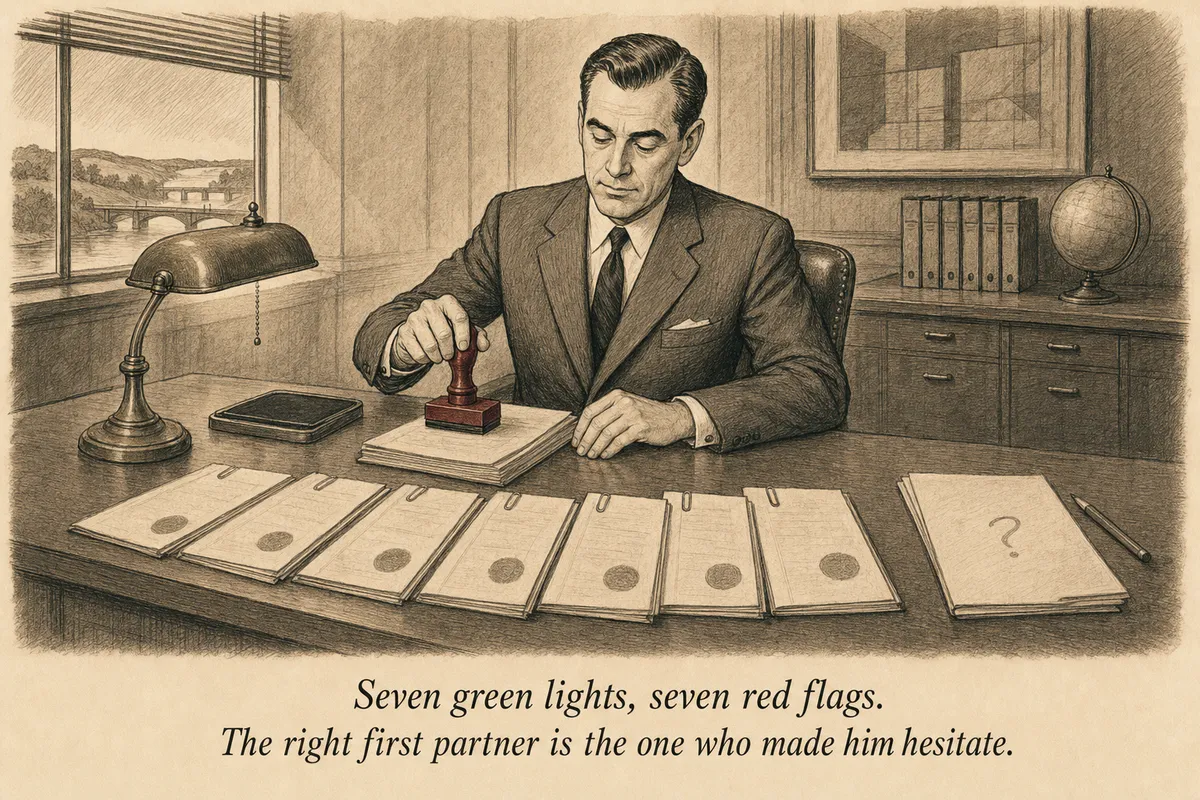
Here are the seven profiles that feel big and aren’t.
1. The creator who doesn’t monetize yet
A creator with 250,000 subscribers and zero affiliate links in their descriptions looks like untapped potential. All that traffic, going nowhere. You could be the one to install the infrastructure and capture the value.
Resist this one. Hard.
A creator who doesn’t monetize isn’t “untapped.” They’re either philosophically opposed to it, haven’t prioritized it, or haven’t figured out their business model yet. In every case, you’re not pitching a better version of something they already do — you’re pitching the concept of monetization itself. That’s two conversations, not one: first you sell the idea, then you sell your implementation.
The right first partner already monetizes. They already have affiliate links. They already understand that their traffic has economic value. Your pitch is surgical: I can make the thing you’re already doing work 3× better. That’s a much easier yes than you should start doing this thing you’ve chosen not to do.
2. The creator who already has a marketing team
If there’s an agency managing their links, a marketing director optimizing their funnels, or a virtual assistant swapping out affiliate URLs — you’re not filling a gap. You’re competing with an incumbent.
Incumbent relationships have inertia, history, and trust you can’t match with a cold pitch. Even if your approach is objectively better, the switching cost isn’t the technology. It’s the human relationship the creator would have to disrupt.
Save your energy for creators where the gap is empty. There are thousands of them. You don’t need to fight for one that’s already occupied.
3. The friend, the cousin, the college roommate
I know. They have 80,000 followers. They’d totally be open to it. You could just text them.
Personal relationships create obligation dynamics that make it nearly impossible to run the partnership as a business. When your friend’s landing page is underperforming, do you have the hard conversation about their content quality? When the revenue split needs renegotiating, are you negotiating — or are you having Thanksgiving dinner with this person next month?
Your first partner should be a professional relationship with documented terms, clear expectations, and no social penalty for either side walking away. Build the business relationship first. If your cousin wants in later, by then you’ll have the process, the data, and the professional frame to do it right.
4. The micro-creator (under 50K reach)
The math doesn’t work on small traffic. If a creator generates 5,000 monthly visitors to their product links and you capture 25% through your landing page, that’s 1,250 new emails per month. At $1.50 revenue per subscriber per month, you’re building toward… $1,875/month in steady state.
That’s not nothing, but it’s thin. Thin enough that one bad month — a video that underperforms, a seasonal dip, the creator taking a week off — drops you below the effort threshold. And the effort to build, deploy, and optimize a toll position is roughly the same whether the creator has 50,000 subscribers or 500,000.
The minimum viable traffic for a first partner is enough to produce 500+ email captures per month. That gives you statistically meaningful data within 30-60 days. Below that, you’re guessing, not optimizing.
The portfolio math changes this equation later — at five partners, several smaller positions can add up. But for partner one, you need enough traffic to prove the model works.
5. The creator in a niche you don’t understand
Your first landing page needs to pre-sell. Pre-selling requires writing copy that speaks the audience’s language, addresses their specific objections, and recommends products with credible specificity.
If you’re building a toll position in the tactical gear niche and you can’t tell a MOLLE panel from a moleskin notebook, your pre-sell copy will read like it was written by a tourist. And the audience — people who spend hundreds of hours researching this stuff — will detect the tourism in about four seconds.
Your first partner should be in a niche where you have genuine knowledge or at least genuine curiosity deep enough to write about it credibly. You don’t need to be an expert. You need to not be a fraud.
Later, with case studies and a team, you can expand into niches you’d need to research. But partner one? Pick the niche where you can write the landing page tonight and have it ring true.
6. The principal who isn’t a principal
This one comes from a matchmaker who spent fifty years learning the hard way.
A principal is the actual decision-maker — the person who can say yes to changing their links, yes to the revenue split, yes to the partnership terms. A middleman is everyone else: the manager who needs to “run it by” the creator, the agency that controls the brand deals, the VA who manages the description links but can’t authorize changes.
If the person you’re talking to can’t make the decision, you’re not pitching. You’re rehearsing. And every layer of indirection between you and the principal adds friction, delay, and opportunities for your pitch to get distorted in translation.
Before you invest time in a pitch, ask yourself: am I talking to the person who signs the deal, or someone who’ll describe it to the person who signs the deal?
If the answer is the latter, find the principal or find a different partner. The matchmaker’s rule was blunt: if you introduce your client to another middleman instead of a principal, you forfeit your claim. The modern translation: if you can’t get to the decision-maker, the deal isn’t real yet.
7. The “too good to be true” creator
They have 2 million subscribers. They respond to your DM within an hour. They love the concept. They want to start immediately.
Slow down.
The most qualified-looking opportunities are often the most qualified to waste your time. Large creators who respond instantly to unsolicited pitches from unknown operators are either (a) drowning in their business and responding to everything without evaluating anything, or (b) serial experimenter types who’ll say yes to your pitch this week and someone else’s next week.
For your first partner, you want enthusiasm matched with stability. Someone who asks good questions. Someone who wants to understand the model before committing. Someone who reads the deal shapes and picks one deliberately rather than saying yes to everything.
Healthy skepticism from a prospect is a signal that they take their business seriously. Instant enthusiasm with no due diligence is a signal that they don’t.
Why your instincts will fail you
Every one of these bad-partner profiles triggers an instinct that feels rational in the moment:
The non-monetizing creator triggers the “untapped potential” instinct. The friend triggers the “easy yes” instinct. The micro-creator triggers the “any start is a good start” instinct. The niche you don’t understand triggers the “I’ll figure it out” instinct. The too-good-to-be-true creator triggers the “this is my big break” instinct.
All of these instincts are optimized for getting started. None of them are optimized for getting data that compounds.
Your first partner isn’t a test of whether you can build the infrastructure — you already know you can; you’re a builder. Your first partner is a test of whether you can generate the data that makes partner two through five progressively easier. That requires traffic volume, niche fit, a real principal, and a professional relationship structure.
The matchmaker who did this for fifty years had a phrase for operators who sent unqualified leads to their clients: “amateur.” Not because they lacked ambition — because they lacked qualification. They wanted the fee without doing the work of verifying that the match was real.
Your equivalent of qualifying the match: fifteen minutes of research before you send the first message. Check the description links. Count the traffic. Identify the niche. Find the principal. If any of those fail the test, add them to your list for later and move on.
The right first partner isn’t the biggest opportunity. It’s the cleanest one.
Partner
Want to find better partners?
This article explored the partner dimension. The newsletter delivers qualification frameworks and outreach patterns weekly.
Unsubscribe in one click. Useful operator material only. Promotions, sponsors, and partner links will be disclosed.