Scale
The 70-Year Model: Why This Isn't New and Why That Matters
The toll position model has worked for seventy years across three market eras. Same architecture, different tools. Here is the pattern.
May 14, 2026 · 8 min read
In 1957, an entrepreneur who’d never write a blog post or record a YouTube video figured out something that most of today’s internet marketers still haven’t grasped.
He didn’t sell products. He didn’t build factories. He didn’t employ salespeople. What he did was simpler and, in retrospect, more elegant: he owned the small piece of proprietary infrastructure that sat between every manufacturer and every customer in his market. A mold. A patent. A trade secret embedded in a chemical formula. He called it a toll position — and every unit that moved through his industry paid him a fee on the way through.
Over the next five decades, that single insight built a portfolio of toll positions spanning consumer goods, industrial equipment, and international licensing deals. Sixty million units of one product alone. International patents generating royalties across multiple countries. All from a guy who never ran a factory, never managed a warehouse, and never hired a sales force.
He called himself a “virtual manufacturer.” He controlled the IP. Everyone else did the work.
If that sounds familiar, it should. It’s the toll position model — just built in atoms instead of bits.
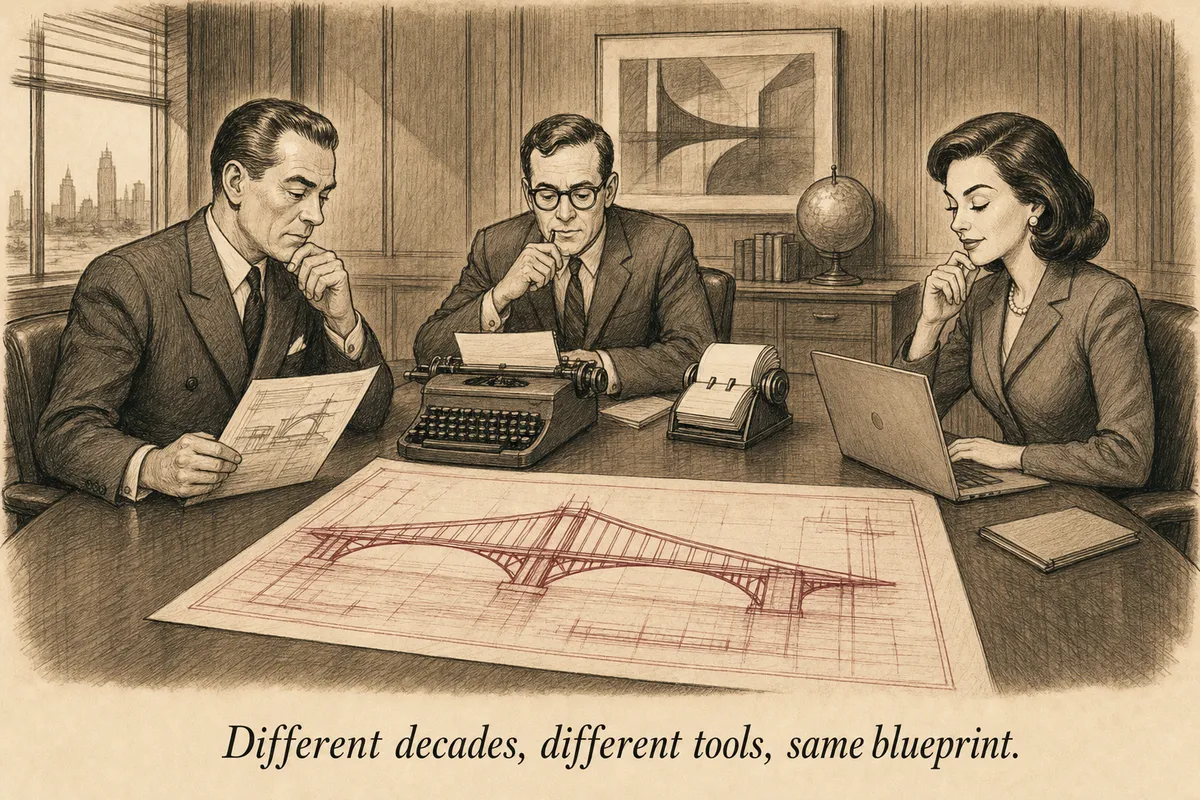
The matchmaker who got paid for 50 years
Around the same time, a different entrepreneur — this one operating out of a small office with a typewriter and a telephone — discovered that you could earn substantial fees by doing nothing more than introducing qualified buyers to qualified sellers.
Not selling. Not brokering. Not negotiating. Just matching.
He’d read an ad from a company looking for a specific type of industrial supply. He’d search his contact network — a handwritten catalog of everyone he’d ever spoken with, what they needed, and what they had — until he found the other side of the deal. Then he’d write a letter to the company saying, essentially: “I’ve found what you’re looking for. Here’s a redacted copy of their offer. If you’ll confirm my fee in writing, I’ll make the introduction.”
That’s it. Introduction made, fee earned, move on to the next match.
He did this for nearly five decades. The methodology never changed. The tools evolved from typewriters to computers, but the structural logic stayed identical: own a catalog of qualified contacts, match both sides of a transaction, and collect a toll on every deal that closes.
He had two absolute laws:
First law: “Put it in writing. Get it in writing.”
Second law: “When you give away your contact’s name before securing a written agreement, nobody is obligated to pay you a fee.”
The contacts were the product. The catalog was the asset. Give away the contacts without an agreement and you’ve given away the only thing you had to sell.
Sound like anything? A database of subscribers. A catalog of creators and merchants. The intelligence about who buys what, when, and why. Give that away without a structure that captures value and you’ve built an expensive hobby.
The licensing strategist
Fast-forward to the 2010s. A business strategist who’d spent decades in the licensing world published a series of frameworks for what he called “Licensing IN” — a system for earning revenue by selling other companies’ products to your own subscriber base.
His pitch to potential partners was elegant in its simplicity: “I have X subscribers who want Y. Let me sell your product to them. You handle fulfillment. I handle promotion. We split the revenue.”
He claimed a 90% agreement rate on that pitch. And why wouldn’t it be high? You’re offering someone free sales. No reciprocal promotion required. No risk on their side. If it works, they make money. If it doesn’t, they’ve lost nothing.
He also formalized the reverse: “Licensing OUT” — packaging your own proven processes, systems, and intellectual property for other businesses to license and deploy. Six different methods, ranging from distribution networks to full master licenses.
The through-line was the same as the original toll position holder and the matchmaker: position yourself between existing supply and existing demand, own the infrastructure that connects them, and collect a toll on every transaction.
Three eras, one architecture
Here’s what matters about these three practitioners spanning seven decades:
They never met. They operated in completely different markets — physical goods, industrial brokerage, digital licensing. They used different tools, different language, and different scales. But they all converged on the same structural insight:
The most durable fortunes aren’t built by creating products or audiences. They’re built by owning the connective infrastructure between existing products and existing audiences.
The physical toll position holder owned molds and patents — the infrastructure between raw materials and finished products. The matchmaker owned a contact catalog — the infrastructure between buyers and sellers. The licensing strategist owned subscriber relationships and deployment systems — the infrastructure between product creators and their next customers.
Each of them was, in modern language, an operator — not a content creator, not a merchant, not an audience builder. An operator who controlled the bridge and collected a toll on every crossing.
What the internet actually changed
If the model is 70 years old, what’s different now?
Three things. And they’re substantial.
1. The capital requirement dropped to near-zero.
The original toll position holder needed physical patents, molds, and manufacturing contracts. The matchmaker needed decades of relationship-building and a filing cabinet full of contacts. Both required years of groundwork before the first dollar of toll revenue appeared.
A digital toll operator needs a landing page, an email system, and a redirect layer. Total cost: $15-50/month. Time to first deployment: weeks, not years. The structural logic is identical — own the bridge between traffic and merchant — but the barriers to entry collapsed.
2. The data layer didn’t exist before.
The physical toll position holder knew his products sold. The matchmaker knew his contacts were qualified. But neither had granular, real-time data on every transaction, every click, every behavioral signal.
A digital toll operator sees everything: which emails get opened, which links get clicked, which products get purchased, which subscribers buy from multiple partners, which segments convert at 3× the average. That data — the experiment log, the behavioral segmentation, the cross-network intelligence — is a new kind of asset that the 1957 version of this model couldn’t produce.
The data doesn’t just inform optimization. It compounds. Every experiment, every subscriber action, every cross-purchase pattern adds to an intelligence layer that makes the next decision better than the last. The physical toll position holder had to rely on intuition refined over decades. You have a dashboard that updates daily.
3. Portfolio compounding accelerates.
The original practitioner took years to parlay one toll position into the next. He’d generate revenue from one patent, use it to fund acquisition of the next, build relationships with manufacturers in one category, then leverage those relationships into adjacent categories. It worked. It just took time measured in years.
A digital toll operator can go from one partner to five in under a year. Each partner adds subscribers, data, and cross-network intelligence that makes the next partner easier to sign and more valuable to serve. The compounding cycle that took the original practitioner a decade now takes months.
Why “this isn’t new” is the most important thing about it
I could have opened this newsletter with “here’s a hot new way to make money online.” That framing would probably generate more clicks. The internet rewards novelty, and “70-year-old business model” doesn’t exactly scream viral.
But here’s why the history matters more than the hype:
Survivorship. A model that’s generated wealth across seven decades, three completely different market contexts, and the entire transition from analog to digital isn’t a tactic. It’s an architecture. Tactics have half-lives measured in months — the latest Facebook ad strategy, the current TikTok algorithm hack, whatever growth-hack du jour is making the rounds. Architectures persist because they’re built on structural advantages that don’t depend on any single platform, technology, or market condition.
The toll position works in 1957 with physical molds. It works in 1978 with a typewriter and a filing cabinet. It works in 2026 with a static site and an email platform. It’ll work in 2036 with whatever comes next — because the structural logic doesn’t change. There will always be traffic. There will always be merchants. There will always be value in owning the bridge between them.
Legitimacy. When someone tells you they’ve discovered a new way to make money online, your skepticism is well-calibrated. Most of it IS garbage. But this isn’t a new discovery. It’s an established wealth-building architecture with a 70-year track record, adapted for a medium that happens to make it faster, cheaper, and more data-rich than any previous version.
You’re not betting on a theory. You’re deploying a proven model in a better environment.
Patience. If the practitioners who built these fortunes over decades could be patient — waiting months for postal correspondence, years for patent approvals, decades for portfolio compounding — then you can wait 90 days for your first toll position to produce meaningful data.
The compound effect isn’t a motivational platitude. It’s the mathematical reality of how this model works. Month 1 looks like nothing. Month 8 looks like something. Month 18 looks like a business. Month 36 looks like an asset worth owning. The 70-year track record proves it — but only for the people who stick around long enough to let the math work.
The model isn’t the edge. The medium is.
Every generation of toll position operator had access to the same structural insight: own the bridge, collect the toll. What separated the successful ones from the theoretical ones was deploying that insight in the medium of their era with the tools of their era.
In 1957, that meant patents and molds and manufacturing contracts. In 1978, it meant a contact catalog and professional correspondence. In 2026, it means landing pages, email sequences, behavioral data, and AI tools that can optimize faster than any human.
The model is 70 years old. The opportunity to deploy it with near-zero capital, real-time data, and compounding speed? That’s right now.
Scale
Ready to go from one position to a portfolio?
This article explored scaling. The newsletter delivers portfolio expansion patterns and operational frameworks weekly.
Unsubscribe in one click. Useful operator material only. Promotions, sponsors, and partner links will be disclosed.