
Reader kit
The Un-Community
A Community Operator's Playbook
The book's checklists and figures, set up to print and keep beside you while you work inside someone else's room: what to read before you propose anything, what to settle with the owner in writing, how the trading floor runs, and what goes back to the owner when the work ends. Everything here is already in the book. This page just puts it on paper.
This page is for readers of the book. It's free, and you don't need to sign up to use it.
In the kit
- The Guardrails Checklist (Appendix B, its own printable page)
- The switching-cost inventory (Chapter 1)
- The room scorecard (Chapter 3, with an interactive scorer)
- The division-of-labor sheet (Chapter 2 and Appendix A)
- The container and the proof-task sheet (Chapter 4 and Appendix A)
- Sorting questions and the privacy note (Chapter 5 and Appendix A)
- The weekly rhythm and the handoff checklist (Chapter 6)
- The exchange board (Chapter 7 and Appendix A)
- The deal room (Chapter 8 and Appendix A)
- The member record and the weekly scan (Chapter 9 and Appendix A)
- Three honest ways to be paid (Chapter 10)
- Perks, placements and group deals (Chapter 12)
- The quarterly room review and the handover (Chapter 14 and Appendix A)
- Rules change (dated note)
Each worksheet has its own print button. The book's disclaimer applies to all of it: nothing here is legal, tax, accounting, investment or financial advice, and every number in the figures is an illustration, not a result or a forecast.
Appendix B
The Guardrails Checklist
The book's working positions in one place, to run at each stage of operating a room: the lines that don't move, and what to check before you take a room, before you sort it and spread the hosting, before you build the trading floor, before you keep a member record, before you get paid, before you launch a program, before you join an operator alliance, and when you hand a room back. If the answer to any question is "no" or "I'm not sure," stop until you've sorted it out.
The Un-Community · Chapter 1
The switching-cost inventory
Before you propose anything to an owner, find out what's holding their room together today. This is an hour of reading, done with the owner's permission, as a member or a guest. Rate each reason to stay strong, weak or absent, and write down the evidence.
| Reason to stay | What to read for | Strong, weak or absent | Evidence |
|---|---|---|---|
| Peers | Read the last month of posts. In how many threads does a member answer another member before the owner does? Are there names that show up in each other's threads again and again? | ||
| Proven results | Look for members posting what happened when they tried the method. Not praise for the owner, which is common and cheap. Actual reports: I did the thing, here's what changed. Count them. Notice whether anyone responds. | ||
| Status | Is there a visible way to become somebody here? Levels, roles, a reputation for answering a certain kind of question, a history of being asked to share. Or is everyone just a name in a list? | ||
| Economic connections | Have members hired each other, referred business, bought from each other, built something together? Often you'll find this in passing remarks ("thanks to Nell for the intro last month") rather than any formal place. In the book's view, the strongest of the four. |
What the ratings tell you
- Warm peers and no economic connections. The room needs a trading floor.
- Results but no peers. It needs structure for newcomers.
- None of the four. It needs a hard conversation about whether it's worth operating at all. That's what the room scorecard is for.
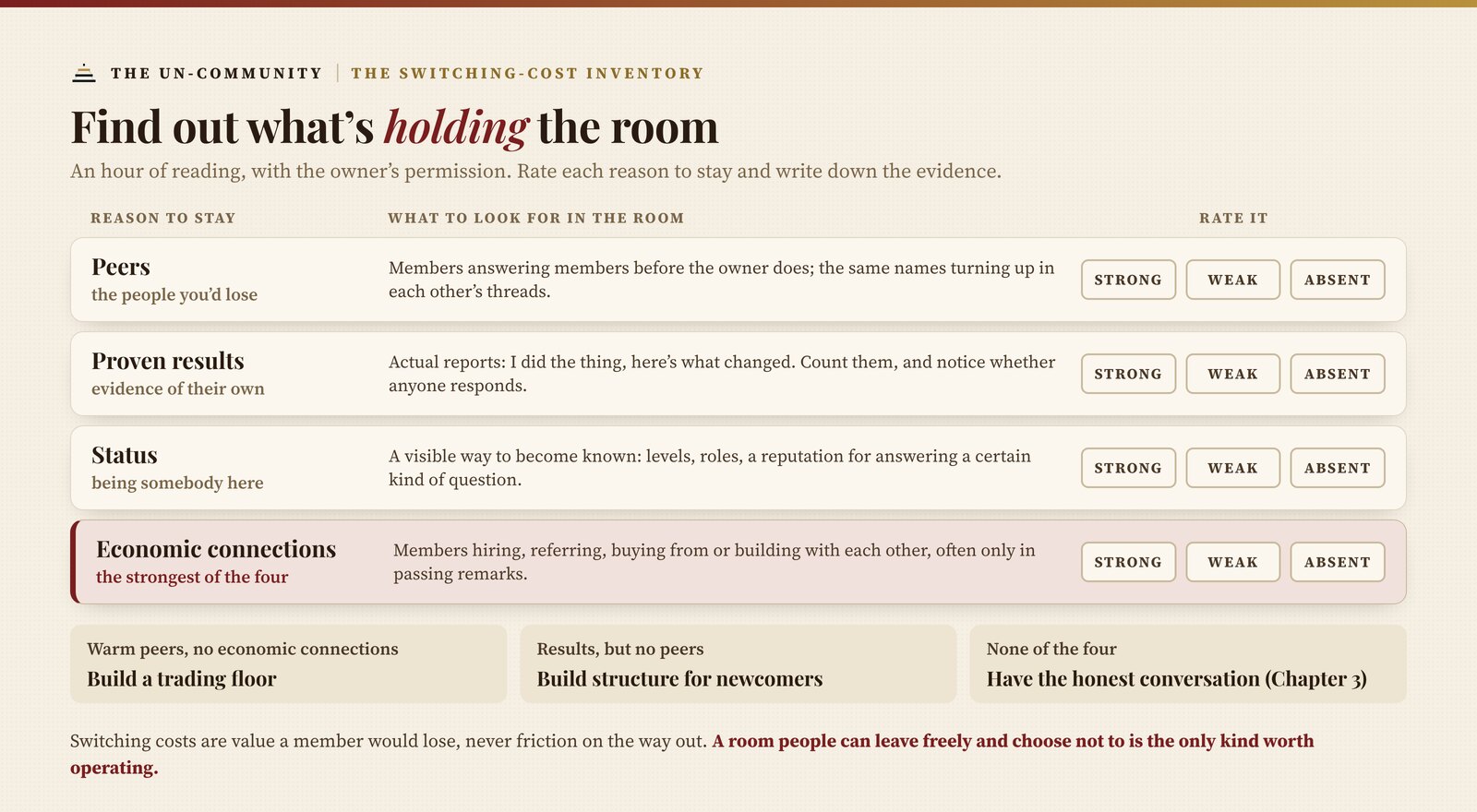
Build reasons to stay, never obstacles to leaving. The switching costs in this book are value a member would lose, like a partner, a result, or a working relationship. They are never friction a member runs into on the way out: hidden cancellation, confusing renewal terms, or data a member can't take with them. Paid rooms follow automatic-renewal and cancellation rules, and members who want to go should find the door easily. A room people can leave freely and choose not to is the only kind worth operating.
The Un-Community · Chapter 3
The room scorecard
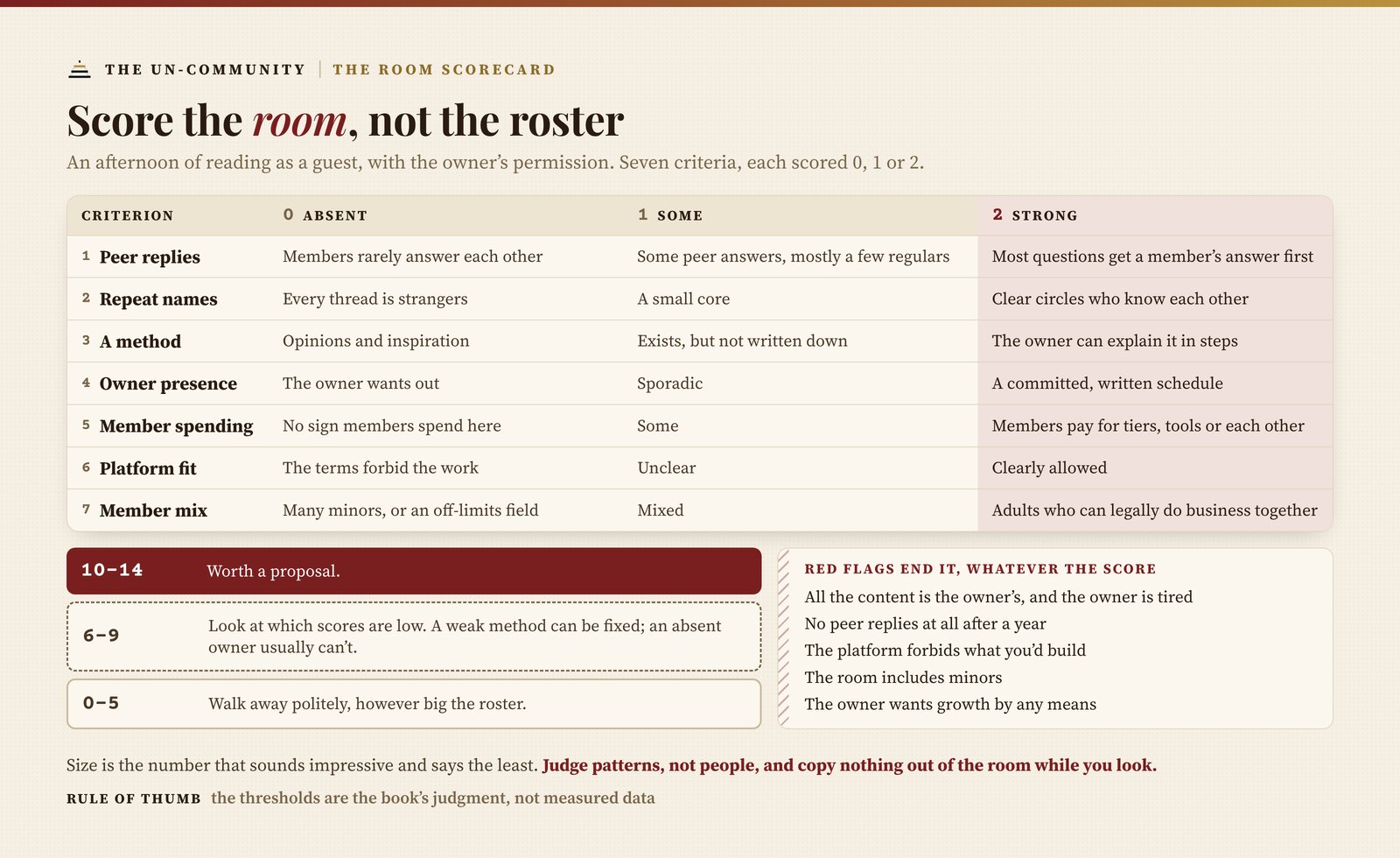
Score each room 0, 1 or 2 on seven signals. It takes an afternoon of reading, with the owner's permission, as a guest or member. Headcount isn't one of the seven.
Prefer to score on screen? The room scorecard adds it up as you go.
| 1. Peer replies | 0: members rarely answer each other. 1: some peer answers, mostly among a few regulars. 2: most questions get a member's answer before the owner's. | |
|---|---|---|
| 2. Repeat names | 0: every thread is strangers. 1: a small core. 2: clear circles of people who know each other. | |
| 3. A method | 0: opinions and inspiration. 1: a method exists but isn't written down. 2: a method the owner can explain in steps. | |
| 4. Owner presence | 0: the owner wants out. 1: sporadic. 2: a committed, written schedule. | |
| 5. Member spending | 0: no sign members spend in this area. 1: some. 2: members already pay for tiers, tools or each other's services. | |
| 6. Platform fit | 0: the platform's terms forbid what you'd build. 1: unclear. 2: clearly allowed. | |
| 7. Member mix | 0: many minors, or a field where the exchange would be off-limits. 1: mixed. 2: adults in a field where members can legally do business with each other. | |
| Total | Add the seven scores. |
Reading the total
- 10 or more. Worth a proposal.
- 6 to 9. Look closely at which scores are low. A weak method can be fixed with the owner, but an absent owner usually can't.
- Below 6. Walk away politely, however big the number on the roster.
The thresholds are the book's rule of thumb, not measured data.
Red flags that end the conversation, whatever the score
- All the content comes from the owner, and the owner is tired. You'll be asked to rescue a broadcast.
- No peer replies at all after a year. The room's culture has set.
- The platform forbids what you'd build. The answer is no, or a move the owner has to want.
- The room includes minors. That's a different job with different law.
- The owner wants you to grow it by any means. Buying members, scraping contacts from other groups, automated messages to people who didn't ask. You'll be the one whose name is on it.
Five questions for the owner
- "What happens in the room when you're away for a week?"
- "Who are the members you'd miss most if they left?"
- "What have members done together that you didn't organize?"
- "What do you want the room to produce in a year?"
- "How much of your week can you give it, in writing?" This is the answer that matters most.
Read a room's platform terms before you propose anything, and don't build what they forbid: no scraping, no automated messages the platform bans, no workarounds. Evaluate a room as a guest or member with the owner's permission, and don't copy member names, profiles or posts out of it while you look. What you're judging is patterns, not people. Rooms with minors are out of scope for the playbooks in this book; ask a lawyer before operating one.
The Un-Community · Chapter 2 · Appendix A
The division-of-labor sheet
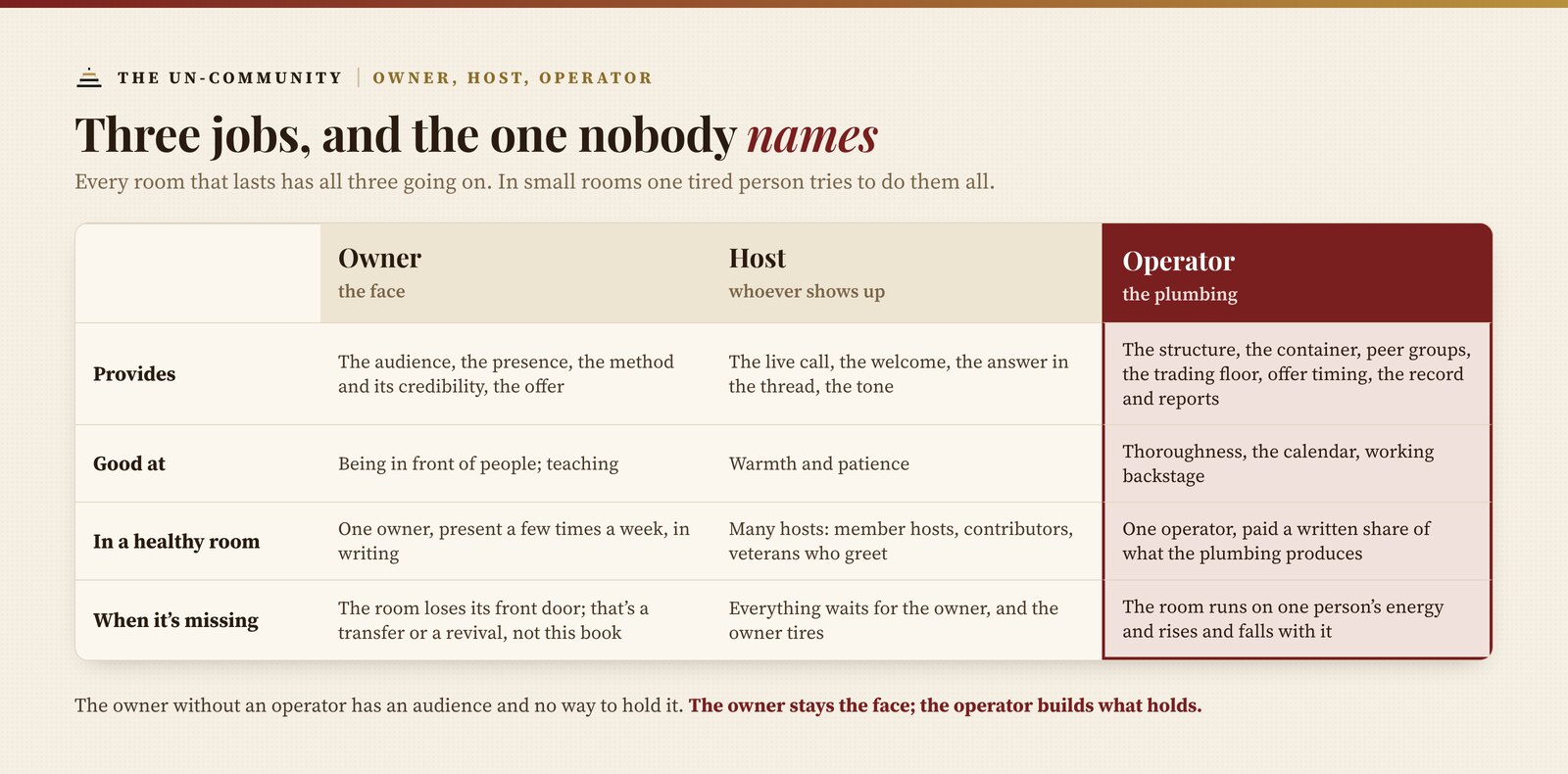
One page, signed by owner and operator before any money changes hands. Put a name in exactly one column for each task. Where a task is shared, write who decides and who does. Most owner-operator fights start with a task each side thought the other was doing.
| Recurring task | Owner | Host | Operator |
|---|---|---|---|
| Welcoming new members | |||
| The weekly live session | |||
| Moderation | |||
| The container | |||
| The trading floor | |||
| Offers and their timing | |||
| Billing questions | |||
| The monthly report | |||
| Member data | |||
| Who talks to sponsors | |||
Four lines at the bottom
- Presence. How often the owner will show up, in writing. "Three appearances a week" is a commitment; "when I can" is a warning.
- Data. Whose member data it is (the owner's), what the operator may access and why, and what happens to it when the arrangement ends.
- Exit. How either side ends the partnership, how much notice, and what the operator hands back.
- Know-how. The operator keeps de-identified patterns about what works, with nothing that identifies a member, and none of the owner's confidential numbers.
Write down what the share is a share of
"Thirty-five percent of the community" means nothing when the argument starts. "Thirty-five percent of net membership revenue from the paid tier, reported monthly, with read access to the platform's billing" means something.
Put the owner-operator agreement in writing before you build anything: the scope, your share and exactly what it's a share of, reporting, your right to see the numbers, and term and exit. The members are the owner's relationship. You handle their data on the owner's behalf, under that agreement, taking only what the job needs, keeping it secure, and returning or deleting it when the work ends. Say in the agreement that you keep de-identified know-how (patterns about what works, with nothing that identifies a member and none of the owner's confidential numbers), so neither side is surprised later. Members should be told plainly what's collected about them and why. Treat patterns in this chapter as a checklist; have a lawyer draft the real agreement.
The Un-Community · Chapter 4 · Appendix A
The container and the proof-task sheet
A structure a new member moves through that makes the owner's method prove itself, with the member doing the proving. Three parts, in order: a plan they can see on day one, a small proof they perform themselves, and peers who pull them the rest of the way. The operator builds all three. The owner supplies the method underneath them and stays the face.
The plan: three steps, visible, in plain language
| Step 1 | |
|---|---|
| Step 2 | |
| Step 3 |
The first step should cut against what the member already believes. The plan is a promise about a process, not an outcome. The book's example, for a room of small shop owners: stop categorizing every receipt; set up three buckets and a weekly fifteen-minute sweep; close the month in an afternoon.
The proof-task sheet
Fill it in before the proof goes into the room, so the owner, the operator and any member host are running the same test.
| The belief | The one sentence that has to fall before a member commits to the method. "If I don't categorize everything, my books will be a mess." |
|---|---|
| The task | What the member does, in one or two sentences. "Sort last week's receipts into the three buckets." |
| The time limit | Fifteen minutes, stated on the task, and a timer if the platform has one. |
| What to post | The member's own number and one sentence, where other members can see it. "My time, and one thing that surprised me." |
| What counts as a surprise | The result that contradicts the belief. "Under fifteen minutes, and nothing important was lost." |
| A null result | What it looks like when the task didn't move the belief, and the line inviting members to post it anyway. "It took forty minutes and I'm still worried." |
The null-result line keeps the room's evidence real: a proof that only collects surprises has stopped being a test.
Where to find the belief
- The questions people ask right before they buy, or right before they don't. "Will this work if I only have an hour a week?" is a belief wearing a question's clothes.
- The objections members raise in threads when the method comes up, especially the polite ones.
- The members who left early. If the owner has any record of why, it's the best evidence in the room.
- Write the candidate beliefs on one page and ask the owner which one, if it fell, would make everything else easy.
The peers
- Pods. Three or four members at a similar stage, formed in the first two weeks, with one light obligation: check in once a week.
- Review pairs. Two members who look at each other's work and reply within a couple of days.
- The hot seat. A regular slot where one member brings a real problem and the room works on it together.
- The owner's offer comes after the proof and after the peers have formed, often three or four weeks in.
Count every week, for the whole room
- Proof completion. Of the members who joined this week, how many posted a proof result within seven days?
- Pod pulse. How many pods checked in this week? A pod that misses two weeks in a row needs a nudge or a merge.
- Peer replies. The Chapter 3 measure, now watched over time.
- The offer window. How many members saw the offer, and at what point in their path?
Nobody's pod attendance should turn into a scorecard members can see.
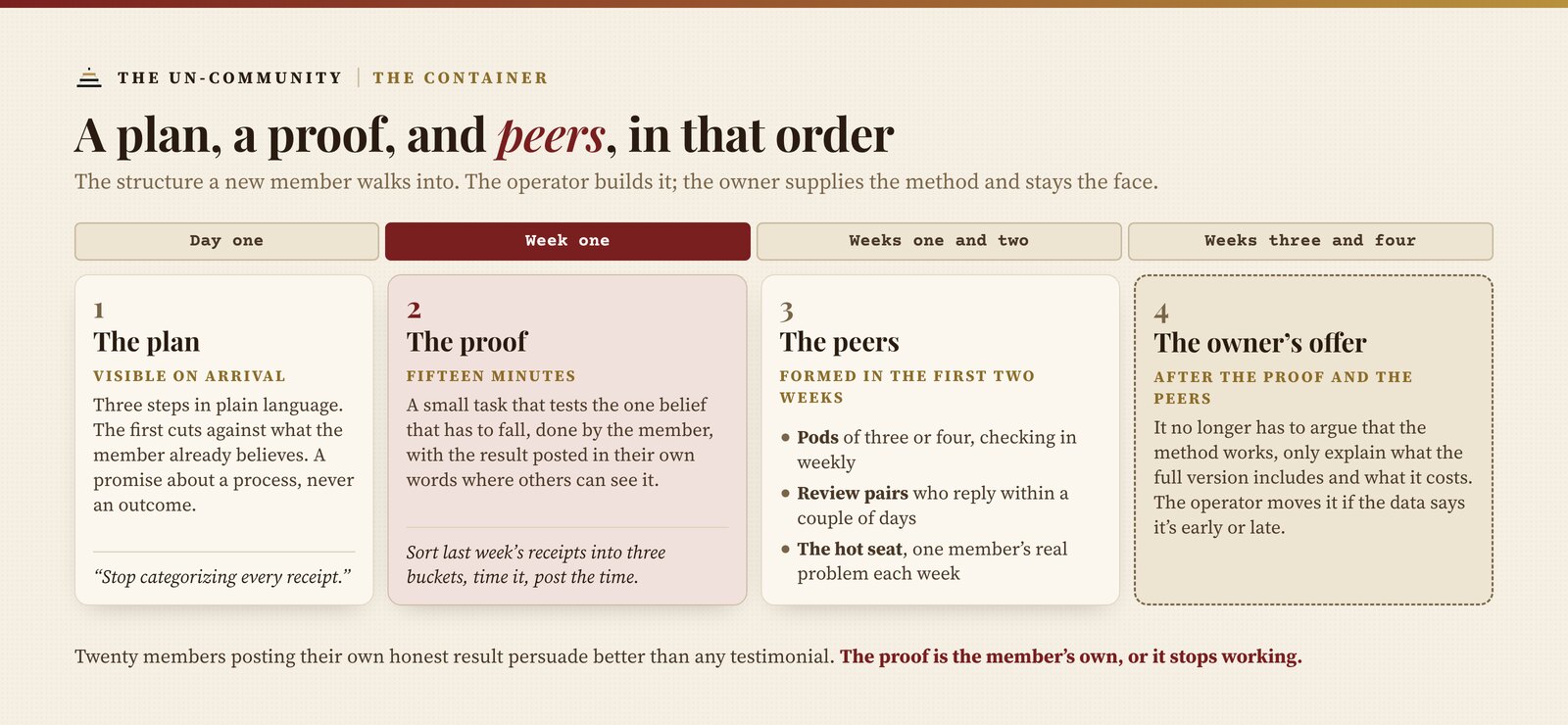
The container persuades with the member's own experience, so it has to stay honest. The plan promises a process, never an outcome or income. Proof tasks are real, results are the members' own and unedited, and members who got nothing from the proof are free to say so. Testimonials used anywhere are real, typical or clearly labeled, with any connection to the owner disclosed. Paid tiers the container leads to follow renewal and cancellation rules. The playbook assumes adult members; rooms with minors need different rules and a lawyer.
The Un-Community · Chapter 5 · Appendix A
Sorting questions and the privacy note
Ask the kind of question that lets a room sort itself, in the open, then use what members said in ways they'd recognize and welcome. Once a month is plenty. Mix the kinds of question, or the room will start to suspect it's being measured.
Four questions that sort a room
- The hypothetical price. "Hypothetical for the group: if you could hand your books to a part-time finance person tomorrow, what would you expect to pay a month? Curious how people think about this."
- The tools thread. "What's one tool you pay for that you'd never give up?"
- The before-and-after prompt. "Where were you a year ago with this, and where are you now?"
- The two-option event. A free thirty-minute session and a paid half-day workshop, or a group call and a small-table session. Who signs up for which tells you who's ready to invest more.
The tier record, about an index card per member
| Ready to invest | Members naming larger numbers, paying for serious tools, choosing the paid option. |
|---|---|
| Building | Mid-range answers, a mix of paid and free, clear upward stories with real constraints. |
| Starting | Small numbers or "never," mostly free tools, stories about getting going. |
| Watching | Members who read and rarely answer anything. |
Record only what members said in the room, where other members could see it, and only what you'll actually use. A tier is a snapshot. Review the record every quarter and let the old guesses go.
Three rules for follow-up
- 1. Follow-up comes from the owner or the operator, in the room's normal channels, and it's the kind of thing a member would have wanted to hear about anyway.
- 2. Anything recommended with a paid connection says so, in plain words, where the member sees it.
- 3. Individual answers never leave the room. When a sponsor or partner wants to know about the audience, they get a picture of the whole room (roughly how many members are building, roughly what they spend on this kind of thing), never names, handles or anyone's answer.
The privacy and welcome note, in the owner's voice
- What we read. The owner and operator read discussion answers to shape programs and offers.
- What we note. We keep a short note of roughly what stage each member seems to be at, based on what they've posted, to decide what to offer them. You can see or remove yours.
- The member record. For members who opt in to introductions: what's on the page, who can see it, and how to see or delete yours.
- What never happens. Nothing is sold or shared with outside parties by name. Sponsors see only a picture of the whole room.
- Paid connections. Anything recommended with a paid connection says so where you see it, including how the operator is paid.
- How to ask. Who to contact to see, correct or remove your information.
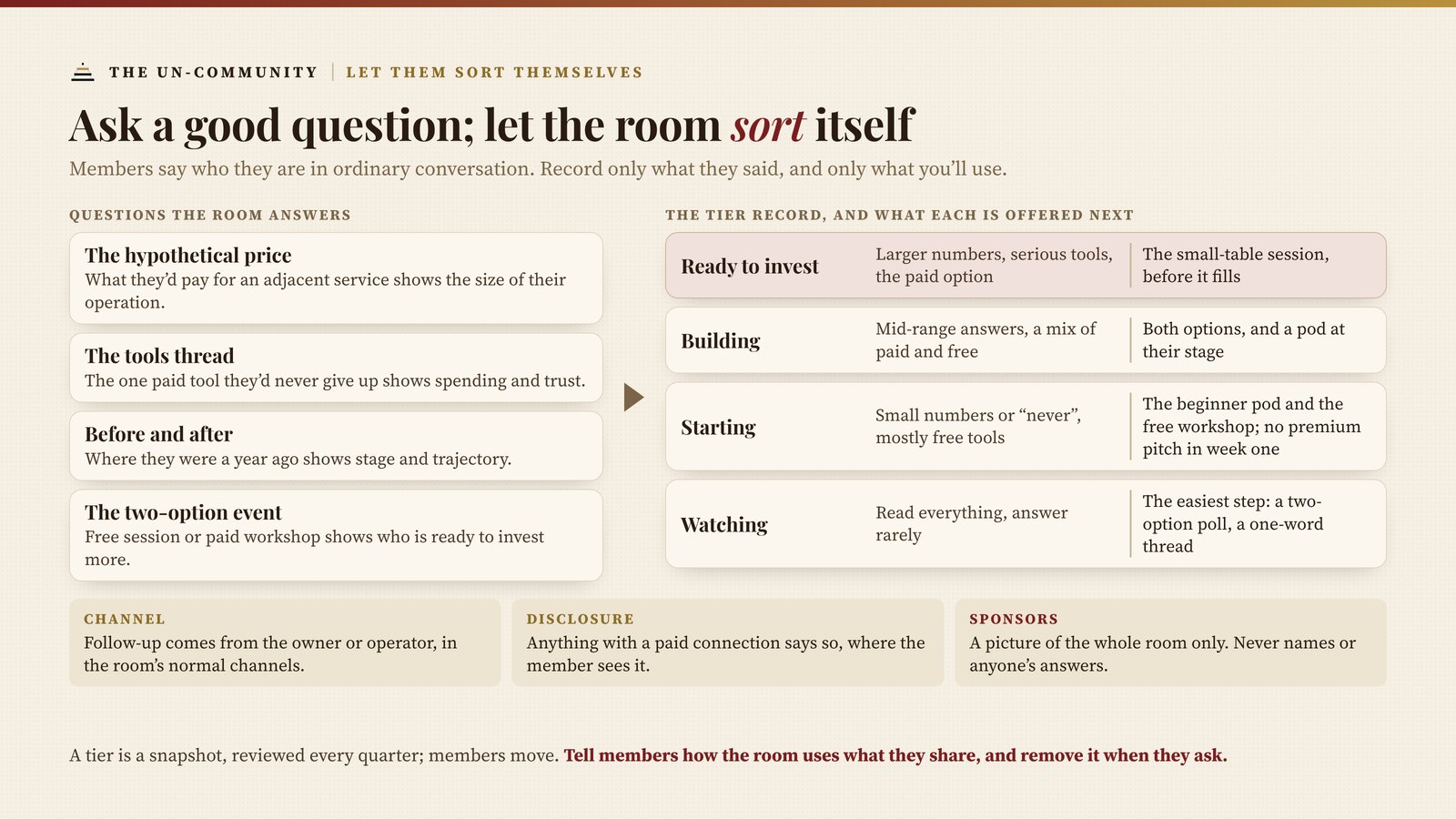
Tell members how the room uses what they share. A line in the room's welcome and privacy note does it: the owner and operator read discussion answers to shape programs and offers; we keep a short note of roughly what stage each member seems to be at, based on what they've posted, to decide what to offer them, and you can see or remove yours; nothing is sold or shared with outside parties by name, and anyone can ask to have their information removed. Honor those requests. Sponsors and partners get only aggregate descriptions of the room, never individual members or their answers. Any follow-up that involves a paid relationship discloses it plainly. Don't collect more than you'll use, and don't carry it outside the room.
The Un-Community · Chapter 6
The weekly rhythm and the handoff checklist
Five things hold a room up: rituals, member hosts, contributor slots, pods and a moderation rota. Put them on one calendar and you have the room's rhythm. The book's version for a room of a few hundred active members is in the middle column; write your room's beside it.
| Day | The book's example | Your room |
|---|---|---|
| Monday | Goals thread, opened automatically, answered by members. | |
| Tuesday | Owner appearance: a short post or recorded note. This is the owner's one fixed commitment. | |
| Wednesday | Hot seat, led by a rotating member host. | |
| Thursday | Contributor slot, twice a month; pods check in on the other weeks. | |
| Friday | Wins thread, opened automatically. | |
| Weekend | Quiet on purpose, with the moderation rota covering anything urgent. |
Start with fewer rituals than you think you need. Three that happen every single week beat six that happen when someone remembers.
Recruiting member hosts
- Look for members who already do the job informally. They answer newcomers' questions, ask good follow-ups in the hot seat and post their own results without being prompted.
- Ask privately, for one session, with a clear brief: what the ritual is, how long it takes, what a good session looks like, who to call if something goes wrong.
- After the first session, thank them in public and ask whether they'd do it again next month.
- Keep the rotation wide. A room that depends on one volunteer host has only moved its single point of failure from the owner to a member.
The escalation path
- Ordinary issues (off-topic posts, a heated thread): the moderator handles them by the posted rules.
- Anything that involves removing a member goes to the owner, with a note of what happened.
- Anything serious (threats, harassment, someone who may be at risk of harm, illegal content) goes through the platform's reporting process right away and, where needed, to the proper authorities. Moderators don't counsel, diagnose, or give legal advice; they get the right people involved.
- Keep a simple log of removals and serious incidents: the date, what happened, what was done, and by whom.
The handoff checklist, a week before anyone's away
- Every ritual for the period has a named host and a backup.
- The owner's fixed appearance is recorded in advance or explicitly paused, and members are told which.
- The moderation rota covers every day, with the owner's escalation delegated to a named person.
- Scheduled posts and reminders are set and checked.
- Members know who to contact for billing or access problems.
- Someone is watching the room's health numbers and knows what would count as a problem.
Can the room carry itself?
- The share of the week's activity that happens without the owner: threads started by members, rituals that ran, questions answered by someone other than the owner.
- What happens during the owner's absences. Compare a quiet week to a normal one. A small dip is healthy. A collapse means the room is still a broadcast.
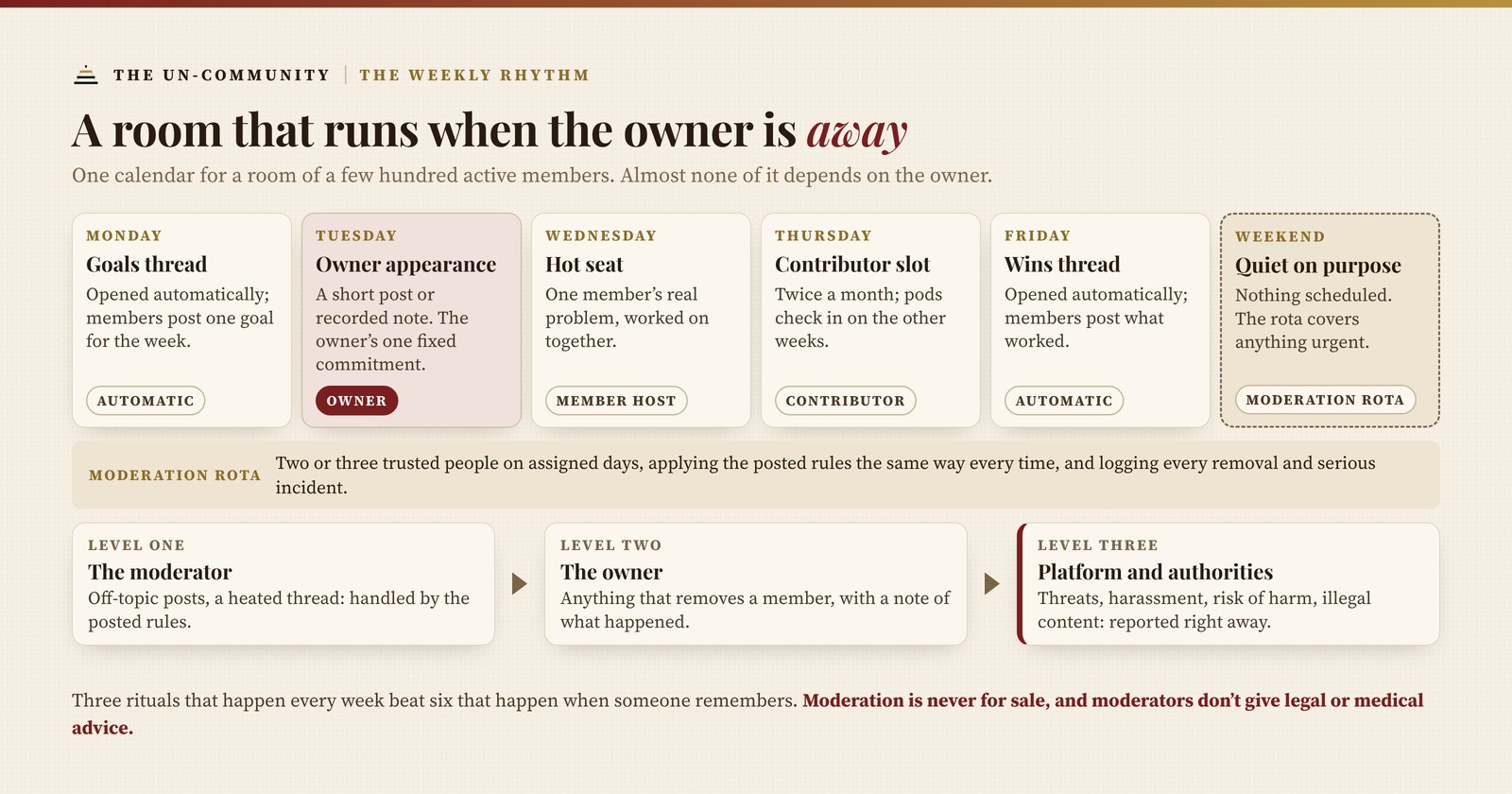
The owner sets the rules and the operator enforces them consistently, in writing, with a clear escalation path and a record of removals. Moderation is never for sale: no one pays to have a complaint hidden or a competitor removed. Threats, harassment, self-harm and illegal content follow the platform's reporting process and, where needed, the authorities; moderators don't give legal, medical or mental-health advice. Member hosts and moderators get only the access their role needs, and member data stays inside the owner's agreement. Member hosts and moderators volunteer; the role is never a condition of membership, and it stays light. If hosts get free membership, pay, or a regular schedule of real work, ask a lawyer about volunteer and contractor rules. The rituals in this chapter assume adult members.
The Un-Community · Chapter 7 · Appendix A
The exchange board
Two columns, Have and Need, in a dedicated place in the room where members know to look. Every post follows the same short shape, so members can scan the board in a minute and the operator can check a post in two.
The board post
- Have or need. One sentence. What the member offers, or what they're looking for.
- Niche. As specific as the member will allow. A niche narrow enough to picture is a niche someone can match.
- Size, in numbers. Audience size and a recent engagement figure, monthly visitors, hours of capacity, volume. For a need, the budget. Only numbers the member can show, and never the prices members charge their own customers.
- Looking for. What the member wants in return: a test, an introduction, a referral, a joint project.
- Can't. Anything off the table: exclusivities, platform limits, fields they can't work in.
- Expires. A date, usually thirty days out, with easy renewal.
Curation rules
- Quantified, or it doesn't go up. "I have a big audience" says nothing. "About 3,000 subscribers, mostly independent retailers, a newsletter every Tuesday" says something.
- Real, not planned. Members post what they have now, not what they intend to build.
- Checked in good faith. A quick look that the numbers are plausible. Say plainly, on the board itself, what that check is and isn't: a basic look for obvious problems, not a verification anyone can rely on.
What never goes on the board
- Licensed and prohibited fields. No investment opportunities, loans, insurance, or real estate deals between members, and no fees on them. No patient referrals of any kind.
- Customer lists and personal data. Members promote each other to their own customers, in their own voice. They don't trade, sell, or hand over lists of people who never agreed to hear from someone else.
- Anything about the prices members charge. Members don't use the room to agree on what they'll charge customers, divide up territories, or decide together not to deal with someone.
Starting the board
- Seed it. Ask ten or so active members to post one have and one need each, following the pattern, and help them make their posts specific.
- Announce the board with those twenty posts already on it.
- For the first month, check the board daily and reply to every post with a nudge if it needs one.
- Tell the room, in the wins thread, when the first deal comes from it.
Watch weekly, as counts for the whole room
- New posts. A board that's still quiet after two months needs a different place in the room or a better prompt.
- Replies per post. Posts that get no reply for a week are the early warning. Usually they're too vague, too big, or aimed at a need nobody in this room has.
- Deals reported. A tally from the wins thread, for spotting patterns, not for billing anyone.
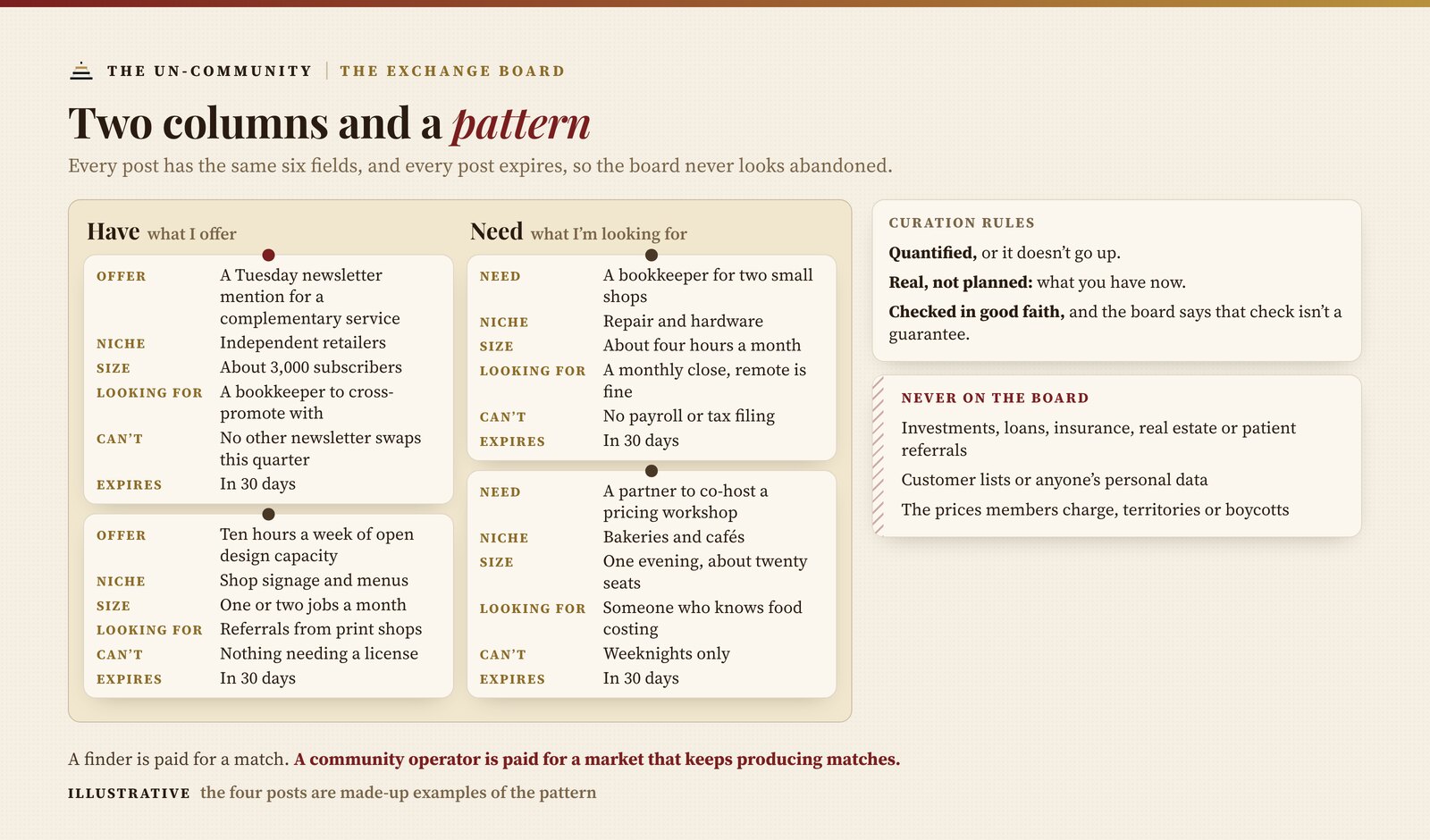
Referral fees between members are fine when the person being referred is told about the fee and the members agree it in writing; secret fees aren't, and fees in licensed or prohibited fields (securities, lending, insurance, real estate, patient referrals) are off the board entirely. Members share only what they may lawfully share about their own customers, and the operator never brokers customer lists. The operator's good-faith check of a post is described honestly and isn't a guarantee of anyone's claims. The board's rules, including these, are posted where every member can read them.
The Un-Community · Chapter 8 · Appendix A
The deal room
A protocol, pinned where members can see it, that turns a spark of interest into a small, contained test before anyone commits to anything large. The operator designs it and maintains it. The operator doesn't run the deals.
Step 1: discovery on real numbers
Thirty minutes, two members, one agenda. The operator writes the agenda; the members run the call.
- 1. What do you each have that the other side could use? One sentence each.
- 2. What are the real numbers behind it? List size and recent open rate, monthly visitors, conversion rate on the relevant page, the terms of the program you're offering. Only figures you can show.
- 3. What would each of you need to see to call a first test a success?
- 4. What's the smallest version of this that would tell you something?
- 5. Is there anything either of you can't do? Contract limits, platform terms, a partner who has exclusivity, a line in your own privacy policy.
- 6. Next step: a test from the menu, or a friendly no.
"No fit" is a good outcome. Two members who discover in thirty minutes that their audiences don't overlap have saved each other a season.
Step 2: the small-test menu
- One endorsed send. Member A mails their own list once about Member B's offer, in A's own voice, with a disclosed link. Nobody hands anybody a list.
- One placement. A single slot in the other member's newsletter, podcast or resource page.
- One co-hosted session. A single live session for both audiences, with each member promoting it to their own people.
- One referral. A single introduction to a client the referring member can't serve, under a disclosed fee agreed in writing first.
- One shared page. A comparison page or joint guide that sends traffic to both sides for thirty days.
Each test has a start date, an end date and two or three numbers to count, and nothing more. The menu leaves out list swaps on purpose.
Step 3: the results review, one sheet for both members
| Member A | Member B | |
|---|---|---|
| What you did, and when | ||
| The counts: sends, opens, clicks, sales, refunds, unsubscribes, complaints | ||
| What surprised you, in one sentence | ||
| What you'd change next time | ||
| Second test? Yes, no or not yet |
Mediocre results, reported straight, build more trust than good results reported with spin.
Step 4: the written agreement, only if both want more
- What each side contributes.
- The revenue definition, and the split or fee, stated as a number.
- How results are reported, how often, and each side's right to see the underlying numbers.
- Who owns what: content, customers, data. Customers stay with the member they bought from unless both sides and the law say otherwise.
- How either side ends it, with how much notice, and what happens to anything in flight.
- Disclosure: how the members will tell their audiences that one is paid for recommending the other.
These are headings, not fill-in forms, and a lawyer should look over anything with real money in it. The agreement is between members. The operator isn't a party to it unless the operator is paid as one, and then the operator says so on the page.
Where the operator stands
- Visible at the edges. Write the agenda, maintain the test menu, review the results sheets for anything that looks like a problem, and nudge on process.
- Absent from the middle. Don't sit on the discovery calls, don't push for a yes, and don't take sides on price.
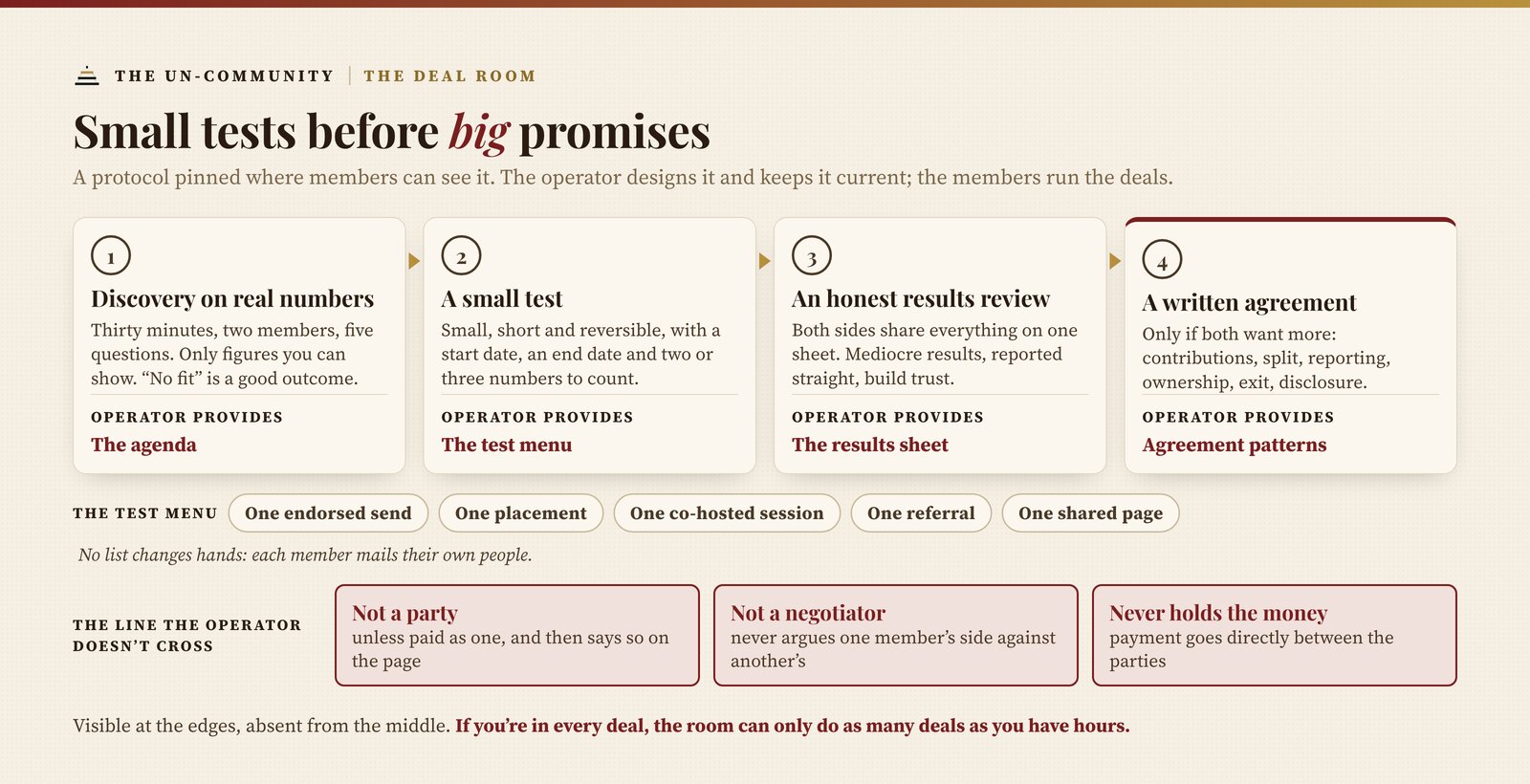
The operator designs the protocol, not the deals. Don't negotiate for one member against another, don't hold members' money (payment goes directly between the parties or through a proper payment platform), and don't vouch for anyone's claims beyond the good-faith check you did on the board. Members sharing customer data with each other need that customer's consent and a lawful basis, which is why the test menu uses endorsed sends instead of list swaps. An endorsed send is commercial email: it follows CAN-SPAM (clear identification, a working unsubscribe, a physical address) and discloses the paid link; ask a lawyer who counts as the sender when one member's email promotes another's offer. If a deal touches investing, lending, insurance, real estate or patient care, it doesn't belong in the deal room at all.
The Un-Community · Chapter 9 · Appendix A
The member record and the weekly scan
A structured page for each member who has agreed to be on it, updated as the member's situation changes, and read on a schedule. About ten fields. More than that and nobody keeps it current.
The page
- Who. Name, business, the member's own one-line description.
- Niche. As specific as the member will allow. "Fitness" is useless. "Strength training for women over fifty" is a match waiting to happen.
- Has. Assets the member is willing to put to work.
- Needs. This quarter.
- Can't. Exclusivities, platform limits, regulated fields.
- Deal history. Introductions, tests, outcomes.
- Referred by.
- Last confirmed. The date the member last confirmed the page is accurate. The most important field on it.
- Consent. What the member agreed to, and when.
- Notes. Written as if the member will read them, because they can.
Build it in the open
- Members opt in after a plain note: what's on the record, who can see it, how to see your own page and how to have it deleted.
- Fill it from things the member has said on purpose: their exchange board posts, their intake answers, the sorting questions, their own description in a short intake form.
- No scraped profiles, no mined private messages, no pages for members who didn't join. Anything a member tells you in a private conversation goes on the record only if you ask first.
- Ask members to confirm their page every quarter, with a one-click "still accurate" link, and archive pages that don't get confirmed.
The weekly scan, thirty minutes
- Read what changed. New members, updated needs, confirmed pages, finished tests.
- Look for pairs. For each new need, which existing member has the matching asset? For each new asset, which existing need does it fill?
- Look for threes. One member's unused audience, a second member's product that audience would want, a third member's skill to connect them.
- Make at most three introductions. Then step back.
- Log every introduction: the date, the pair or trio, why you made it.
The introduction note, to both members at once, in writing
- Who each of them is, in a sentence.
- Why you think they should talk: the specific have and need that match.
- Anything either of them should know, including whether you or the owner earn anything from this introduction.
- A pointer to the deal-room agenda.
- Then nothing more from you, unless they ask.
The log becomes your pattern library
One line each: the kind of match, what usually happens, and what you do differently now. The patterns are your judgment about matching, and they carry no member's personal information. The record is the owner's room's data, held on the owner's behalf.
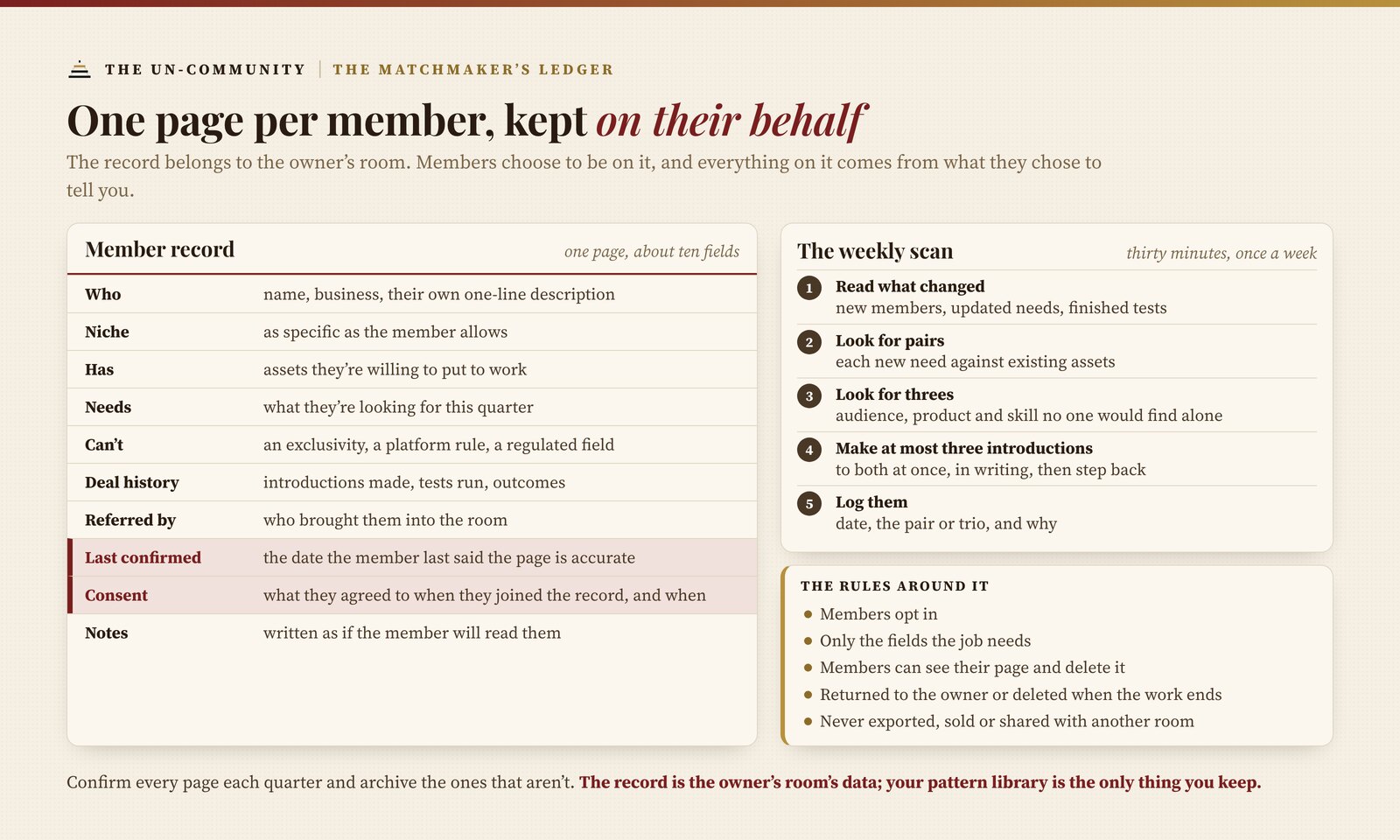
The member record is personal data, and the members belong to the owner's room, not to you. Keep it under a written agreement with the owner that says who holds it, how it's secured and what happens to it when your work ends. Take only the fields the job needs, tell members what's on it, let them see their page and delete it on request. Privacy laws differ depending on where members live (the EU and UK rules and several US state laws are stricter than people expect), so ask a lawyer who knows privacy before the room includes members from those places. Never export the record to use elsewhere, never sell it, and never share it with another room.
The Un-Community · Chapter 10
Three honest ways to be paid
One rule runs under all three: members know how the operator is paid, and the owner agreed to it in writing. A single room can use all three at different stages.
| The retention share | The trading floor is free to every member, and the owner pays the operator a share of the room's revenue. The simplest model and the right place to start in most rooms. If the owner doesn't believe the retention case, measure it: renewal rates for members who've been in a deal room test versus members who haven't, reported monthly. |
|---|---|
| The premium tier | The exchange board, deal room and introductions become part of a higher membership tier. It works once the trading floor has a track record. The tier is described by what's included, never by what a member will earn. |
| The disclosed platform fee | A small, disclosed percentage of deals that start on the exchange board or through an introduction, paid by the members who do the deal, under terms both members see before they start. Billed through the owner's platform, never deducted by the operator. It doesn't apply where members' professional rules restrict sharing fees; ask a lawyer before using it in a room of licensed professionals. |
Choosing by maturity
- The first six months: retention share only. Build the floor, run the first tests, measure renewals.
- When members are clearly finding business: consider a premium tier, priced by what it includes and never by projected income.
- When deals are frequent and well defined: consider a disclosed platform fee, usually alongside the tier rather than instead of it.
What members are told
- On the exchange board and in the deal room: how the operator is paid, in one sentence. "The operator is paid by the owner out of membership revenue."
- On every introduction: if the operator or the owner earns anything from that particular introduction, say so in the introduction itself.
- Between members: if one member pays another a referral fee, the member being referred is told who's paid, by whom and roughly how much, and the arrangement is agreed in writing first.
The owner agreement covers
- Which model or models apply, and the numbers.
- What counts as the room's revenue, and what the operator's share is a share of.
- For any deal fee: which deals count, how they're reported, how long an introduction stays eligible.
- Reporting: what the operator sends the owner each month, and the operator's right to see the room's numbers.
- Member data: who holds the member record, and what happens to it when the work ends.
- Term, notice and a clean exit.
A lawyer drafts the real thing. Bring these headings already thought through, and the conversation is short.
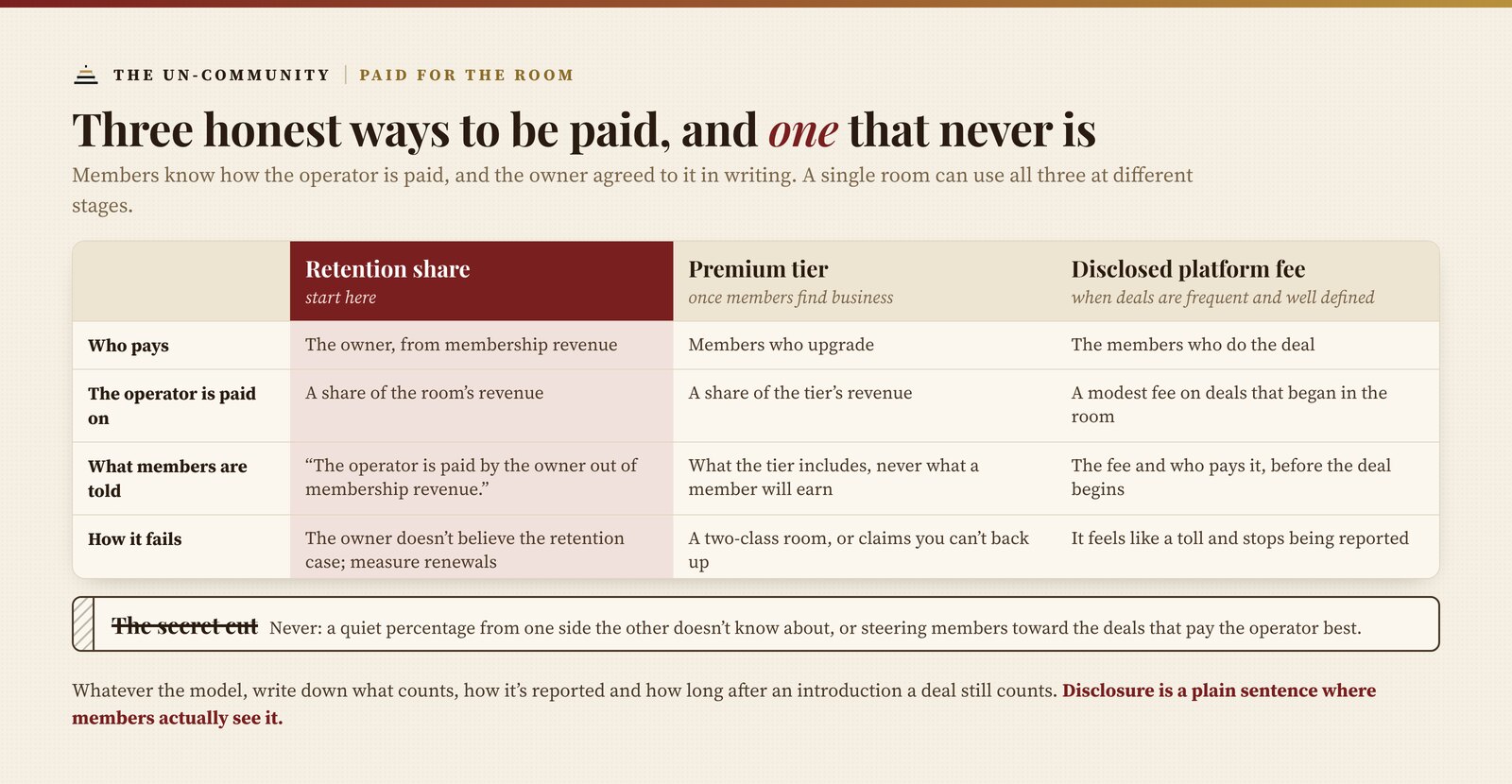
Tell members plainly how you're paid, and have the owner's written agreement to every fee. No secret cuts, and no steering members toward deals because they pay you more. Referral fees between members are disclosed to the person being referred and agreed in writing; in licensed fields (investing, lending, insurance, real estate) they're off the board entirely, and fees for patient referrals are off-limits for everyone. When you recommend something you're paid for, federal endorsement rules require a clear disclosure. Fees you earn are taxable and may be reported to you on a 1099; talk to a tax adviser about how to set this up.
The Un-Community · Chapter 12
Perks, placements and group deals
Each of these needs the owner's consent and a clear disclosure, and group deals have a legal line running right through them.
A group deal, in five steps
- 1. Ask, then count. The owner (or the operator, in the owner's name) asks the room who needs a particular thing in the next few months. Interest gets collected on a simple form: who, what, when. No money changes hands at this stage.
- 2. Find two or three suppliers. Members with experience of a supplier are the first source; the exchange board is the second. Ask each supplier for group terms based on the real count.
- 3. Share the terms with the members who asked. One message, the options side by side, the supplier's own terms attached.
- 4. Members contract and pay directly. Each member signs with the supplier and pays the supplier, or pays through a proper payment platform the supplier runs. The operator never collects members' money to pass along.
- 5. Collect reviews afterward. A short, plain summary of how it went goes back to the room.
If the operator or the owner gets anything from the supplier (a finder's fee, a commission, a free service), members are told that before they decide.
What members buy, never what they charge
- Put the line in the room rules. Group deals are about what members buy. Members don't discuss or agree on the prices they charge, how they divide customers or areas, or refusing to deal with a supplier or competitor.
- Keep deal threads on topic. A group-order thread is about the order. Conversations that drift toward members' own pricing get gently closed.
- Ask early when the room is a trade group. If the room's members compete with each other, have a lawyer review the group-deal process and the room rules before the first one runs.
The perks page
- Organized by the problems members have, not by product. "Getting paid on time" is a heading; a list of invoicing apps is what sits under it.
- Each entry says what it's for, who in the room has used it, any member discount the owner negotiated, and whether anyone is paid when a member uses it.
- If any link on it pays the owner or the operator, the page says so, next to the entry.
- Reviewed every quarter. Anything members stopped recommending comes off.
Placements
- The owner approves every sponsor in writing, and can refuse any of them.
- Placements are labeled where they appear.
- Sponsors never get the member list or member data. They get the placement and an aggregate report.
- Nothing the sponsor pays for touches moderation, the exchange board or the member record.
Giveaways
- Fine if they're free to enter or awarded on skill: the best answer to a question, the most helpful member of the month as judged by stated criteria.
- A drawing that members pay to enter, or that requires a purchase, can be an illegal lottery under state law. If a giveaway involves any payment, any purchase or a prize of real value, a lawyer looks at it first.
- Auctioning a limited item to members is a sale, and it's fine. Drawing for it isn't.
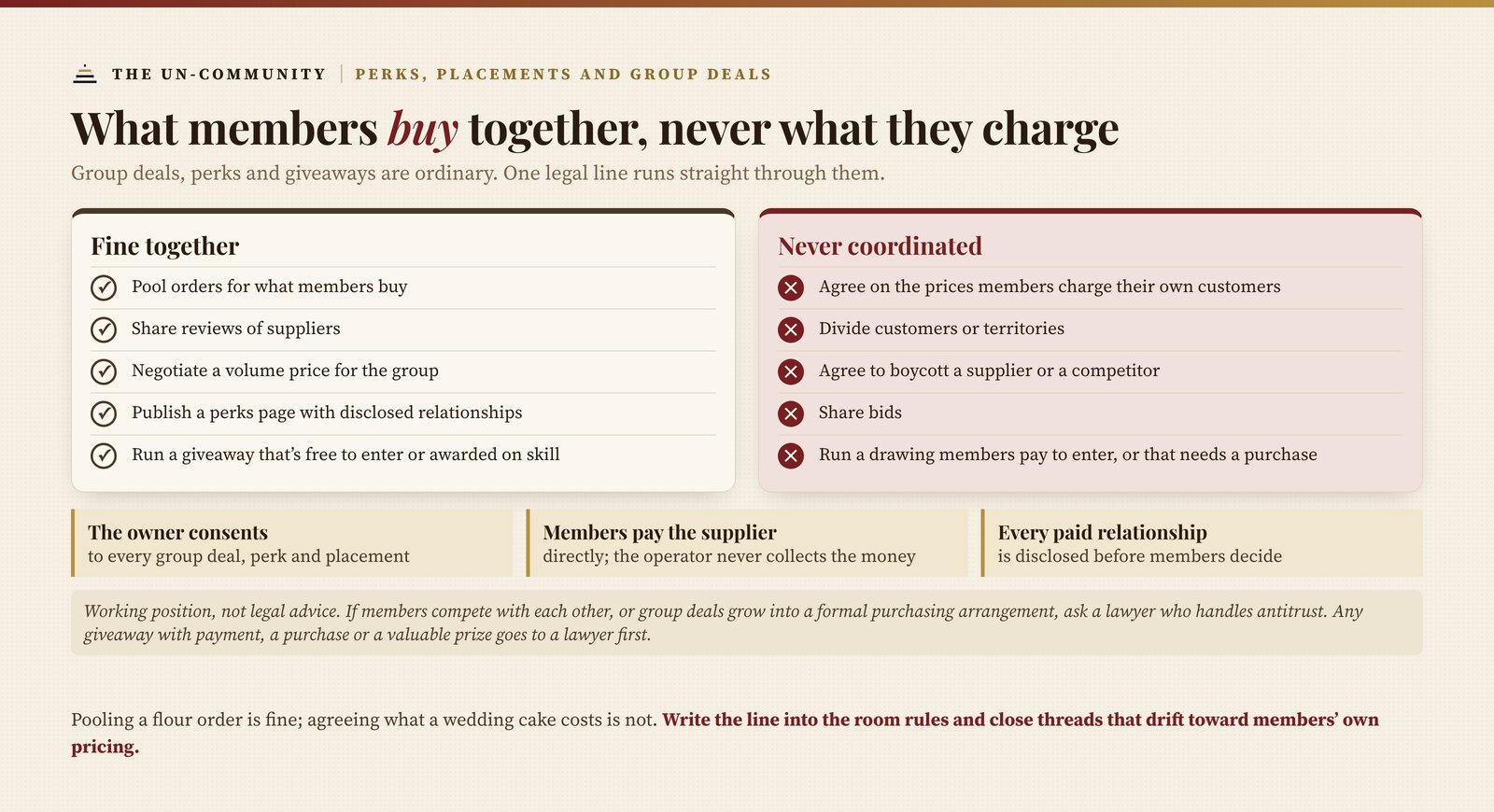
Members pooling what they buy is ordinary. Competitors in the same room agreeing on the prices they charge, dividing customers or territories, sharing bids or boycotting a supplier or rival is antitrust territory. Price-fixing, bid-rigging and dividing customers can be crimes, and the rest can be illegal depending on the facts. Keep group deals about purchases, write the line into the room rules, and close conversations that drift toward members' own pricing. If the room is made up of businesses that compete with each other, or if the group deals grow into a formal purchasing arrangement, ask a lawyer who handles antitrust before you go further.
The Un-Community · Chapter 14 · Appendix A
The quarterly room review and the handover
Once a quarter, each room gets an hour. The review is the same for every room, so the rooms can be compared. Each answer gets one line.
| Is the room alive without its host? | Rituals running, member hosts rotating, conversations between members rather than only replies to the owner (Chapter 6). | |
|---|---|---|
| Is the trading floor producing second deals? | Tests finished, second deals started, disputes resolved (Chapters 7 and 8). | |
| Is the owner still engaged? | Showing up at the agreed rhythm, answering members, approving what needs approving. A drifting owner is the most reliable early warning in the review. | |
| Is the member record current? | The share of pages confirmed in the last quarter. Below half, matching gets worse (Chapter 9). | |
| What share of earnings is it? | Against the rule of thumb: keep any single owner, partner or client well under a quarter of what you earn. | |
| What would handing it back take? | The answer should get shorter over time. | |
| The decision | Keep going as is, change one thing, have a conversation with the owner, or start preparing the handover. |
Handing a room back
- Notice to the owner in writing, with the handover date.
- Every login and account transferred to the owner or their chosen successor, and your access removed on the date.
- The member record returned to the owner or deleted, exactly as the agreement says, with written confirmation. Nothing kept.
- The room's operating manual: the rituals, the rota, the exchange board rules, the deal room protocol, the programs, the reports, written so someone new could run them.
- A note to members from the owner, in the owner's voice, saying who runs things now.
- Open deals and programs: a list of what's in flight, who's involved and what's owed.
- A ninety-day watch list for the successor: the three or four signals that show whether the room is holding.
- Final payments settled as the agreement says.
What you keep is your pattern library: the anonymized judgment about what works, with nothing in it that identifies a member or an owner. Everything else was the owner's.
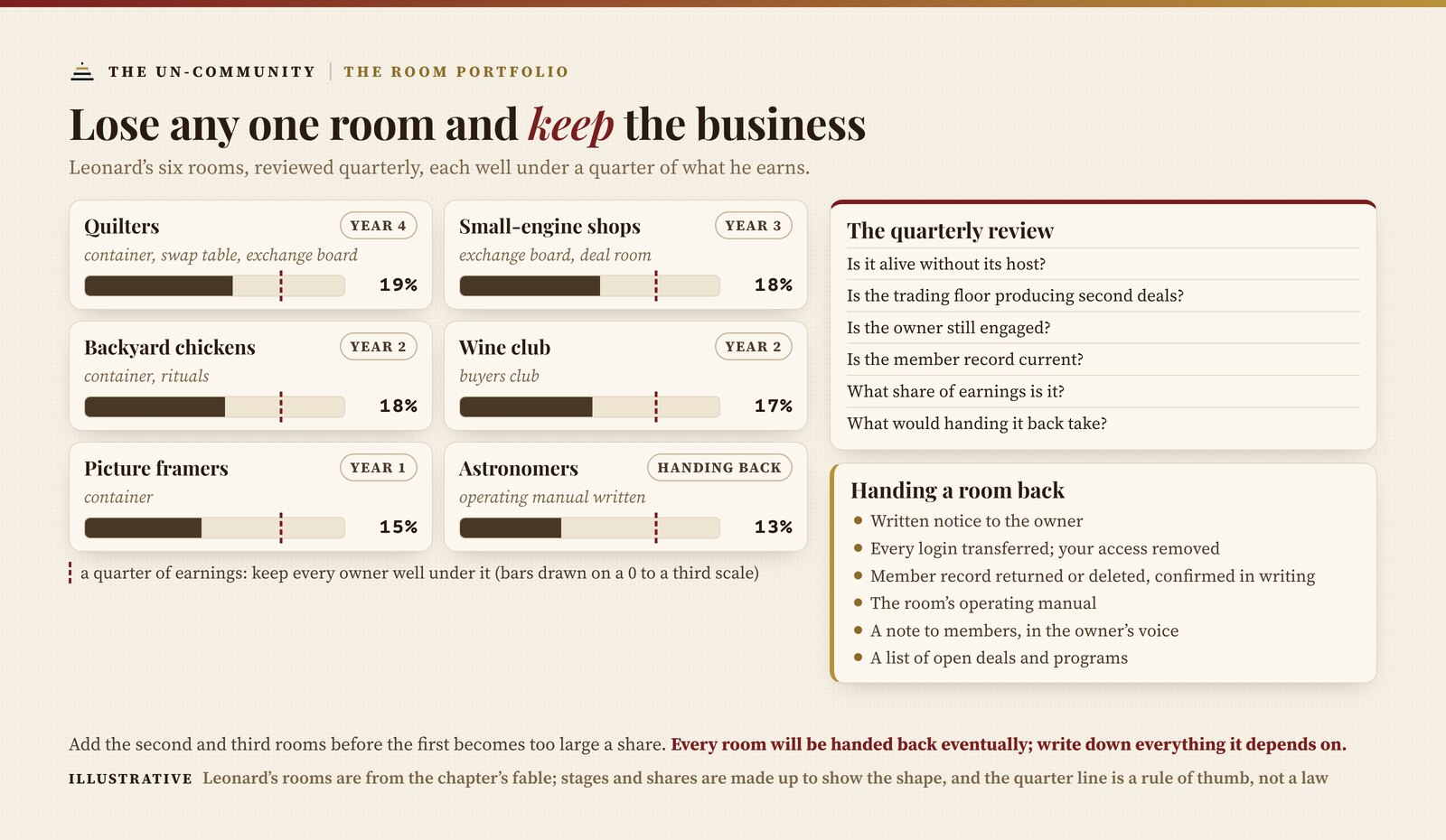
When the work ends, member data goes back to the owner or gets deleted, exactly as your written agreement says, and you confirm it in writing. Don't keep a copy, don't take members with you to another room, and don't contact members afterward for your own purposes. Transfer every account and remove your own access on the handover date. If the room includes members in places with stricter privacy laws, ask a privacy lawyer how the handover should be documented.
Rules change · Last reviewed 31 October 2026
The lines the book sends to a lawyer move
Several questions in the book end with "ask a lawyer" or "ask an accountant," because the answers vary by place and change over time. They include automatic-renewal and cancellation rules for paid tiers, privacy laws in the EU, the UK and several US states that reach member records, commercial-email rules and who counts as the sender of an endorsed send, endorsement disclosures, antitrust law for group deals among members who compete, lottery and sweepstakes rules for giveaways, volunteer and contractor rules for member hosts, professions that restrict sharing fees, and how fees and shares are reported for tax. Platforms change their own terms too, on commercial posts, automation, data export and paid tiers.
This page doesn't track those changes for you, and nothing on it is legal advice. It's a reminder that a rule you checked last year isn't checked this year. Before you sign an agreement with an owner, launch a paid tier or take a fee on anything members do together, confirm the current rule with a lawyer licensed in your state.
When a change affects something the book says, we'll note it here with the date.
Keep reading
Three free articles that go further into this book's ground.
- The Referral Flywheel: Why Partners 3-5 Find YouAfter partner three, you stop cold-pitching. The flywheel delivers introductions from operators who already trust your work.
- Cultural Fit: Why Niche Alignment Matters More Than Traffic VolumeA creator with 500K subscribers in the wrong niche will underperform a creator with 80K in the right one. Cultural fit — the match between the crea...
- The Line You Don't Cross: Data Ethics for Toll OperatorsNever use subscriber data in a way a reasonable subscriber would not expect if they could see your dashboard. That is the line operators hold.
A new free article goes out every Friday. Read the newsletter →