Room Scorecard
When you size up a community, the first number anyone offers is headcount. It's the number that sounds impressive and says the least. A big room where members don't answer each other is a broadcast audience. A small room where members answer each other, help each other and do business with each other already has something to operate.
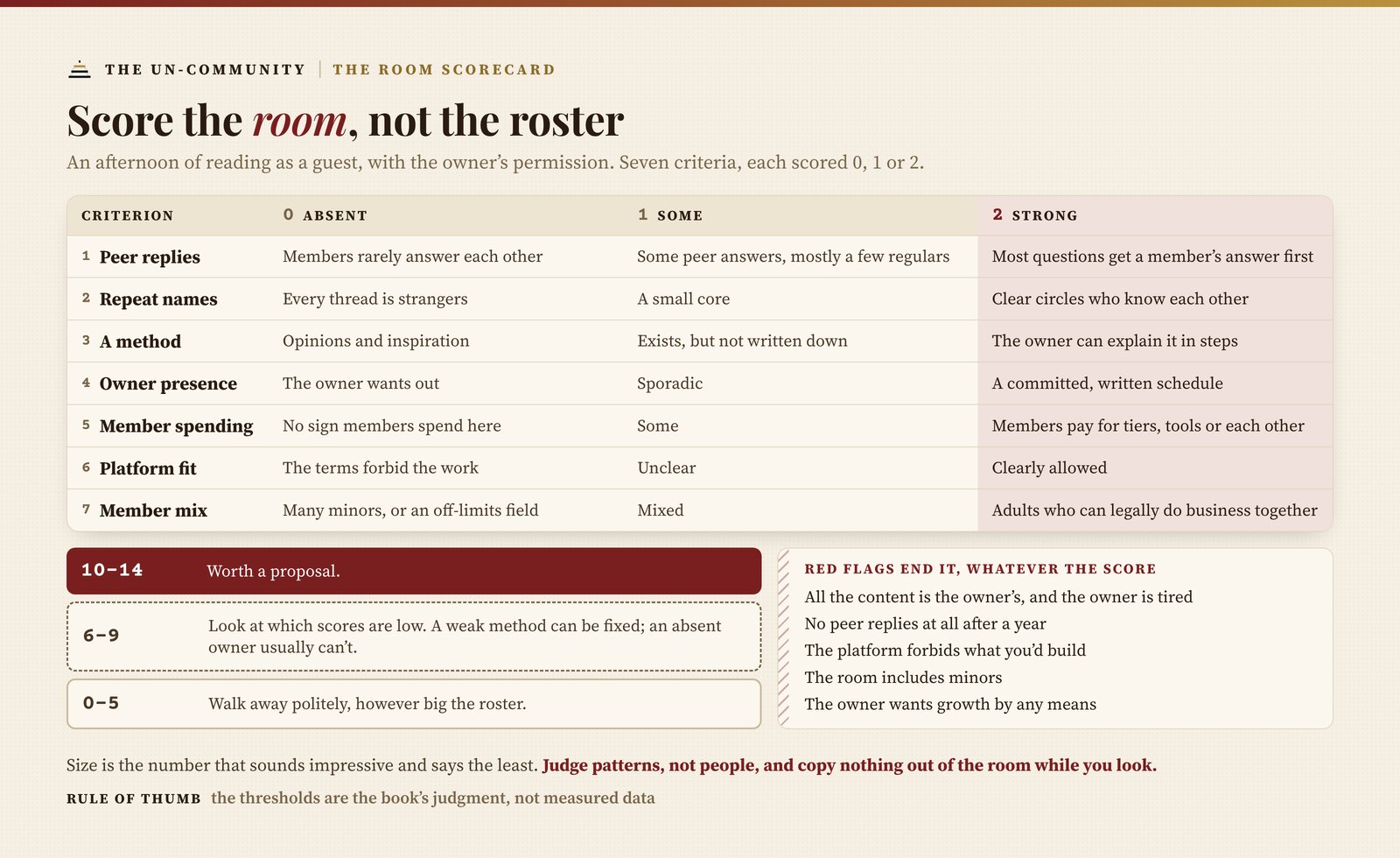
This scorecard is Chapter 3 of The Un-Community. Score a room 0, 1 or 2 on seven criteria, after an afternoon of reading as a guest or member, with the owner's permission. The total, out of 14, suggests what to do next. Headcount isn't one of the seven.
0 of 7 criteria scored
Worth a proposal.
Look closely at which scores are low. A weak method can be fixed with the owner, but an absent owner usually can't.
Walk away politely, however big the number on the roster.
The thresholds are the book's rule of thumb, not measured data.
Reading gets you most of the way. A conversation with the owner gets you the rest, and these five questions do most of the work.
- "What happens in the room when you're away for a week?" How much the room depends on one person.
- "Who are the members you'd miss most if they left?" If the owner can name a dozen, there's a core. If they can't name anyone, there isn't.
- "What have members done together that you didn't organize?" Referrals, collaborations, meetups. This is where the trading floor is hiding.
- "What do you want the room to produce in a year?" Revenue, retention, a launch, a quieter inbox. You'll build differently for each.
- "How much of your week can you give it, in writing?" The answer that matters most.
Read a room's platform terms before you propose anything, and don't build what they forbid: no scraping, no automated messages the platform bans, no workarounds. Evaluate a room as a guest or member with the owner's permission, and don't copy member names, profiles or posts out of it while you look. What you're judging is patterns, not people.
With the owner's permission and access the platform allows, an AI assistant can summarize a month of threads in minutes. Use that as a first pass and nothing more. A summary can count peer replies. It can't tell you whether the regulars are generous or cliquish, or whether the owner is loved or merely tolerated.
Member spending is the criterion the book weighs above size: in its judgment, a few hundred members who spend seriously will outproduce many thousands who only watch. That's a judgment, not a statistic.
Not legal, tax or financial advice. Running infrastructure inside someone else's community involves contracts, consumer-protection rules, privacy law and platform terms. Rooms with minors are out of scope for the playbooks in this book; ask a lawyer before operating one.
This scorecard follows Chapter 3, "Reading a Room," of The Un-Community: A Community Operator's Playbook by Bill Eisenhauer. The chapter also covers what the score can't: why members came. A room full of people who arrived to learn something and use it this month can do something with a container or a trading floor. A room that's nearly all there for the owner's company wants hosting and ritual more than exchange, so price and scope for that.
The score tells you where to spend your attention. It isn't a forecast of what a room will earn for anyone. The dollar figures in the book are illustrations; none of them is a promise, a projection or a typical outcome, and most people who try these methods earn little or nothing at first. Nothing on this page is saved or sent anywhere.