
Reader kit
The Un-Course
A Knowledge Operator's Playbook
The book's checklists and figures, set up to print and keep beside you while you work: what you already know that's worth licensing, where a lesson should sit, how to get your method retold right when you're not in the room, what a license should pin down, and which claims you can stand behind. Everything here is already in the book. This page just puts it on paper.
This page is for readers of the book. It's free, and you don't need to sign up to use it.
In the kit
- The Guardrails Checklist (Appendix C, its own printable page)
- The Knowledge Audit (Appendix A and Chapter 4, with an interactive scorer)
- Mapping a learner's week (Chapter 2)
- The reference frame (Chapter 6)
- A diagnostic that travels (Chapters 7 and 8)
- License Term Patterns (Chapter 15 and Appendix B)
- The claim ladder (Chapter 18)
- The portfolio review (Chapter 21)
- Rules change (dated note)
Each worksheet has its own print button. The book's disclaimer applies to all of it: nothing here is legal, tax, investment, financial or other professional advice, and every number in the figures is an illustration, not a result or a forecast.
Appendix C
The Guardrails Checklist
The book's working positions in one place, to run at each stage: the lines that don't move, and what to check before you write the method down, before you place a lesson with a host, before you sign a license, before you make a claim, before you certify anyone, before you license to other operators, and ongoing. If the answer to any question is "no" or "I'm not sure," stop until you've sorted it out.
The Un-Course · Appendix A · Chapter 4
The Knowledge Audit
The twelve-shelf inventory from Chapter 4, run as a method in an afternoon. It finds what you've already built, sorts out what's yours to license, and tells you where to start. Block two hours.
Prefer to score on screen? The knowledge audit scorer multiplies and sorts as you go.
Step 1: Walk the twelve shelves
Answer four questions for each shelf, in its row.
- Do I have this now? In any form, today. What you could make doesn't count yet.
- Could I explain it to a stranger in two minutes? If not, it isn't ready to license yet, however valuable it is.
- Has anyone asked me about it? "How do you do that?" and "can I borrow that sheet?" are purchase signals from people who don't know they're shopping.
- Is it mine? Did I build it on my own time, with my own inputs? Or did I make it for an employer or a client, or build it on someone else's confidential information? If it isn't yours, it doesn't get licensed until it's rebuilt from scratch.
Anything with a "no" to the fourth question comes off the list now. Anything with a "no" to the second goes on a separate list for Chapter 5's codification work.
Step 2: Score what's left
Score each shelf that survived from 1 to 5 on three things, then multiply them.
- Impact. If this were licensed well, how much would hosts value it? A method that solves an expensive problem for many hosts scores high. A template that saves someone an hour once scores low.
- Confidence. How proven is it, across different situations, people and places? Anything below 3 is disqualified, however high its impact. You license what's been shown to work, never a theory.
- Ease. How quickly could you turn it into something a host can use? A checklist that's already a document scores high. Benchmarks buried across three systems score low.
| Shelf | Have it now? | Two minutes? | Anyone asked? | Mine? | Impact | Confidence | Ease | Score |
|---|---|---|---|---|---|---|---|---|
| 1. The flagship method What you'd describe if someone asked what you do. | ||||||||
| 2. Checklists Anything you run through in the same order every time. | ||||||||
| 3. Qualification and scoring rules How you decide whether a client, partner, supplier or opportunity is a good fit. | ||||||||
| 4. Decision rules The if-this-then-that judgments you make on autopilot. | ||||||||
| 5. Templates and scripts Emails, proposals, agendas, the words you use to open a hard conversation. | ||||||||
| 6. Rhythms and schedules When things happen and in what order. | ||||||||
| 7. Intake questions What you ask at the start of any engagement to understand the situation fast. | ||||||||
| 8. Benchmarks and rules of thumb The numbers you carry around: typical ranges, warning thresholds, what good looks like. | ||||||||
| 9. Onboarding How you bring someone new up to speed on your work. | ||||||||
| 10. Troubleshooting knowledge What goes wrong and what to do about it. | ||||||||
| 11. Pattern knowledge What you've seen across many clients or projects. Licensable only as general lessons, with every client's data stripped out. | ||||||||
| 12. Tools you've built Spreadsheets, calculators, forms, small scripts. |
Reading the score
- The maximum is 125. Anything under 27 waits.
- Around 48 to 100 is usually the sweet spot for a first license: worth the effort of packaging, but not your single most complex asset. Scores near 100 are rare, because they take an asset that's both valuable and easy to package. When one turns up, take it.
- The highest-impact item is often a poor first move, because it's also the hardest to package. Let an easier asset fund the harder one.
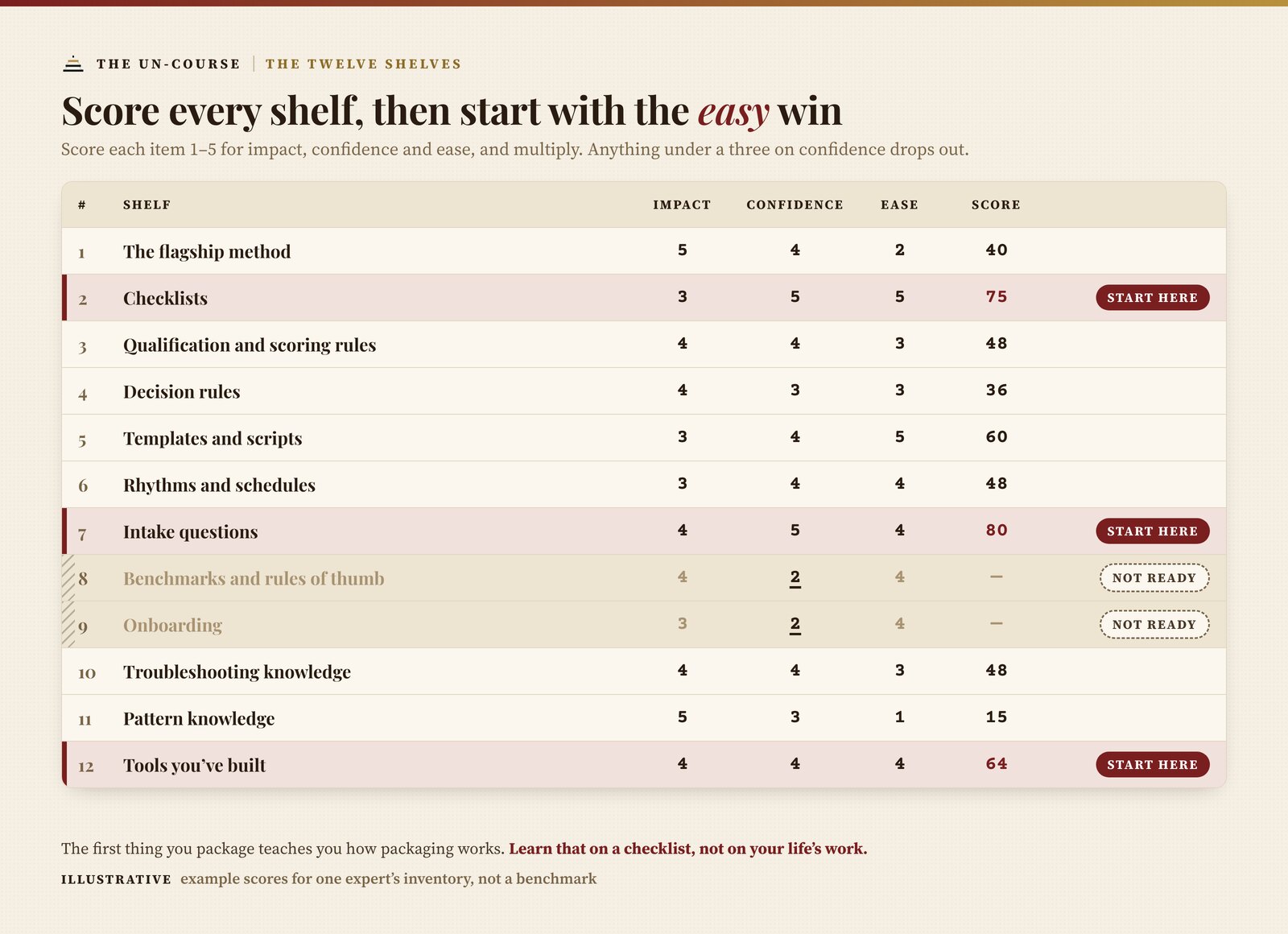
The scores in the figure are one illustrative inventory from Chapter 4, not a benchmark.
Step 3: A worked example
A commercial cleaning company owner who's been running crews for eleven years. This is a hypothetical, and every score is an illustration. After the walk, eight shelves survive. The top four:
| Asset | Impact, confidence, ease | Total |
|---|---|---|
| The new-site walkthrough checklist (shelf 2) | 4, 5, 5. Already a laminated card every crew lead carries. | 100 |
| The quality inspection rubric (shelf 3) | 3, 5, 4. | 60 |
| The crew-lead training plan (shelf 9) | 4, 4, 3. It works, but half of it lives in the owner's head. | 48 |
| The bid-pricing calculator (shelf 12) | 5, 4, 2. Very valuable, but a tangle of formulas only the owner understands, built on client pricing data that would need to be stripped out first. | 40 |
Three good first licenses sit in the 48-to-100 band: the walkthrough checklist, the inspection rubric, and, after some codification work, the training plan. The calculator waits. It's the highest-impact asset and the owner should build toward it, but it would be a hard first license, and its client data has to come out before anyone else sees it.
Step 4: Decide the form and the host
One line for each asset you'll pursue: what form it takes (a guide, a checklist, a scoring card, a module, a diagnostic), which kind of host it fits (another creator's program, an association, an employer, a tool), and what you'll keep (Chapter 15). That line is the start of a placement.
| Asset | Form | Host | What I keep |
|---|---|---|---|
Step 5: Run it again next year
The audit changes as you do. Tangled assets become documents, theories get proven, and new questions point at shelves you didn't know you had. Put the next audit on the calendar now, and keep the apprentice's habit in between: write down what you correct.
| Next audit |
|---|
Some of what you know may not be yours to license. Documents, templates and tools you built for an employer or a client may belong to them under your employment agreement, an IP assignment, a work-for-hire clause or a consulting contract. Knowledge built on a former employer's or client's confidential information, customer lists or trade secrets can't be licensed at all. Pattern knowledge (shelf 11) is only licensable as general lessons with every client's data stripped out; never pass on anything that could identify a client or reveal what they told you in confidence. Check what you signed, rebuild from scratch anything that belongs to someone else, and ask a lawyer where it's unclear.
The Un-Course · Chapter 2
Mapping a learner's week
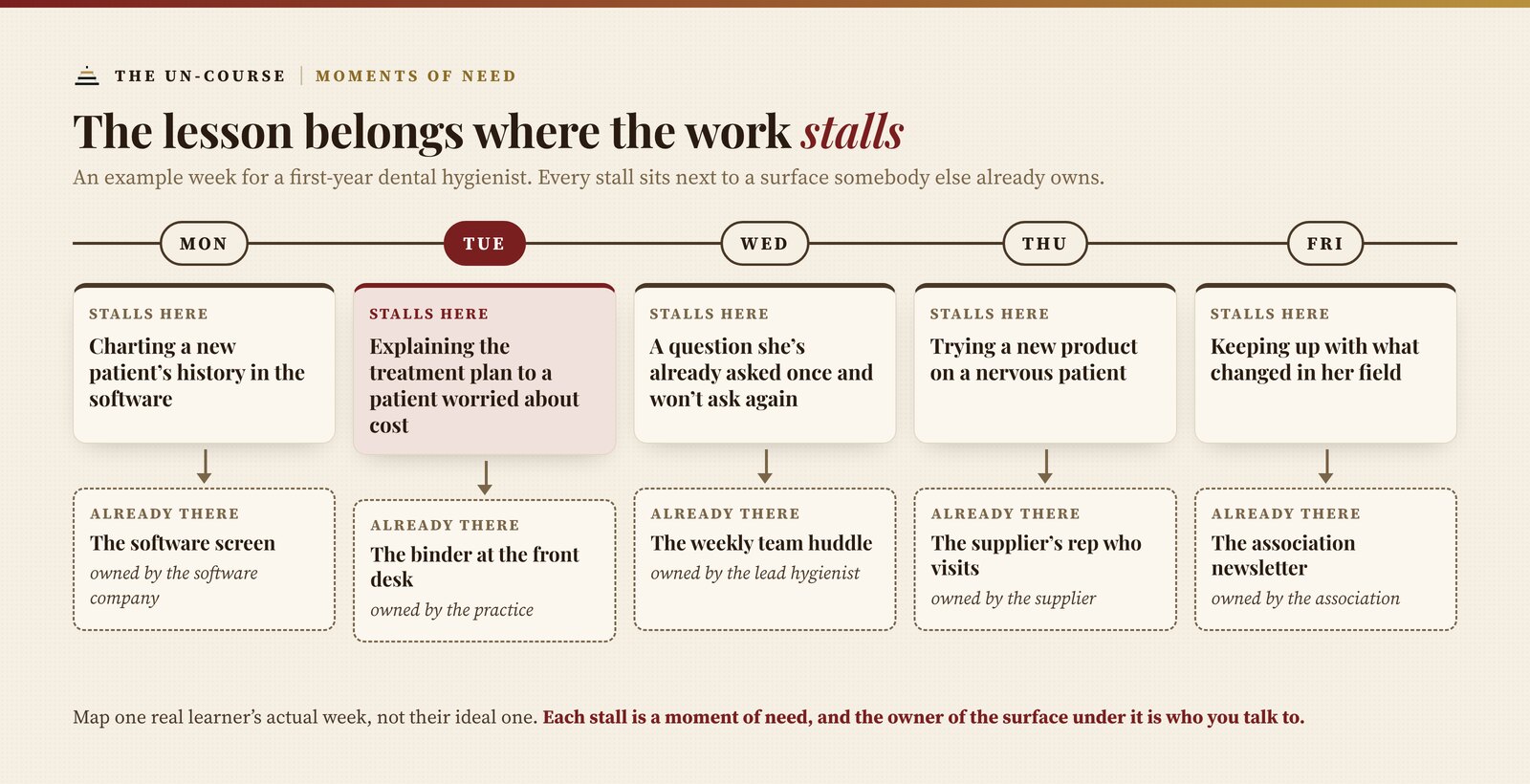
An hour on paper. Pick one kind of learner you'd like to help, and be specific: a new dental hygienist in her first year, a small-contractor's office manager, a first-time property manager with four units, a freelancer who just raised her rates. Then walk through the week they actually have.
| The learner |
|---|
Walk the week
- What do they do on Monday morning? What tools do they open? Who do they talk to?
- Where in the week does the work get hard? Write down the specific task. "Explaining the treatment plan to a patient who's worried about cost" beats "communication."
- When they get stuck, what do they do right now? Ask a coworker? Search on their phone? Guess?
- Which surfaces are already in front of them at that moment? The software screen, the binder at the front desk, the weekly team huddle, the association newsletter in their inbox, the supplier's rep who visits on Thursdays.
| Day | Where the work stalls | What they do now | The surface in front of them, and who owns it |
|---|---|---|---|
| Monday | |||
| Tuesday | |||
| Wednesday | |||
| Thursday | |||
| Friday |
Each pair of a moment and a surface is a candidate lesson: one piece of your knowledge, shaped for one moment, living on one surface someone else already owns.
Five questions for each surface
- 1. Where does the work stall? What do people get stuck on here, and when?
- 2. Would the owner be glad to have the fix? If your lesson doesn't make their product, program or workplace better, it doesn't belong there.
- 3. Where does the owner's material stop? The dead end after onboarding, the gap between module three and four, the last page of the guide.
- 4. How long will it stay useful? A card on a press lasts years. A post lasts a day.
- 5. Can you build the first version quickly? Frank wrote his cards on break-room index cards. Your first placement should be about that humble.
A yes on all five means you've found a surface where your knowledge wants to live.
What goes on the card
- One problem per placement. A placement that tries to teach everything teaches nothing at the moment someone needs one thing.
- Action first, explanation second. The operator at two in the morning needs to know what to do. Why it works can come later, or never.
- The expert's edge. The five things that actually go wrong, without the forty that almost never do. The value is often in what you leave out.
- A way back to more. A short note, a code or a page in the host's resource library, for the person who wants the fuller material later.
When you place something useful inside someone else's program, product or content, the owner agrees to it first, and the learners can see who provided it and how you benefit. If your placement carries a link that pays you, or a way to sign up for something of yours, say so plainly on the page.
The Un-Course · Chapter 6
The reference frame
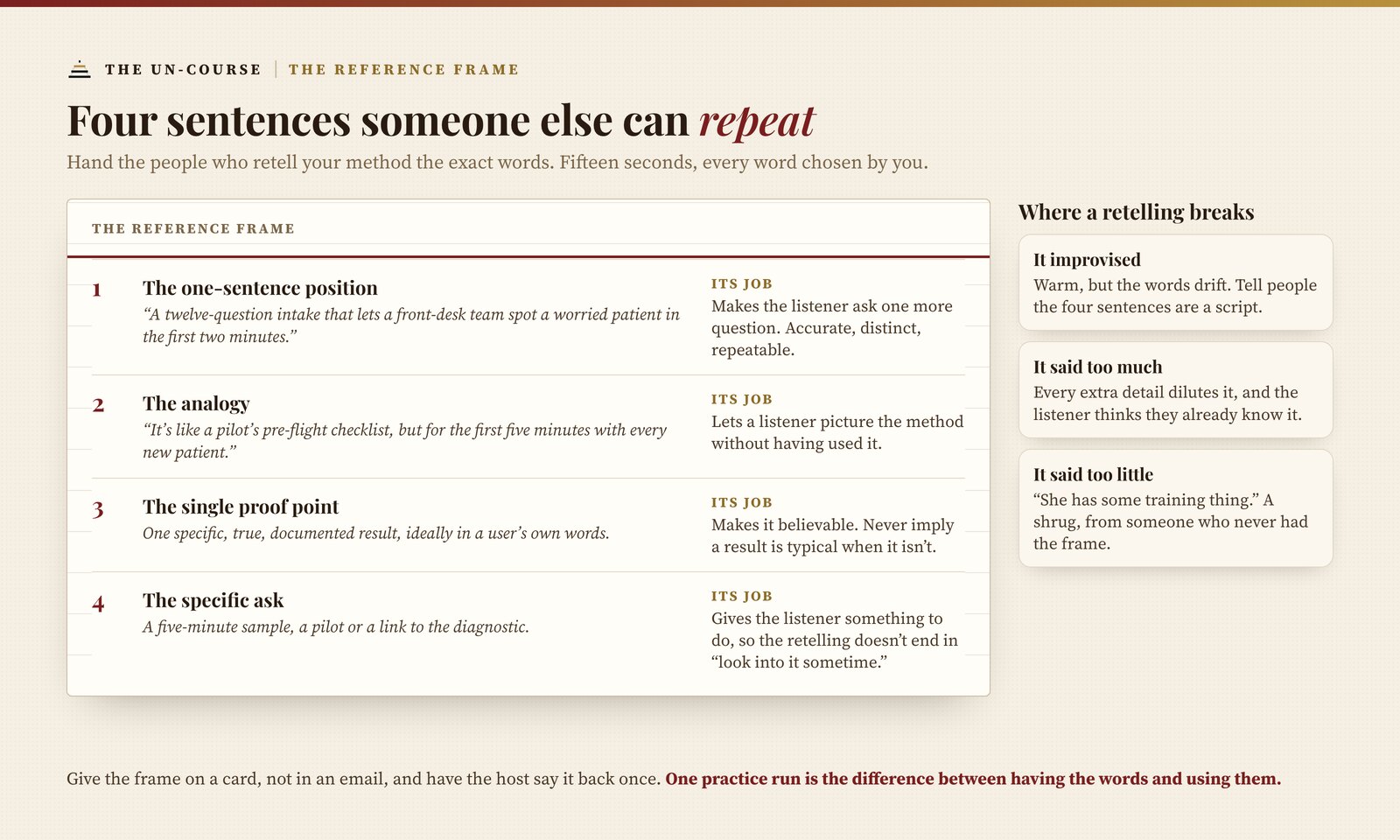
A compact, portable explanation that someone else delivers about your work, when you're not in the room, and that lands correctly on the other end. Four sentences, fifteen seconds to deliver, every word chosen by you so the retelling doesn't have to improvise. Draft the four parts fast, then tighten.
| 1. The one-sentence position | What the method is, in one sentence someone can repeat from memory. Accurate, distinct and repeatable. Name the mechanism, where it lives and who it helps: "A twelve-question intake that lets a front-desk team spot a worried patient in the first two minutes." Its job is to make the listener ask one more question. |
|---|---|
| 2. The analogy | "It's like X, but for Y," where X is something everyone understands: "It's like a pilot's pre-flight checklist, but for the first five minutes with every new patient." Try five before you pick one. You want the one a listener nods at within five seconds. |
| 3. The single proof point | One specific, true, verifiable result, stated precisely enough to be believed, ideally in the words of someone who used the method. A number with a timeframe and a context beats an adjective. If you don't have one you can state precisely and defend, the frame should promise something smaller and certain instead (Chapter 18). |
| 4. The specific ask | What the listener should do if they're interested: a five-minute sample, a pilot, a link to the diagnostic. Small, concrete and free of friction. |
Say the position out loud to someone outside your field. If they answer "so, like, customer service training?", it isn't distinct enough yet.
The retelling test
Give the four sentences to three people who don't know your method. Each reads it once, puts it away, and explains your method to a fourth person the next day. Then ask the fourth person what they understood. If it's close to yours, the frame works. If not, it usually broke in one of three places.
- The retelling improvised. They liked the method and thought they could describe it better in their own words. Tell the people who'll retell it that the four sentences are a script.
- The retelling said too much. Every extra detail dilutes the message, and the listener comes away thinking they already understand it instead of wanting to know more.
- The retelling said too little. "She has some training thing for front desks." That happens when the person never had the frame and reached for the nearest words.
Installing the frame
- Walk the host or licensee through the frame in conversation. Ask which parts they'd say differently, and adjust the language without breaking the structure.
- Ask them to deliver it back to you: "Pretend I'm one of your members and I just asked what this is."
- Give them the frame on paper too, one page or an actual card. A card on a desk gets used.
The proof point is an outcome claim, and outcome claims need substantiation before anyone makes them. State only results you can document, with the basis stated, and never imply a result is typical when it isn't. The frame you hand a host or licensee becomes part of their marketing, and if they sell your method with claims you can't support, that's your problem too. Give them approved words, ask them to use them, and put that expectation in the license (Chapters 17 and 18).
The Un-Course · Chapters 7 and 8
A diagnostic that travels
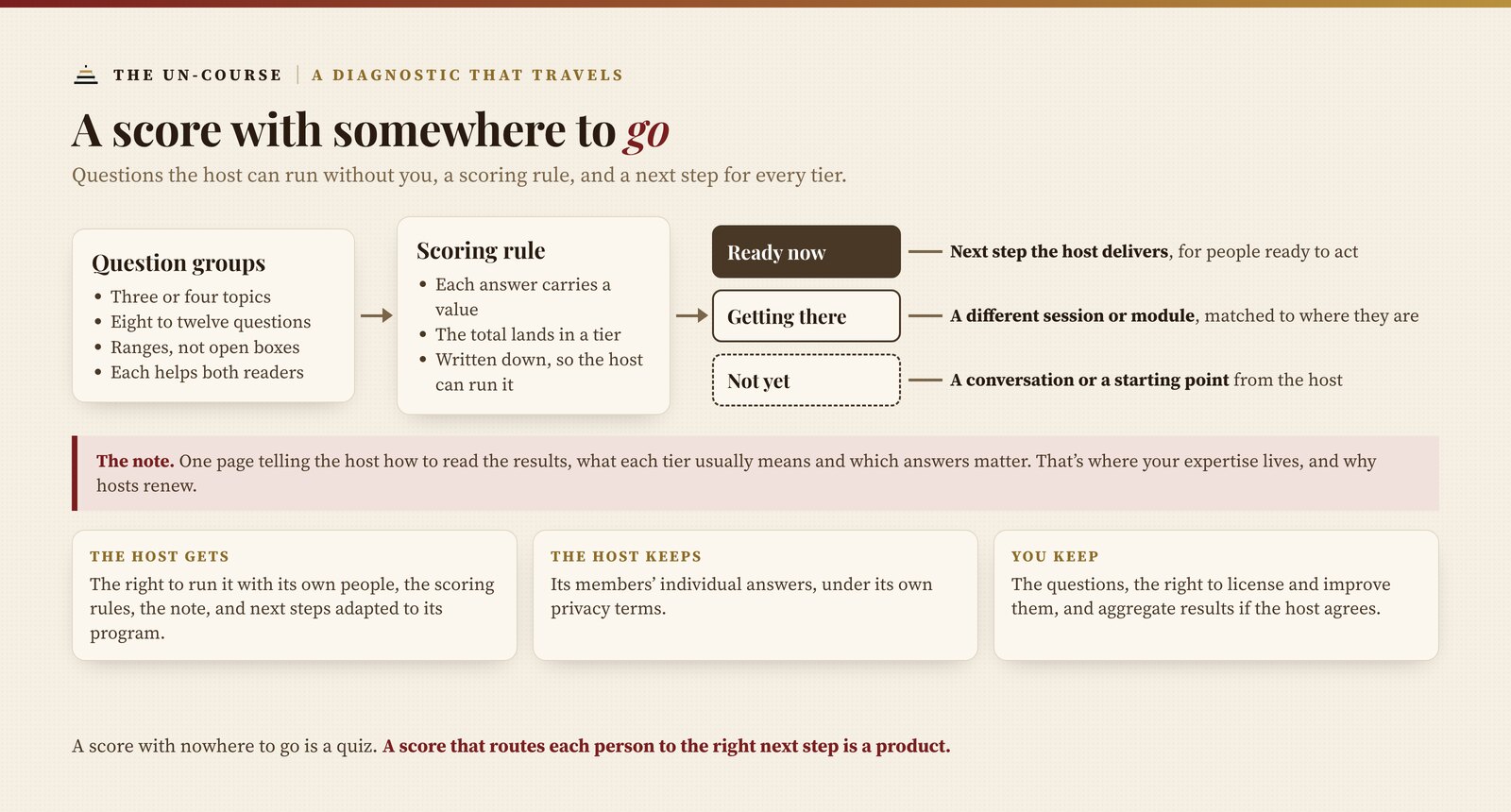
A short, ordered set of questions, a way of scoring the answers, and a set of next steps tied to each score. A good one works in a room you've never visited, run by someone who has never met you. It teaches the person answering, sorts people for the host, and builds a record nobody else has.
Start with the questions you already ask
- Write down the questions you ask a new client or colleague who's stuck, before you give any advice. The ones you always ask, in roughly the same order.
- Put a range next to each.
- Mark which answers change what you'd recommend.
- Run it on ten people you know, by hand, before you build anything. Watch where they hesitate. Cut the question nobody understands. Add the one you kept asking out loud anyway.
Designing a diagnostic someone else can run
- Every question serves two readers. The person answering should feel it's about them, and the host should see a useful field. A question that only helps the host feels like surveillance. One that only helps the person answering wastes a slot.
- Use ranges, not open boxes. "Under 500 / 500 to 2,000 / over 2,000" is faster to answer, easier to score and less embarrassing than a blank box asking for an exact number.
- Group by topic. Three or four small sections read like a conversation. Jumping between unrelated topics makes people quit halfway.
- Keep it short. Somewhere between eight and a dozen questions covers most diagnostics.
- Write the scoring rules down. Each answer carries a value, and the total lands in a tier. Three tiers is usually enough.
- Tie each tier to a next step the host can deliver. A score with nowhere to go is a quiz. A score that routes the person to the right session, module or conversation is a product.
- Write the note. A page that tells the host how to read the results, what each tier usually means and which answers are the interesting ones. That note is where your expertise lives, and it's why the host keeps renewing.
| Tier | Score range | Next step the host delivers |
|---|---|---|
| Ready now | ||
| Getting there | ||
| Not yet |
What the host gets and what you keep
Decide the split before you license the diagnostic.
- The host gets the right to run the diagnostic with its own people, its own branding if you agree to that, the scoring rules, the interpretation note, and the tier-by-tier next steps adapted to its program.
- The host keeps its members' individual answers, given inside the host's program, under the host's privacy terms.
- You keep the questions themselves as your work, the right to license them elsewhere, the right to improve them, and aggregate results if the host agrees: counts and patterns across everyone, never a list of who answered what.
Turning a lesson into a tool (Chapter 7)
A calculator turns a situation into a number. A scorecard judges readiness, fit or health from eight to twelve fixed-answer questions. A checklist walks through a procedure with the decision points marked. The diagnostic grows out of these. Whichever shape fits, the steps are the same.
- Name the decision. Every useful tool helps someone make one decision or answer one question. If you can't name the decision, you still have a lesson.
- List what you'd need to know. What you look at when you make the decision yourself. Those are the inputs. Every extra input costs you users.
- Write down your rule. A formula, a set of thresholds or a series of if-then checks that gets you from the inputs to the answer.
- Decide what the output says. The answer, one sentence on what it means and one suggested next step.
- Test it on real situations. Run ten past cases where you know the right answer. Where the tool disagrees with what you'd have done, fix the rule or add an input.
Two lines matter here. First, collect the minimum: ask only what the score needs, say what's collected and why, and honor requests to delete it. The host's learners are the host's; you receive aggregate reports unless a learner agrees to more. Second, watch the advice line. A diagnostic that scores a business's marketing is education. A diagnostic that tells a specific person what to do about their health, their money, their taxes or a legal problem is professional advice, and a disclaimer doesn't change that. If your field is licensed, keep the output general and send people to a licensed professional, or partner with one. A lawyer in your state can tell you where your particular tool sits.
The Un-Course · Chapter 15 · Appendix B
License Term Patterns
These are patterns, not a form. Each entry describes what a knowledge license usually covers and why, with a short commentary. None of it is legal advice, and none of it is meant to be copied into an agreement. Have a lawyer licensed in your state, one who handles intellectual property and licensing, draft your standard license once. Then use it, and change it with care. If you're licensing a way to run a business to other operators, stop here and read Chapter 19: that needs a franchise lawyer before the first agreement.
Keep the verbs apart
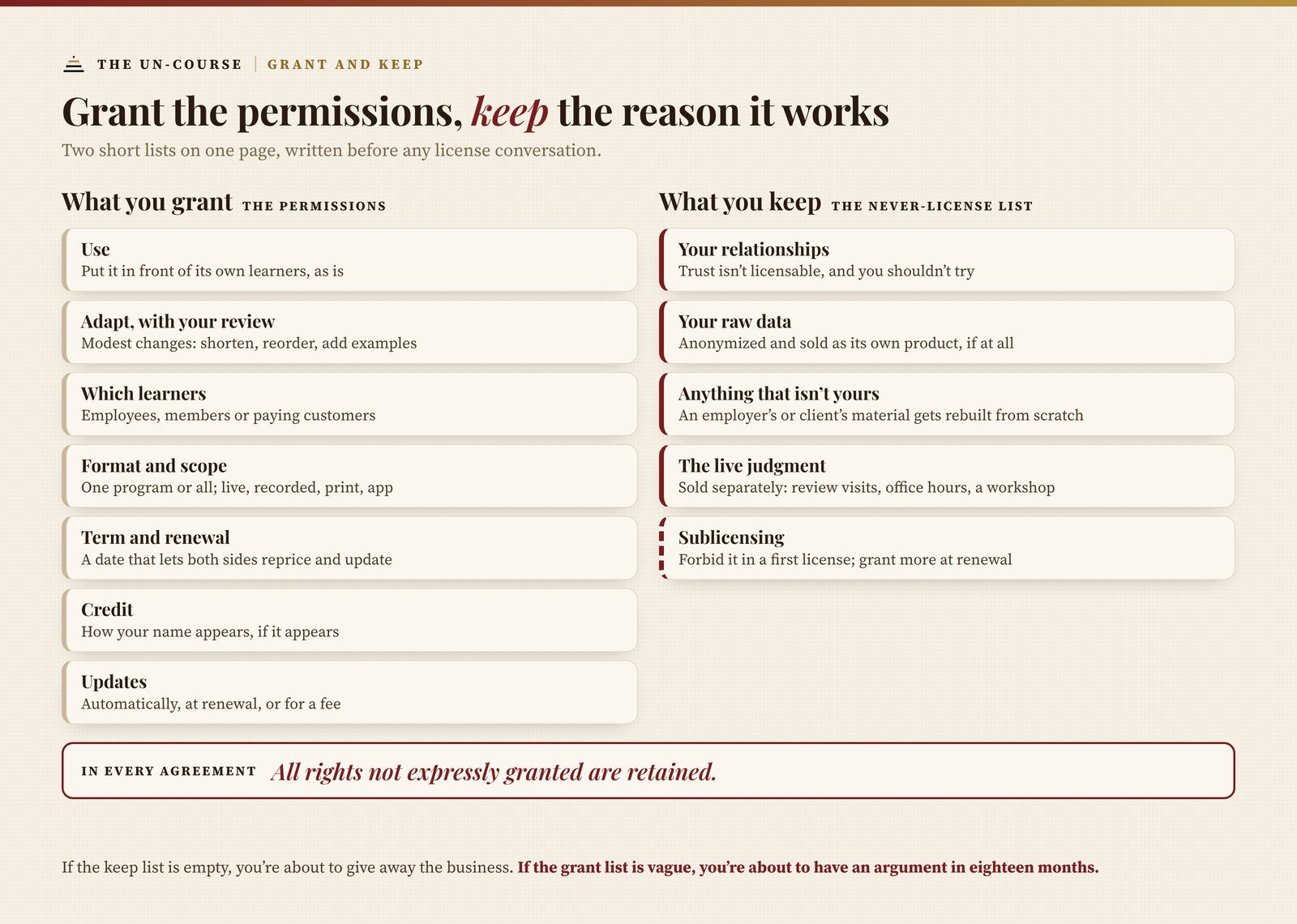
A license gives someone permission to do specific things with your knowledge, for a specific time, under specific conditions. You keep everything you didn't give.
- Use: the host can put the method in front of its own learners, as is.
- Adapt: the host can change it, shorten it, reorder it or add its own examples.
- Sublicense: the host can let someone else use it, which is how a method ends up in places you've never heard of.
- White-label: the host can present it under its own name (Chapter 10).
Most first licenses should grant use, allow modest adaptation with your review, forbid sublicensing, and decide white-labeling on purpose. You can always grant more at renewal. Taking a permission back is much harder than never giving it.
The terms a knowledge license covers
- The grant. Which permissions the host gets: use, adapt, sublicense, white-label. Name each verb separately and grant only what you mean.
- The licensed learners. Who may actually use the material: the host's employees, its members, its enrolled students, its paying customers. This is the clause that separates "use it with your people" from "resell it." Say which one you mean.
- Scope and format. Which program or programs, which delivery formats (live, recorded, print, inside an app), and which version of the method. A license for "the spring onboarding program" is clearer than a license for "training."
- Territory and exclusivity. Whether you'll license the same material to anyone else, and if not, to whom exactly, where and for how long. Price exclusivity (Chapter 15): make it narrow, make it last only while the host uses the material actively or meets a minimum, and show it as its own line in the fee.
- Term and renewal. How long the license lasts, how it renews, and how either side gives notice. A renewal date is the natural moment to update, reprice and reconsider. Put every renewal date on your calendar at least a quarter ahead.
- Fees and payment. The structure (flat, per seat, per site, per learner, revenue share, hybrid), what's paid when, and what happens if payment is late. Keep outcome promises out of the fee clause. If there's a revenue share, say how revenue is reported and what you may see to confirm it.
- Reporting. What the host tells you about how the material is used: learners reached, sites using it, the version in use. Aggregate only. Individual learner data belongs to the host under its own privacy terms, and anything more comes with the learner's consent, never by default.
- Updates. Whether the host gets new versions, when (automatically, at renewal, on request), and whether there's an added fee. Updates are often the reason a license renews. Say whether the host must move to the current version within a set time.
- Credit and marks. How your name and your method's name appear, where, and in what form, and whether the material may be white-labeled. The host shouldn't use your name in a way that implies you endorse the rest of its program.
- Approved claims. The exact language the host may use about what your method does, and a requirement to ask before using anything else. Keep them on the first two rungs of the claim ladder. Any claim about results is written out word for word, with its basis.
- Quality standards and review. The standards document the host follows when delivering the material, and how and when you'll review it. Control your method, your materials and your name. Don't reach into how the host runs the rest of its business; that's where a content license can start to look like a franchise (Chapter 17).
- Learner data. Who holds learner data, under whose privacy terms, and what you receive. The host holds it. Programs for children or placed in schools raise their own rules; so do learners in the EU, the UK and California. Flag those to your lawyer.
- Derivatives and AI. Whether the host may create adapted materials from yours (with or without AI tools), whether those carry your credit, and what happens to them when the license ends. Also whether the host may put your material into AI tools that retain or train on what they're given. "We never discussed it" is the wrong answer here.
- Confidentiality. Which parts of the arrangement (fees, unpublished materials, the host's information) each side keeps private. Keep it mutual and specific.
- Termination and wind-down. How either side can end the license, the cure period for a quality problem, and what happens afterward: learners mid-program finish, materials and your name come down on a stated schedule, copies are deleted. You'll rarely use it. Its existence makes every quality conversation easier.
- Assignment. Whether either side can transfer the license, for example when a business is sold. Licenses that end automatically on a sale make your business worth less (Chapter 20). A sensible assignment clause, with notice, is worth asking for from the start.
- The reservation line. One sentence stating that all rights not expressly granted are retained by you. It's short and dull, and it keeps everything you didn't mean to give away on your side of the table.
- Law and disputes. Which state's law applies and how disagreements get resolved. Your lawyer will have a view. Take it.
The never-license list
Write it before you negotiate, because the host will ask, and a list you wrote calmly beats one you make up across a table.
- Your relationships. The introductions you can make, the people who take your calls. You can sell structured, anonymized intelligence about a market. You can't sell trust, and you shouldn't try.
- Your raw data. If benchmarks built from real clients or learners are packaged at all, they're anonymized, aggregated and sold as their own product with their own terms, never slipped into a curriculum license as a bonus.
- Anything that isn't yours. If it's tangled up in someone else's property, it can't be licensed until it's rebuilt from scratch.
- The live judgment. The part of your expertise that only works when you're in the room, sold separately as a service on top of the license: review visits, office hours, an annual workshop for the host's staff.
When you're unsure, ask: would licensing this make it easier for someone to compete with me in the exact place where I earn today? If yes, it's on the list.
The two lists, side by side
| What I'm granting The verbs, the learners, the scope, the term | What I'm keeping Relationships, raw data, anything not mine, the live judgment |
|---|---|
If the right-hand list is empty, you're about to give away the business. If the left-hand list is vague, you're about to have an argument in eighteen months.
Chapter 4's ownership check comes before every license, and Chapter 5's naming rule applies to the method's name. A lawyer licensed in your state, one who handles intellectual property, is the person to ask about either. The copyright status of AI-generated material is still being settled (U.S. registration requires human authorship), and materials you intend to license should carry enough real human authorship to protect.
The Un-Course · Chapter 18
The claim ladder
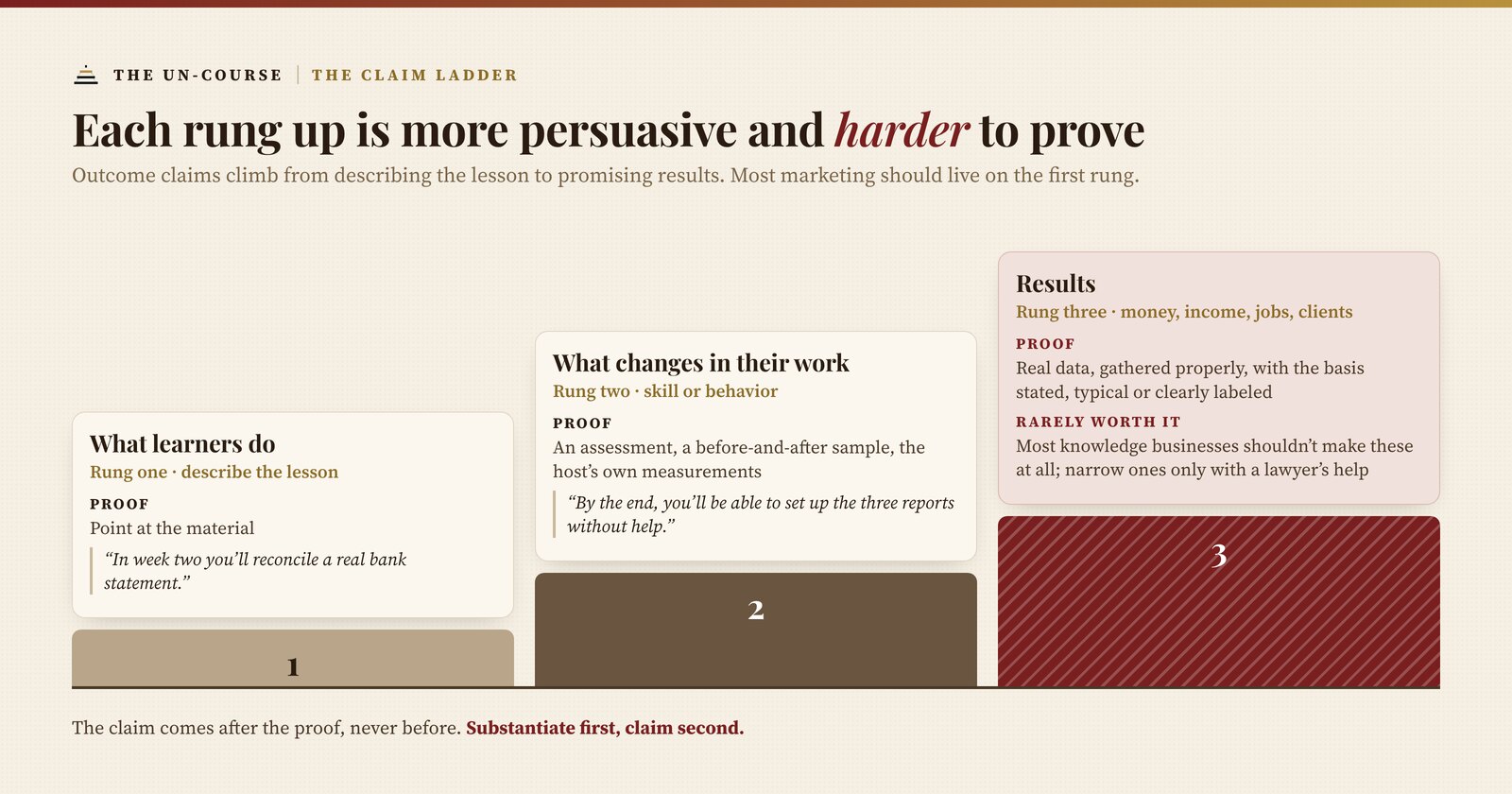
Outcome claims as a ladder with three rungs. Each rung up is more persuasive and harder to prove. Make small promises you can prove, and hold your hosts to the same standard.
| Rung | For example | What it needs |
|---|---|---|
| One: what learners do | "In week two you'll reconcile a real bank statement." | Nothing beyond the material itself, because you can point at it. Most of your marketing, and most of your hosts', should live here. |
| Two: what changes in their work | "By the end, you'll be able to set up the three reports without help." | Evidence: an assessment the learners pass, a before-and-after sample from real users, the host's own measurements. |
| Three: results | Money saved, income earned, jobs landed, clients doubled. | Real data, gathered properly, with the basis stated, reflecting what learners generally achieve or shown right next to it. Most knowledge businesses shouldn't make these at all. Some can make narrow ones, carefully, with a lawyer's help. |
Substantiate first, claim second
Before you or a host says anything on rung two or three, have the evidence in hand.
- What did learners actually achieve?
- How was it measured?
- Across how many people, over what time?
- Is the group you measured like the group you're selling to?
If the answer to any of those is "we'll find out," the claim waits. The book's fables and illustrations never go in a brochure.
Testimonials
- Show what's typical. Put what learners generally achieve, in plain words, close to any testimonial describing an unusual result. A "results not typical" line doesn't fix it. If you don't know what learners generally achieve, you're not ready to use the testimonial.
- Connections disclosed. If the person got something for it (a discount, free access, a payment, a business relationship with you or the host), say so.
- Real and unedited in meaning. Never invent one, never combine two people into one, never trim a sentence so it says more than the person said, and never generate one with a machine.
The approved-claims page
The exact sentences a host may use about what your method does. Hosts can write whatever they like about the rest of their program. About your method, they use your sentences or ask first.
| Rung | The exact sentence | Its basis |
|---|---|---|
Then check. The annual review includes reading each host's brochure, sales page and enrollment emails. A claim that has drifted gets a phone call and a correction, the same as a shortened module.
Certificates, credit and careers
- Certification words. "Certified," "accredited," "approved" and "licensed" each mean something specific. A certificate of completion from you is exactly that and no more (Chapter 13).
- Continuing-education credit. Credit is granted by the relevant board or an approved provider. A lesson is "eligible for credit" only when that approval exists, and the claim says whose.
- Careers and licensed professions. Never suggest that a lesson prepares someone for, or substitutes for, a professional license unless the licensing body's rules have been checked. And never promise a job.
Every outcome claim about your method, including what your hosts say about it, needs evidence in hand before it's made: what learners actually achieved, how it was measured, and whether it's typical. A testimonial showing an unusual result must be accompanied, close by, by what learners generally achieve; every testimonial must disclose any connection, and never be invented, combined or edited to change their meaning. Make no promises of income, jobs, credentials or expertise in a set time. Consumer-protection enforcers treat education and career claims seriously; a lawyer licensed in your state who handles advertising or consumer-protection law is the person to review your claims and your hosts' approved-claims page before either goes out.
The Un-Course · Chapter 21
The portfolio review
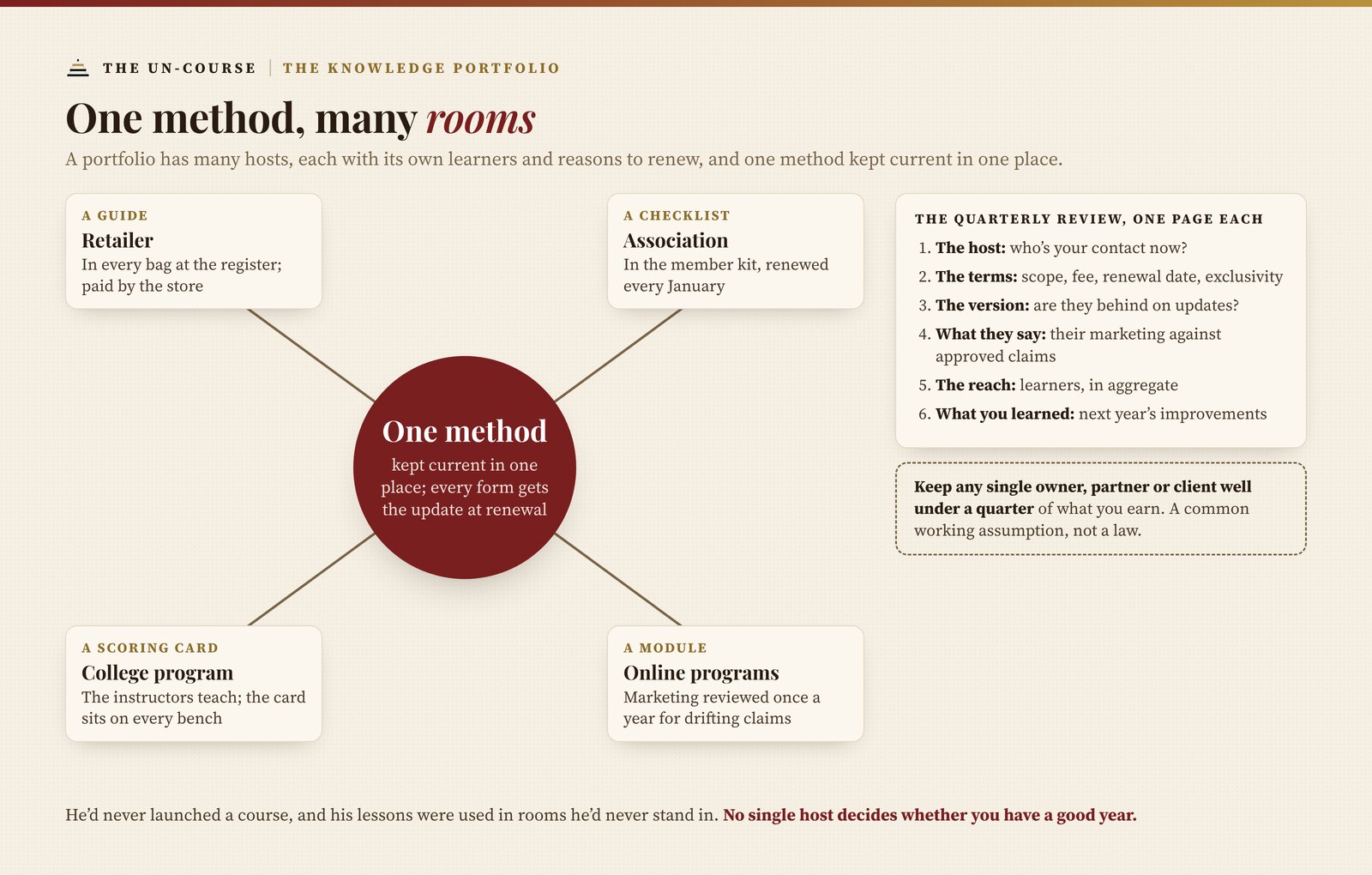
Many placements, one method, kept current in one place. One afternoon every quarter, one page per placement. Print a copy for each host.
| Placement | |
|---|---|
| Quarter | |
| The host | Who's your contact now, and did they change since last quarter? Contacts moving on is the most common reason a good license quietly fails to renew. |
| The terms | The license, the scope, the fee, the renewal date, any exclusivity and its conditions. Renewal dates go on a calendar at least a quarter ahead. |
| The version | What version are they using? If they're two updates behind, why? Updates they haven't taken are value they're paying for and not getting, and eventually they'll notice. |
| What they've said | Their current marketing about your method, read against the approved-claims page. Fix drift with a phone call. |
| Learners reached | In aggregate, from the host's own reporting. Individual learner data stays with the host. |
| What you learned | The questions hosts' learners ask are the best source of next year's improvements you'll ever have. |
Don't let one host become the business
- A common working assumption: keep any single owner, partner or client well under a quarter of what you earn. It's a rule of thumb, not a law, and early on you'll break it because you'll only have two or three hosts.
- When one host passes a quarter, the next placement you pursue should be with someone new, not a bigger deal with the same one.
- Check the less obvious places too. If every host is in the same industry, one bad year for that industry is a bad year for you. If every placement depends on one platform, a change in its terms reaches all of them at once.
One placement, then the next
- Pick the first placement for how much you'll learn, not how much it pays. A small, friendly host whose learners will tell you where the lesson falls short is worth more in year one than a large host who'll never call you back.
- Do the second one slightly differently: a different kind of host, a different form of the same method.
- Stay close to the work. Keep running the thing yourself, on a smaller scale, so the method stays true.
A portfolio multiplies your obligations along with your placements: every host carries its own license terms, approved claims, data arrangements and renewal dates. Keep all of them current, keep individual learner data with the host, and keep your own marketing and every host's marketing within the claims you can prove. If the portfolio grows into a network of operators running your system under your name, go back to Chapter 19 and a franchise lawyer before the next agreement. License fees and royalties are taxable income; a tax adviser can tell you what applies.
Rules change · Last reviewed 31 October 2026
The lines the book sends to a lawyer move
Many questions in the book end with "ask a lawyer" or "ask a tax adviser," because the answers differ by state and change over time. The copyright status of AI-generated material, which is still being settled. The federal rules on endorsements, testimonials and fake reviews. State automatic-renewal laws and the federal rules on recurring billing. Franchise and business-opportunity rules for anyone licensing a way to run a business. Who can approve continuing-education credit. Privacy rules for learners in the EU, the UK and California, and for children's programs and schools. And the tax on license fees and royalties, especially across borders.
This page doesn't track those changes for you, and nothing on it is legal advice. It's a reminder that a rule you checked last year isn't checked this year. Before you sign a license, launch anything consumers pay for monthly, call anything a certification or offer your method to other operators, confirm the current rule with a professional licensed in your state.
When a change affects something the book says, we'll note it here with the date.
Keep reading
Three free articles that go further into this book's ground.
- The 70-Year Model: Why This Isn't New and Why That MattersThe toll position model has worked for seventy years across three market eras. Same architecture, different tools. Here is the pattern.
- The Experiment Log: Why the Moat Isn't the InfrastructureThe operator who runs one experiment per week for a year has 52 data points no competitor can see. The log is the moat.
- The Flipped JV: Why You Promote Their Product Before Asking for AnythingDon't pitch the creator with a plan. Pitch them with proceeds from a proof-of-concept you already ran. The flipped JV.
A new free article goes out every Friday. Read the newsletter →