← Tools Free Tool

Knowledge Audit Scorer

Most of what you know that's worth licensing isn't the thing on your website. It's the checklist you run before every launch, the questions you ask in the first ten minutes, the spreadsheet that does some of the thinking for you. The Un-Course calls these the buried shelves.

This scorer runs Steps 1 and 2 of the book's Knowledge Audit. List what you have, put each item on one of the twelve shelves, and score it from 1 to 5 on impact, confidence and ease. It multiplies the three, sorts the list, and shows which items sit in the band the book suggests for a first license.

It opens on the book's worked example, a hypothetical cleaning company owner. Every score in it is an illustration. Replace it with your own.

Steps 1 and 2 · Appendix A
Your inventory
List only what you have now, in any form, not what you could make. Nothing you type is saved or leaves this page.

ImpactIf this were licensed well, how much would hosts value it? A method that solves an expensive problem for many hosts scores high. A template that saves someone an hour once scores low.

ConfidenceHow proven is it, across different situations, people and places? Anything below 3 is disqualified, however high its impact. You license what's been shown to work, never a theory.

EaseHow quickly could you turn it into something a host can use? A checklist that's already a document scores high. Benchmarks buried across three systems score low.

Two of the walk's four questions decide whether an item gets scored at all: is it yours, and could you explain it to a stranger in two minutes? Untick either one and the item is set aside, as the book does.

In the 48–100 band 0 / 0

0 items scored

Sorted by score

    Score an item's impact, confidence and ease to rank it here.

    Reading the score

    Multiply the three. The maximum is 125. Anything under 27 waits.

    Around 48 to 100 is usually the sweet spot for a first license: worth the effort of packaging, but not your single most complex asset. Scores near 100 are rare, because they take an asset that's both valuable and easy to package. When one turns up, take it.

    The highest-impact item is often a poor first move, because it's also the hardest to package. Let an easier asset fund the harder one.

    The book says "around" 48 to 100. This page draws the band at exactly 48 and 100, so read a score just outside it as a close call, not a verdict.

    Then decide the form and the host. For each item you'll pursue, write one line: what form it takes (a guide, a checklist, a scoring card, a module, a diagnostic), which kind of host it fits (another creator's program, an association, an employer, a tool), and what you'll keep. The reader kit has a printable sheet for it, and for running the audit again next year.
    Before you license anything

    Some of what you know may not be yours to license. Documents, templates and tools you built for an employer or a client may belong to them under your employment agreement, an IP assignment, a work-for-hire clause or a consulting contract. Knowledge built on a former employer's or client's confidential information, customer lists or trade secrets can't be licensed at all.

    Pattern knowledge (shelf 11) is only licensable as general lessons with every client's data stripped out. Never pass on anything that could identify a client or reveal what they told you in confidence. Check what you signed, rebuild from scratch anything that belongs to someone else, and ask a lawyer where it's unclear.

    The twelve shelves
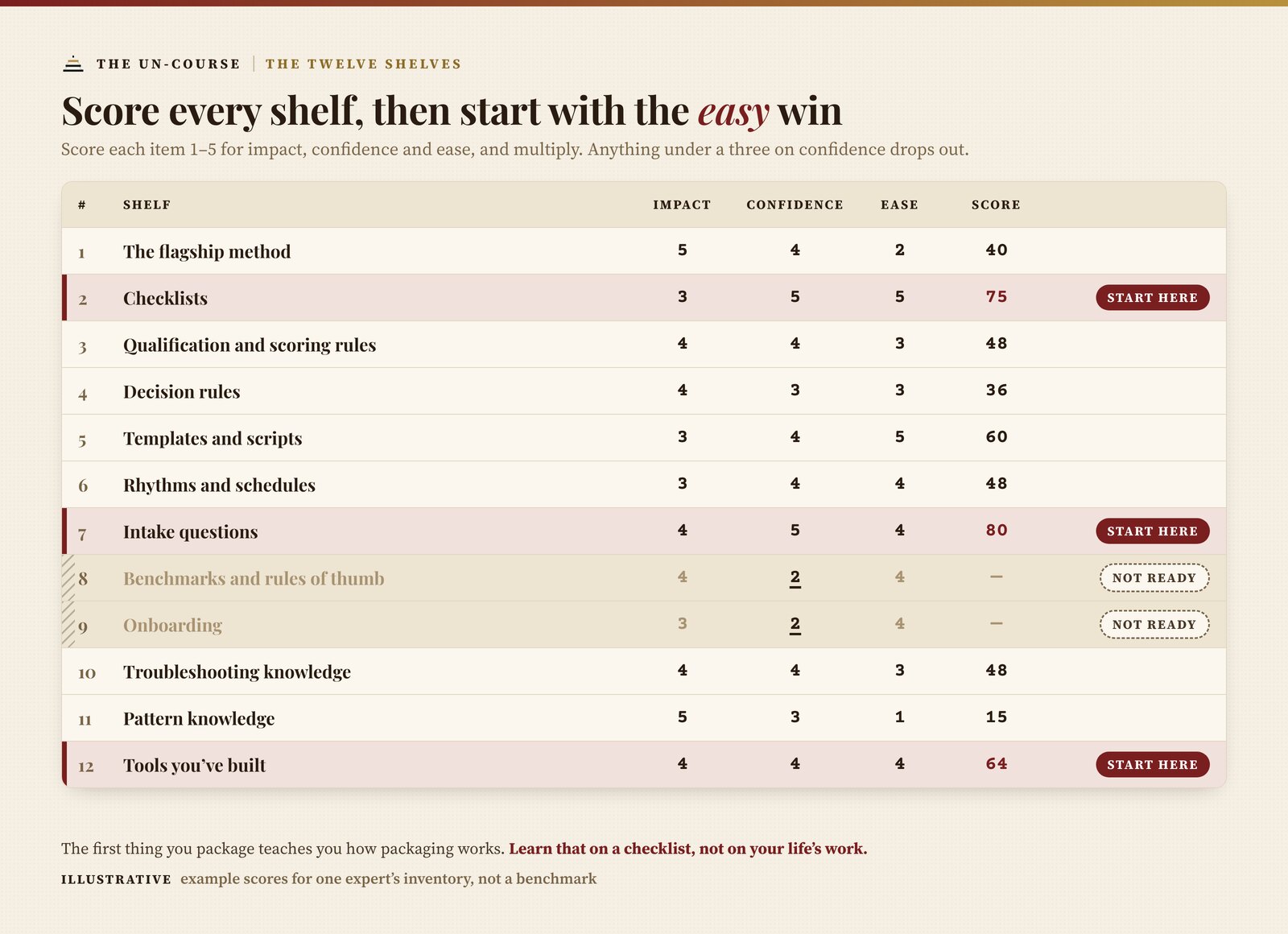
    An example twelve-shelf inventory with illustrative scores from one to five for impact, confidence and ease, multiplied into a score. The flagship method scores 40, checklists 75, qualification and scoring rules 48, decision rules 36, templates and scripts 60, rhythms and schedules 48, intake questions 80, troubleshooting knowledge 48, pattern knowledge 15 and tools you've built 64. Benchmarks and onboarding score only two on confidence, so they drop out as not ready. Checklists, intake questions and tools are marked as the places to start: high on impact and ease, not necessarily the single most valuable item. The scores are illustrative, not a benchmark.
    Figure 4.1 from the book. Its scores are one illustrative inventory, not a benchmark.
    From The Un-Course

    This scorer follows Appendix A, "The Knowledge Audit," and Chapter 4, "The Buried Curriculum," of The Un-Course: A Knowledge Operator's Playbook by Bill Eisenhauer. The defaults are the appendix's worked example: a commercial cleaning company owner who has run crews for eleven years. The owner is hypothetical and every score is an illustration. In the book, three of the four items land in the band. The bid-pricing calculator waits: it has the highest impact, but it's a tangle only the owner understands, built on client pricing data that has to come out first.

    The score helps you choose what to package first. It isn't a forecast of what anything will earn, and the defaults are a hypothetical, not a result. No education, career or earnings outcome is promised, and most people who try these methods earn little or nothing at first. Nothing here is legal, tax, investment, financial or other professional advice. Check your employment and client agreements before you license anything you built while working for someone else.