The Un-Employable, Chapter 1: Quick Sync
A free sample chapter · The Un-Employable: A Novel · about 2,000 words
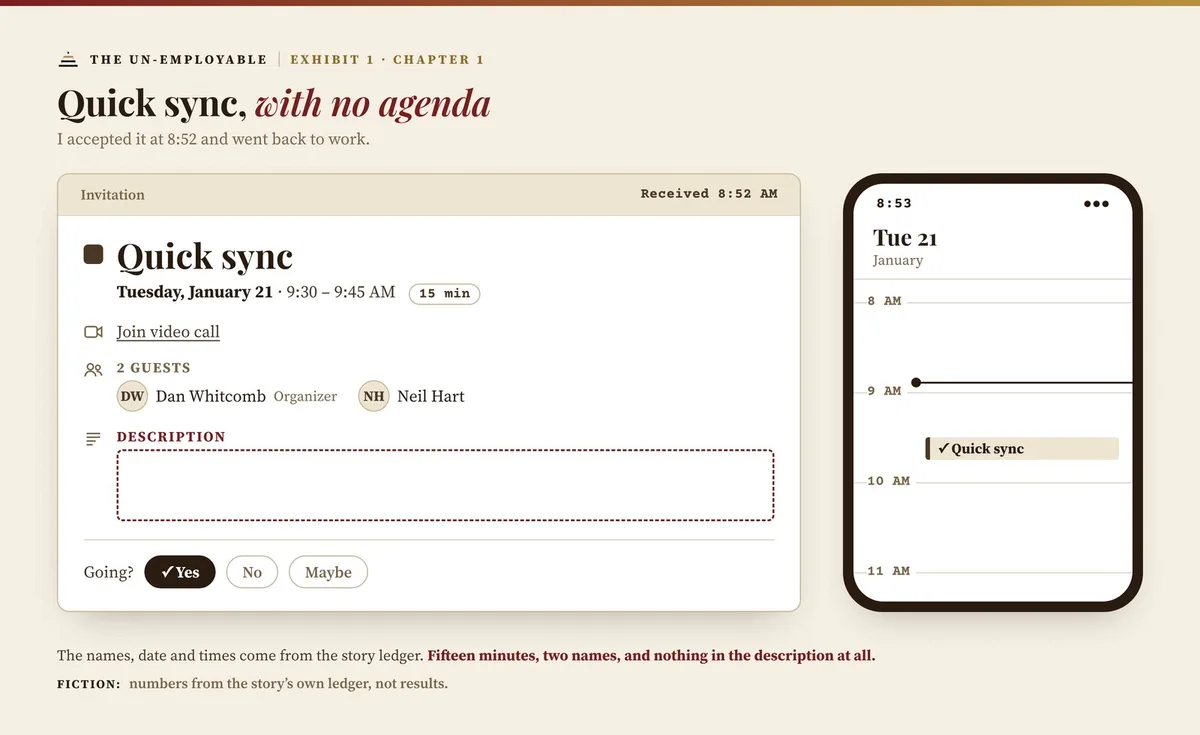
The invite came in at 8:52 on a Tuesday in late January. I know the time because I looked at the corner of the screen when it chimed, which is a habit you pick up after twenty-six years of being paged. When something happens, you want to know when it started.
I was at the kitchen table in Olathe with my laptop open and my second cup of coffee going cold. Anne had left for the library at a quarter past eight. Biscuit was asleep on my feet under the table, the way he’d slept on my feet every working morning since the office went to two days a week, and he was snoring the deep, wet snore of an old yellow Lab who has nowhere to be.
The invite was from Dan Whitcomb. It said “Quick sync.” Fifteen minutes, 9:30 to 9:45. There was a video link and two names, his and mine, and nothing in the description at all.
I didn’t think anything of it. I want to be clear about that, because later people asked me if I’d known, and the honest answer is that I was pleased.
I’d sent Dan the Ledgerline migration estimate on Friday afternoon. Ledgerline is the billing engine I built at Corvane in 2004, when we were a much smaller company in a much uglier building, and it still sends every invoice the company sends. The plan was to move it off the old servers and onto the new platform without anyone’s customers noticing, which is the only good way to move a billing system. My estimate was longer than anybody wanted, and I’d assumed Dan wanted fifteen minutes to tell me so.
I clicked Accept. A small green check appeared next to the title.
Then I went back to work. I reviewed a pull request from a kid on the payments team who’d written a retry loop that would, under the right conditions, charge a customer forever. I left a polite comment.
I ate a granola bar over the sink. Biscuit moved from my feet to the heating vent and sighed about it.
At 9:24 the VPN dropped.
It does that sometimes. I reconnected, and the single sign-on page came up instead, the blue one, and I typed my password, and it thought about it.
Your account has been disabled. Contact your administrator.
My first thought was that identity was down. Two years earlier the identity provider had fallen over on a Monday morning and locked nine hundred people out of everything, and I’d spent the day on a bridge call with a man in Dublin who kept saying “interesting.”
So I opened a ticket in my head, the way I’d opened a thousand of them. Symptom: SSO rejects valid credentials. First seen: 9:24. Impact: one staff engineer, mildly annoyed.
I picked up my phone to check the status channel. The work chat app asked me to sign in again, and then it didn’t let me.
The calendar on the phone still worked. The phone hadn’t heard yet. I remember noticing that the way you notice a log entry that arrives out of order, and filing it, and not thinking about what it meant.
At 9:26 a text came in from a number I didn’t know.
Hi Neil, this is Kristen with the People team at Corvane. Dan and I will meet you at this link at 9:30. Thank you.
There was a Zoom link under it. Not the company’s video system. A plain link, the kind you’d send your sister.
I read it twice. Then I closed the ticket in my head. Resolution: working as intended.
I joined from the phone, propped against the napkin holder, because the laptop wasn’t mine anymore in any way that counted. I sat up straighter than I needed to. I don’t know who that was for.
Dan was in his home office in Leawood with the bookshelf behind him, the one with the framed photo of his kids on a dock somewhere. I’d known Dan since he was a director with hair. He looked like he hadn’t slept, or had slept and regretted it. Kristen was a small square with a blurred background and a headset, and she smiled at me with real warmth, the way you’d smile at someone you were about to hand a casserole.
I had never seen her before in my life.
“Neil,” Dan said. “Thanks for joining. I’m afraid I have some difficult news.”
He was reading. I could tell because his eyes went left to right and then dropped a line, left to right and down, the way people’s eyes move when the words are on a second monitor. I’d watched Dan present to the board a dozen times without notes. He was reading this.
“Due to the evolving needs of the business, your position has been eliminated, effective today.”
Biscuit got up from the vent and came over and put his chin on my knee. Dogs know when a room changes. Nobody knows how.
Kristen took the next part. A packet would come to my personal email within the hour. It would explain my severance and my benefits and the timeline for my decision, and I should read it carefully and take my time, and if I had questions I could reach her directly at the number she’d texted from.
A box would come by courier for the laptop, with a prepaid label. I didn’t need to do anything with the laptop. She said that twice, gently, as if I might try to.
“I know this is a lot,” she said.
It wasn’t a lot. That was the strange part. It was a few sentences, and they’d been written to be short.
“Who’s taking the migration?” I asked.
Dan looked off the second monitor for the first time. “We’ll make sure there’s a transition plan.”
“The estimate’s in your inbox. Page six is the one that matters. The tax tables.”
“I’ll make sure it gets to the right people.”
He meant it. I could see he meant it. I could also see that he didn’t know who the right people were, and that he’d been told not to say anything that sounded like a promise, and that he was a decent man doing a bad job he’d been handed on a Tuesday.
I’ve had a long time to think about Dan since then. That’s still about where I come out.
Nobody said “Ledgerline.”
I kept waiting for it. It would have been easy. It’s in the architecture diagrams, with my initials in the corner of the box.
While we talked, it was running the morning batch. I knew the schedule. I’d written the schedule. Somewhere a dentist’s office in Topeka and a property management company in Omaha were getting invoices that had passed through code I’d typed with my own hands, and the three of us on that call talked for fifteen minutes and none of us said its name.
“We’re grateful for your contributions,” Dan said. He was back on the second monitor.
“Thank you,” I said.
I heard myself say it. I would like to report that I said something else, something dry that people would repeat at the holiday party I wouldn’t be invited to. I said thank you, in the voice I use for waiters, and I’ve hated it ever since. Of everything about that morning, it’s the one thing I’d take back.
Kristen asked if I had any other questions. I said I didn’t think so. She said she’d be in touch, and that she was sorry, and I believed her about the second part.
The call ended at 9:45. Not 9:44, not 9:46. They’d run it on time. In any other meeting I’d have admired that.
The house was very quiet afterward.
I don’t mean it was silent. The refrigerator hummed and the furnace kicked on and Biscuit’s tags clicked against his water bowl. But the quiet I’m talking about was the absence of everything that had been running underneath my mornings for twenty-six years: the chat notifications, the build alerts, the little calendar chime telling me I had a meeting in five minutes. All of it had been turned off at once, from somewhere else, by someone whose name I’d never know.
I didn’t know what to do with my hands. That sounds like a figure of speech. It wasn’t.
I put them on the table. I took them off. I picked up the coffee and it was cold and I put it down.
Then I closed the laptop, and I lined it up with the edge of the table, square, the way I’d line up a printout before stapling it. I adjusted it twice. I still don’t know why that mattered.
Biscuit watched me do it with his head on his paws.
I picked up my phone and texted Anne. Call when you can.
I looked at that for a while. She’d see it at the circulation desk, and she’d think someone was in the hospital, and she’d step into the staff room with her heart going, and then I’d have to tell her over the phone with the microwave beeping behind her. I deleted it.
Got laid off. I’m fine. Talk tonight.
I read it four times, which was more than I’d read the invite. Then I sent it.
The three dots came up almost right away, and went away, and came up again. I pictured her at the desk, typing and stopping. When it came, it was four words.
Leaving early. Don’t cook.
Here’s what I thought, sitting there. I want to put it down plainly, because it was wrong in an instructive way.
I thought I’d been surprised more than hurt, and that was true. I thought the hurt would come later and pass, and that was half true. And I thought this would take a month to fix. Maybe six weeks, if February was slow.
I had reasons. I was a staff engineer with twenty-six years at a company of nine hundred people, and I’d built the thing that sent its invoices. I’d sat on the hiring committee for years, so I knew what a résumé like mine looked like from the other side of the table. For most of my career, people had forwarded it to each other without being asked.
Recruiters had called me every few months for two decades. I’d been polite to them in the tone of a man who didn’t need anything.
I’d been estimating work for a living since before some of those recruiters were born. I was usually close. A month, I thought. Six weeks, outside.
I’d never been less right about anything, and I’ve estimated tax-table migrations.
At 10:30 I tried the laptop again, out of something I’d like to call diligence. The sign-on page came up, blue and patient. I closed it and lined it up again with the table’s edge.
My phone was face up next to it. The work calendar was still there, still synced, a little behind the rest of the world. By noon the whole account would be gone from the phone, quietly, the way they’re built to go. But for now there it was, at the top of the day, where I’d left it.
Quick sync. 9:30–9:45.
And next to it, the little green check that meant I’d accepted.
End of Chapter 1
By Friday night Neil is at the kitchen table with a yellow legal pad, writing one question: If I stopped working tomorrow, what would still pay us? The rest of the novel is the year it takes him to change the answer.
A novel: its people, companies and numbers are invented. Nothing here is legal, tax or financial advice, or a promise of income.