Build
AI-Powered Pre-Sell Content — Using Claude to Write What Converts
What took three days now takes three hours. But AI-generated content that converts isn't about prompting faster — it's about prompting differently. Here's the workflow, the prompt engineering, and the quality control that turns Claude from a writing assistant into a conversion machine.
October 22, 2026 · 8 min read
Last March, I needed to write pre-sell content for eleven product pages. Eleven. Each one needed a product review angle, a comparison angle, and a recommendation angle. That’s thirty-three pieces of conversion-focused copy.
The old way — researching each product, writing drafts, editing, testing — would have been two and a half weeks of solid work. I know because I’d done it before. Three days per batch of three, and that was moving fast.
I sat down on a Tuesday morning with Claude, a structured prompt template, and the product data for all eleven pages. By Thursday evening, all thirty-three pieces were drafted, edited, and deployed. Three days instead of seventeen. Same conversion rates on the first batch. Better conversion rates by the third batch, because I’d fed the performance data back into the prompts.
That wasn’t the revelation, though. Speed is nice, but speed is a party trick. The revelation was what happened over the next 60 days: I iterated. I tested variations. I had Claude rewrite underperforming pages using the data from high-performing ones. The feedback loop between performance data and content generation compressed from “monthly review” to “Tuesday afternoon” — and conversion rates across the entire portfolio climbed by 23%.
The speed wasn’t the advantage. The iteration speed was.
Why AI + human editing outperforms either alone
Pure AI content reads clean but generic. It lacks the specific, opinionated angles that make pre-sell content persuasive. It tends toward completeness when it should tend toward conviction.
Pure human content has voice and opinion but takes ten times longer and is harder to iterate. When a page underperforms, rewriting is expensive — so you don’t. The underperforming page sits there for months, quietly leaking conversions.
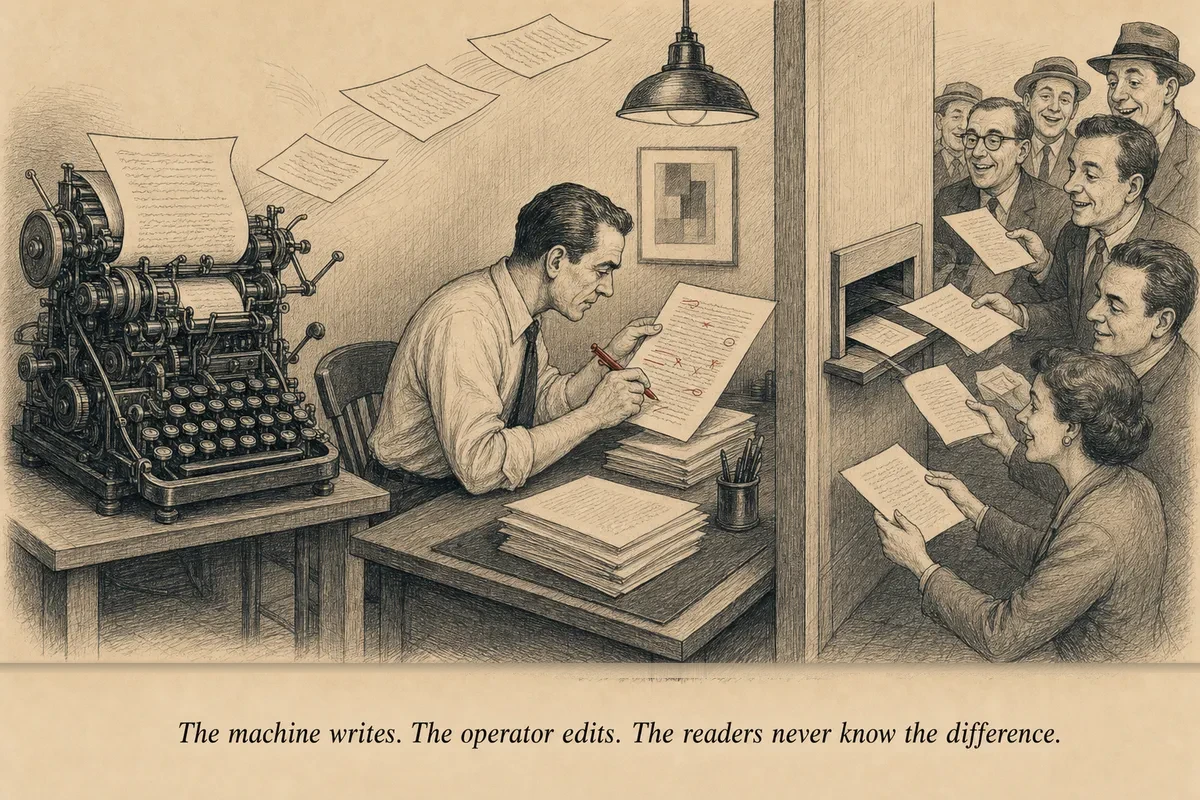
The combination solves both problems. AI generates the structural draft — the research summary, the comparison framework, the objection-handling paragraphs — in minutes. The human adds the editorial layer — the voice matching, the specific opinions, the “here’s what I actually think” moments that convert.
In the portfolios I’ve observed, the conversion rates break down like this:
| Content Type | Avg. Conversion Rate | Time to Produce |
|---|---|---|
| Pure AI (unedited) | 1.8-2.5% | 20 minutes |
| Pure human | 3.0-4.5% | 4-6 hours |
| AI draft + human edit | 3.2-5.0% | 45-90 minutes |
The AI-assisted content slightly outperforms pure human content on average — not because the AI is better, but because the time savings get reinvested into iteration and testing. When you can produce a page in 90 minutes instead of 6 hours, you can afford to write three variations and test them against each other. The testing is what drives the higher conversion, not the AI itself.
This article continues for paid subscribers with the prompt engineering templates (product reviews, comparison pages, recommendation content), the editing workflow, the feedback loop protocol, and quality control standards.
Paid Content
This article continues for subscribers.
The full implementation — the steps, the templates, the math — is delivered via the newsletter.
Unsubscribe in one click. Useful operator material only. Promotions, sponsors, and partner links will be disclosed.
Build
More on building toll infrastructure?
This article covered one piece of the build dimension. The newsletter delivers a new install pattern every week.
Unsubscribe in one click. Useful operator material only. Promotions, sponsors, and partner links will be disclosed.