Monetize
The Un-SaaS Ch. 1 — Income Follows Assets
Why a seven-year consulting practice produced exactly zero revenue during a 90-day medical break — and what the operator next door built instead.
June 26, 2026 · 13 min read

Chapter 1 of 26
This is a chapter from The Un-SaaS: A Toll Stack Engineer's Handbook. Each Friday, we're publishing a chapter as a bonus for our readers.
Why Your $175/Hour Ceiling Is the Problem
There’s a consulting developer I know — good one, too — who ran an experiment on himself without meaning to.
He’d been billing $175 an hour for seven years. Custom Salesforce integrations, mostly. His calendar was full. His pipeline was full. His bank account was full on the 15th and half-empty by the 30th. He looked prosperous. By every conventional metric, he was.
Then he took ninety days off.
Not a sabbatical. Not a planned break. A medical thing — the kind where the doctor says “no screens, no calls, no work” and means it. His wife handled the logistics. His phone went into a drawer. His laptop went on a shelf.
When he came back, his inbox had two thousand unread messages and his revenue for those ninety days was exactly zero.
Seven years of work. Seven years of clients. Seven years of reputation, relationships, and referrals. The moment he stopped showing up, every dollar stopped too. Not a trickle. Not a slow fade. A cliff.
He wasn’t running a business. He was running a job with an LLC wrapper.

Daniel Priestley wrote a book called 24 Assets. Most of it is fine. One sentence is worth the whole thing:
“Income follows assets. Every problem in a business is an asset deficiency.”
When a business isn’t making the money it should be making, it’s not because the team isn’t trying hard enough or the market isn’t big enough or the product isn’t good enough. It’s because a specific, nameable asset is missing. The winery doesn’t need more wine tastings — it needs a follow-up email sequence. The consultant doesn’t need more traffic — they need an offer ladder. The podcast doesn’t need more downloads — it needs a lead magnet capturing the downloads it already gets.
That’s Priestley’s contribution, and it’s a good one. But there’s a follow-up question he doesn’t quite answer, and it’s the one that matters for you.
The 90-Day Test
Priestley has a filter for what counts as a real asset, and it’s the cleanest one I’ve read.
He calls it the 90-day yachting test. Imagine you disappeared for ninety days on a boat with no phone, no laptop, no way to intervene in your business. When you come back, is the thing still producing revenue?
If yes: it’s an asset.
If no: it’s a job disguised as a business.
The consulting developer failed the test comprehensively. But here’s the thing — so does almost every side hustle that engineers attempt. The micro-SaaS with forty dollars in MRR? Needs you to handle support tickets and fix bugs. The freelance gig? Needs you to show up. The course you planned to build? Needs you to create, market, and sell it. The newsletter? Needs you to write it.
Run the yachting test against your current income streams, including your W-2. Be honest about it. Almost everything in your financial life fails.
Now run it against a toll position.
A landing page sitting between a creator’s 400,000 subscribers and their checkout — does it keep converting while you’re on the yacht? Yes. It’s software. It doesn’t know you left.
An email sequence nurturing 4,000 subscribers toward a purchase — does it keep sending while you’re gone? Yes. It’s automated. The emails fire on schedule.
A revenue-share arrangement splitting commissions 70/30 on every transaction — does it keep splitting while you’re away? Yes. The payment rail doesn’t take days off.
The experiment log stops compounding while you’re gone — nobody’s running new tests. But the existing infrastructure keeps producing. The list keeps growing. The sequences keep converting. The revenue keeps splitting.
That’s the difference between an asset and a job. The asset works on its own schedule, not yours.
Five Things an Operator Builds
Not all assets are equal. The Toll Stack framework recognizes five types that an operator installs inside a partner’s business, each with different economics, different timelines, and different compounding characteristics.
1. Capture assets. Landing pages, opt-in forms, lead magnets — anything that converts anonymous traffic into a known contact. A capture asset is the first thing you install because nothing else works without it. The YouTuber’s description link pointing to your landing page instead of straight to Teachable? That’s a capture asset. Its value compounds because every subscriber it captures enters a sequence that can monetize for months or years.
2. Conversion assets. Email sequences, persuasion pages, webinar funnels — anything that moves a known contact toward a purchase. The five-slide sequence you write after the landing page capture? That’s a conversion asset. Its value improves with optimization: every subject-line test, every slide reorder, every timing experiment makes it slightly more effective, and the improvement applies to every subscriber who ever enters it going forward.
3. Monetization assets. Offer structures, pricing pages, upsell flows, order bumps — anything that determines how much money moves per transaction. The bonus offer you attach to the Teachable forward? That’s a monetization asset. Its value scales with traffic: a 10% increase in average order value produces 10% more revenue on every sale, forever, without additional work.
4. Retention assets. Reactivation campaigns, loyalty sequences, re-engagement flows — anything that pulls dormant subscribers back into the buying cycle. A quarterly reactivation email hitting a 40,000-person dormant list? That’s a retention asset. Its value grows with list age: the bigger the dormant pool, the more revenue each reactivation produces.
5. Intelligence assets. The experiment log, the behavioral database, the cross-network patterns — anything that makes your other assets smarter over time. This is the one most operators undervalue and the one that matters most in year two and beyond. Intelligence assets are the reason month eight looks nothing like month one, and the reason a competitor can’t just copy your landing page and get your results.
Every toll position you build is some combination of these five. A simple position might be just a capture asset and a conversion asset — a landing page and an email sequence. A mature flagship position might include all five, running continuously, each one improving the others.
The consulting developer had zero of the five. He had expertise, reputation, and a Rolodex. All three evaporated the moment he stopped working. He had labor, not assets.
Revenue Per Person
Priestley offers another metric worth stealing: revenue per person.
It’s a simple ratio: total annual revenue divided by the number of people required to produce it. For a traditional agency, the number might be $80,000 to $150,000. For a SaaS company, maybe $200,000 to $400,000. For a Fortune 500 consultancy, perhaps $300,000 to $500,000.
For a Toll Stack Engineer, the business is a category of one. You are the only person. Revenue per person is literally your entire annual net.
At twelve positions producing a combined $10,000 to $15,000 per month, your revenue per person is $120,000 to $180,000 — with a time investment of twelve to eighteen hours a week. On a per-hour basis, that’s $125 to $290 per hour of actual work, but unlike consulting, the rate goes up over time instead of staying flat. The experiment log compounds. The list grows. The positions improve. Year two pays more than year one on fewer hours, not more.
That’s the fundamental inversion. In every labor model — W-2, consulting, freelancing, agency work — more revenue requires more time. In an asset model, more revenue requires better assets, not more hours. You don’t work harder in year two. You work on higher-leverage experiments.
The consulting developer was earning $175 an hour, which sounds impressive until you realize it was capped. There is no version of billing $175 an hour that produces $250 an hour next year without billing more hours. The rate is the rate. The ceiling is the ceiling.
An asset model has no ceiling because the rate is a function of infrastructure quality, not time spent.
The Asset Deficiency Audit
Here’s the exercise that changed my own thinking, and it’s one you can do in twenty minutes.
Pick any three businesses you’re familiar with — a friend’s consulting practice, a podcast you listen to, a creator you follow, a local business you frequent. For each one, ask:
- What is this business’s primary revenue source? (Product sales, services, ads, sponsorships, subscriptions?)
- Does the revenue stop if the owner stops working for ninety days? (The yachting test.)
- Which of the five asset types is missing? (Capture? Conversion? Monetization? Retention? Intelligence?)
- What would it cost to build the missing asset? (In time, not money — you’re an engineer.)
- What would the missing asset be worth if it existed? (Revenue per month, conservatively.)
The first time I did this exercise, I looked at a fitness YouTuber with 180,000 subscribers and a $47 ebook linked in every video description. No landing page. No email capture. No follow-up sequence. No offer ladder. No experiment log. Five out of five asset types were missing. The business was a single-link-to-checkout operation leaking revenue at every stage.
The mental math was sobering. Even a modest landing page with a 25% email capture rate and a basic five-email sequence would likely double or triple the ebook revenue — and create a list asset that compounds independently of YouTube’s algorithm.
Once you put on these glasses, you cannot take them off.
Every business you look at becomes a bundle of asset gaps. The podcast with no lead magnet. The course creator with no reactivation campaign. The SaaS founder with no partner channel. The consultant with no nurture sequence. Each gap is a toll position waiting to be installed — by someone with the technical skills to build it and the strategic sense to negotiate a rev-share instead of a flat fee.
That someone is a Toll Stack Engineer.
And the fact that most engineers have never heard the phrase “asset deficiency” — let alone thought about it as an installable opportunity — is exactly why the window is wide open.
The Income Gear Progression
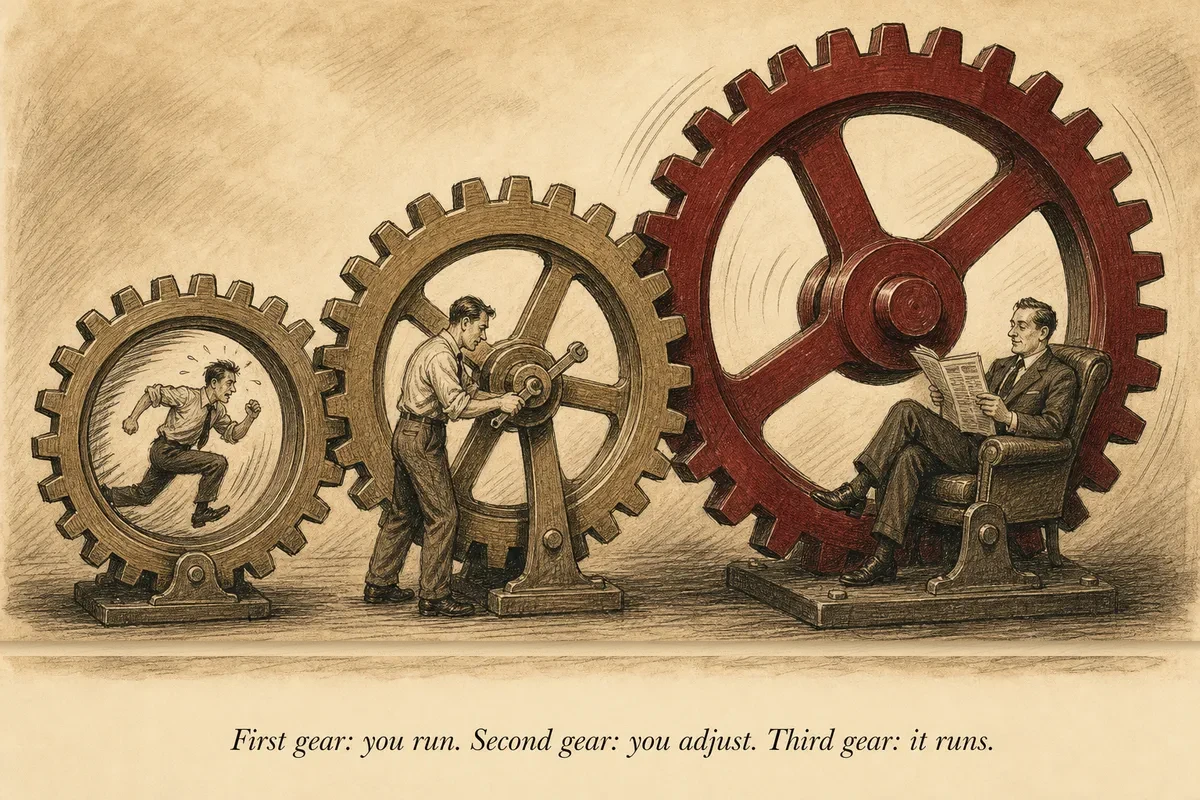
Most people who read the previous section walk away thinking: “Great. Build toll positions. Collect commissions. Got it.”
And they’re right — that’s first gear. But the car has four.
The problem with advice like “build assets” is that it sounds like a destination. You arrive, you’re done. Income follows assets, asset built, income flowing, congratulations. In reality, the asset model has its own progression — a set of gears that compound on each other, each one unlocking economics the prior gear can’t reach. Most operators idle in second gear for years without realizing the transmission goes higher.
Here’s the full shift pattern.
First gear: Commission Operator. This is where every toll position starts. You build the bridge — a landing page, an email sequence, a redirect layer — inside a partner’s business. Traffic flows through your infrastructure. Revenue splits on every transaction. You earn $500 to $2,000 per month per position, depending on the partner’s traffic volume and the product’s price point.
Commission income is real income. Three positions at $1,200 each is $3,600 a month, which is $43,200 a year — not bad for a side operation running on twelve hours a week. But commission income has a ceiling that most operators don’t see until they hit it. Your revenue is a percentage of someone else’s product, sold to someone else’s audience, through your infrastructure. You’ve decoupled income from hours. You haven’t decoupled it from the partner’s business decisions.
If the partner raises prices and tanks conversions, your commission drops. If the partner pivots to a new product, your sequences need rebuilding. If the partner quits creating, your traffic evaporates. You own the bridge, but the bridge only works while someone else’s river flows.
First gear is better than consulting. But it’s not the endgame.
Second gear: Strategic Partner. In second gear, you stop being the person who builds the bridge and start being the person who architects the entire commerce layer. Instead of a single landing page and email sequence, you’re running the full monetization stack — offer ladders, launch sequences, reactivation campaigns, cross-sells, upsells, and the intelligence layer that makes all of them improve.
The economics shift. Instead of $500 to $2,000 per position, you’re earning $2,000 to $5,000 per month per partnership because you’re capturing a share of total revenue improvement, not just a commission on individual sales. You negotiate rev-share agreements that reflect the full infrastructure value. The partner who was paying you a 15% commission on one product is now paying you 20% of the incremental revenue across their entire funnel — because you built the entire funnel.
Strategic partners also get longer deals. The commission operator can be replaced by another commission operator in a weekend. The strategic partner who built the experiment log, the tag taxonomy, the cross-sell matrix, and the reactivation campaigns — that person is load-bearing infrastructure. Replacing them costs six months and tens of thousands in lost optimization.
Third gear: Equity Holder. Here’s where the economics change fundamentally. In third gear, you stop building inside someone else’s business and start owning pieces of the businesses you operate.
This can happen two ways. The first is direct: you acquire a small media property — a newsletter, a community, a dormant forum with an active email list — and install the same toll position infrastructure you’ve been building for partners. Except now, 100% of the revenue is yours. A niche newsletter with 8,000 subscribers and a well-built monetization stack can produce $2,000 to $4,000 per month in sponsorship and affiliate revenue. You paid $7,000 to acquire it. That’s a twelve-month payback.
The second way is indirect: you negotiate equity stakes with early-stage partners. A course creator with growing traffic but no commerce infrastructure might trade 5% to 10% equity in their business for the full toll stack buildout. At year one, that equity is worth little. At year three, when the business is doing $500,000 a year with infrastructure you built, it’s worth $25,000 to $50,000 — and the revenue share is still running on top of it.
Third gear income is passive in the real sense. Contributors create content. Sponsors pay for audience access. The editorial architecture runs on a cadence staffed by people who aren’t you. If you took a ninety-day sabbatical — our favorite test — contributors keep publishing, sponsors keep paying, members keep engaging.
Fourth gear: Licensor. In fourth gear, you monetize the playbook itself. You’ve built a portfolio of toll positions. You’ve developed systems, templates, and frameworks that reliably produce results. You have an experiment log with hundreds of completed tests across multiple niches.
Other operators — people who are where you were in year one — will pay for that knowledge. Licensing takes many forms: courses, cohorts, templates, consulting, franchise-style arrangements where new operators build positions using your infrastructure and you earn a percentage of their revenue.
The economics here are uncapped. A licensing operation doesn’t require your hands on any individual position. You earn revenue from teaching and replicating what you’ve already proven, while your existing portfolio continues producing. The operators you train become your distribution network for intelligence that feeds back into your own experiment log.
Here’s the gear progression rule that most people miss: you can’t skip gears.
The strategic partner needs the experiment log that only commission operating produces. The equity holder needs the pattern recognition that only multi-partner strategic work develops. The licensor needs the documented playbook that only portfolio-scale operation creates. Each gear compounds on the prior one. The knowledge and data from gear two make gear three possible. The portfolio and systems from gear three make gear four credible.
Trying to jump from first gear to fourth — building a course about toll positions before you’ve run a portfolio — is a credibility problem. It’s the equivalent of teaching a masterclass on bridge construction when the only bridge you’ve built is a footbridge over a puddle. The market can smell it.
The operators who idle in first gear are doing fine. The operators who reach fourth gear are building something that looks less like a side hustle and more like a holding company. One that started with a single landing page and a $47 course three years ago.
I covered the full escalation ladder from commission to equity — the specific conversations, the deal structures, and the math at each stage — in Purchase the Cow. For now, the thing to internalize is simple: the car has four gears. Know which one you’re in. Know which one is next.
Next Friday: What a toll position actually is, how the bridge works, and why the dead clicks in a creator’s YouTube description are the most under-monetized asset on the internet.
Monetize
Want to structure better deals?
This article covered one monetization pattern. The newsletter delivers deal structures and revenue mechanics every week.
Unsubscribe in one click. Useful operator material only. Promotions, sponsors, and partner links will be disclosed.