Scale
The Un-SaaS Ch. 4 — The 70-Year Model
The toll position model has worked for seventy years across three market eras. Same architecture, different tools. Here is the pattern.
July 17, 2026 · 11 min read

Chapter 4 of 26
This is a chapter from The Un-SaaS: A Toll Stack Engineer's Handbook. Each Friday, we're publishing a chapter as a bonus for our readers.
In 1957, a man whose name you’ve never heard owned fourteen molds and three patents in the plastics industry. He didn’t run a factory. He didn’t employ workers on a production floor. He didn’t ship product, manage inventory, or handle customer service.
What he did was collect a fee on every unit that moved through his industry — because the molds and the patents were his, and anybody who wanted to manufacture certain products needed access to them. The factories did the work. He collected the toll.
He wasn’t rich because he was smart about plastics. He was rich because he was smart about position. He owned the thing that sat between supply and demand, and he made sure that thing was indispensable.
He retired comfortably. His molds kept producing fees for years after he stopped paying attention to them. The 90-day yachting test? He could have taken the 90-year yachting test.
Here’s the thing that matters about that story: it happened sixty-nine years ago. And the model he was running is structurally identical to what this book teaches.
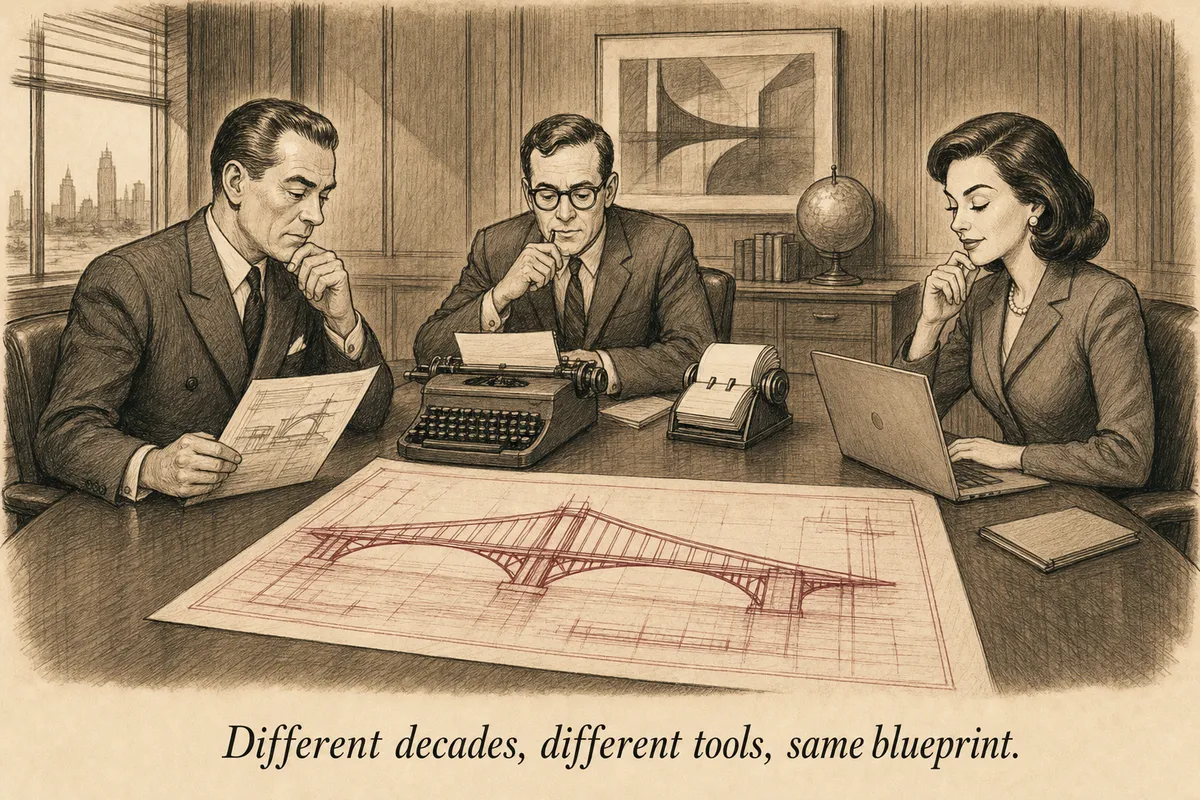
Three Eras, One Model
The toll position isn’t an internet invention. It’s a business pattern that has been generating quiet fortunes for at least seven decades, across wildly different industries, tools, and economic conditions.
Era 1: The Mold Maker (1950s–1970s)
The plastics industrialist is the archetype. He identified an industry with high demand and fragmented supply, then positioned himself as the owner of a critical piece of infrastructure — the molds — that every manufacturer needed. He didn’t compete with the manufacturers. He enabled them. And because the molds were expensive to create but nearly free to maintain, his revenue per hour of ongoing work was extraordinary.
The economics were simple: high upfront investment (designing and building the molds), near-zero marginal cost (the molds lasted for years), and a toll on every unit produced (licensing fees or per-unit royalties). The risk was concentrated in the initial build. Once the mold was proven, the revenue was durable.
Sound familiar? It should.
Era 2: The Matchmaker (1970s–1990s)
By the late 1970s, a different version of the same model emerged in the brokering world. Finders — people who introduced qualified buyers to qualified sellers — discovered that the introduction itself was the valuable infrastructure.
One practitioner kept a handwritten catalog of contacts: who needed what, who sold what, who was looking to buy. He followed two rules that he considered inviolable. First: get the agreement in writing before making the introduction. Second: never give away a contact without securing the fee.
He did this for nearly five decades. The tools evolved from typewriters to computers, but the structural logic never changed. By 1985, a good finder working a single vertical — say, industrial equipment in the Southeast — could earn $80,000 to $120,000 a year in introduction fees. Not salary. Not billable hours. Fees on connections that closed whether or not the finder was in the room when the handshake happened.
The math was elegant. A $500,000 equipment deal with a 2% finder’s fee produced $10,000 from a single introduction. Twelve introductions a year at that rate was $120,000. The finder’s total time per deal: a few phone calls, a written agreement, and a follow-up. Maybe four hours of work. That’s $2,500 per hour of effort — in 1985 dollars.
But here’s what capped the model: every introduction required personal knowledge. The finder had to know both parties. Had to have met them, or at least spoken with them. Had to maintain the relationship through phone calls, lunches, and industry events. The Rolodex was the asset, and the Rolodex only grew at the speed of human networking.
A great finder could manage maybe forty to sixty active relationships at any given time. Beyond that, the quality of knowledge degraded. You couldn’t remember who was looking for what if your contact list exceeded a few hundred entries and your only retrieval tool was your memory.
He didn’t build products. He didn’t buy inventory. He didn’t generate demand. He sat in the middle of existing demand and existing supply, made the connection, and collected a percentage. His infrastructure was a Rolodex, a phone, and a set of relationships that took years to build and were impossible to copy overnight.
The matchmaker model added something the mold maker didn’t have: a compounding data asset. Every deal the matchmaker brokered added to his knowledge of who buys what, at what price, under what conditions. By year five, his contact catalog wasn’t just a list — it was an intelligence database. He could predict which introductions would close, which buyers were ready, which sellers were flexible. The data made him better over time, and the improvement was invisible to outsiders.
Era 3: The Licensing Strategist (2000s–2020s)
In the 2000s, a strategist formalized two concepts: “Licensing IN” and “Licensing OUT.” Licensing IN meant acquiring the right to use someone else’s assets — a product, a brand, a customer list — in exchange for a percentage of the revenue you generated. Licensing OUT was the mirror: letting someone else use your assets under the same arrangement.
The strategist realized that most businesses had assets they weren’t fully using. A course creator had a list of 40,000 subscribers they emailed once a month with a generic newsletter. A consultant had a methodology they’d never productized. A SaaS company had a user base they’d never cross-sold to.
In each case, the underutilized asset could be “licensed in” by an operator who knew how to extract more value from it than the owner was extracting. The owner kept doing what they were good at (creating courses, consulting, running the SaaS). The operator installed monetization infrastructure against the underutilized asset. Revenue split.
This is where the model starts to look exactly like the Toll Stack. The licensing strategist was doing in 2010 what this book teaches you to do in 2026. They just didn’t have the AI agents, the automated experiment log, or the ability to run twelve positions simultaneously as a solo operator.
What Changed: The Internet + AI
All three eras ran the same playbook: find existing demand, own the connective infrastructure between that demand and its monetization, collect a toll on every transaction.
The differences across eras were in tools, scale, and headcount. The mold maker needed physical molds (expensive). The matchmaker needed a physical Rolodex and in-person meetings (time-intensive). The licensing strategist needed a small team to handle the operational load (agency-shaped).
The internet changed three things:
Capital requirement dropped to near-zero. A landing page costs $0 to $15 per month to host. An email sequence costs pennies per subscriber. The payment infrastructure is free or near-free. The “mold” — the toll infrastructure — went from costing tens of thousands of dollars to costing less than a dinner out. This means the barrier to entry isn’t capital anymore. It’s knowledge.
A new data layer appeared. The matchmaker’s Rolodex was powerful but static. The internet gave operators a behavioral data layer — who clicked what, who opened which email, who bought which product, who came back after sixty days. The experiment log that compounds over time? That didn’t exist in 1978. The cross-network intelligence that makes five partners more valuable than five individual deals? That requires a digital database. The internet made the data moat possible.
Portfolio compounding accelerated. The mold maker ran one or two positions because each mold was expensive to design and build. The matchmaker ran a handful because each deal required personal attention. The licensing strategist ran five to ten because the operational load required a team.
A solo Toll Stack Engineer in 2026 can run twelve because AI agents handle the operational load that used to require a team.
That’s the real breakthrough. Not the internet — the internet has been around for thirty years. The breakthrough is AI collapsing the headcount requirement. A competent engineer with a stable of specialized agents can now do, in a weekend, what used to require an agency’s work-month.
The agent workforce handles drafting, QA, triage, routine optimization, and reporting. You — the engineer — allocate attention, approve changes, make strategic calls, and build new positions. The split is the same as the mold maker’s: high upfront investment in building the infrastructure, near-zero marginal cost in running it, and a toll on every transaction.
The difference is that you can build a mold in an afternoon instead of a month, and you can maintain twelve molds instead of two.
The 2024 Inflection
Every era of the toll position had a bottleneck that determined how many positions one person could run.
The mold maker’s bottleneck was capital. Each mold cost thousands to design and fabricate. Two or three molds was a portfolio. A dozen was a corporation.
The matchmaker’s bottleneck was attention. Each relationship required personal maintenance — phone calls, lunches, handwritten notes. Forty relationships was manageable. A hundred was chaos.
The licensing strategist’s bottleneck was headcount. Running a monetization stack against someone else’s assets required copywriters, designers, tech support, and project managers. Five positions meant a five-person team. The economics worked, but the model was agency-shaped. The strategist’s real innovation was the deal structure, not the operational efficiency.
Then, in 2024, the bottleneck collapsed.
AI agents reached the point where a single technical operator could delegate the operational layer — drafting email sequences, formatting analytics, monitoring conversion rates, checking links, running QA. All of it went to a roster of specialized agents that cost pennies per task. Not theoretical. Not “someday AI will.” In 2024, the tools crossed the line from interesting to load-bearing.
Run the numbers. In 1985, the matchmaker earned $120,000 a year managing forty relationships and closing twelve deals. In 2010, the licensing strategist earned $300,000 a year running a five-person team across eight partnerships. In 2026, a solo Toll Stack Engineer running twelve positions with an AI agent workforce can earn $120,000 to $180,000 a year — on twelve to eighteen hours a week.
The revenue per hour of human effort went from $2,500 per deal for the matchmaker (who needed four hours per introduction but only closed one a month). The operator earns $125 to $290 per hour — working twelve to eighteen hours per week, every week, with compounding returns. The matchmaker’s income spiked and crashed with each deal cycle. The operator’s income compounds.
What changed isn’t the strategy. What changed is that AI made the solo version viable for the first time. The matchmaker needed decades of networking. The licensing strategist needed a payroll. The Toll Stack Engineer needs a laptop, an agent roster, and the discipline to run experiments.
That’s the seventy-year arc in one line: the model stayed the same, but the minimum viable team shrank from a company to a department to an agency to you.
The Master Lease
There’s a real estate strategy that maps onto every era above. It’s called the master lease.
A property owner has a building they don’t want to manage. A master leasee signs a long-term lease, takes over the operations, and captures the spread between what they pay the owner and what they earn from tenants. The leasee doesn’t buy the property. They bring operational skill the owner lacks, improve the yield, and share the upside.
The mold maker was a master leasee of manufacturing knowledge. The matchmaker was a master leasee of relationships. The licensing strategist was a master leasee of distribution.
And the toll position operator is a master leasee of digital traffic.
You don’t buy the audience. You lease operational control through a deal memo, install infrastructure that improves conversion, and capture the spread between the creator’s unoptimized traffic and your optimized bridge. The owner keeps the property (their audience). You keep the operation (the infrastructure and the experiment log). Both sides earn more than either could alone.
Robert Kiyosaki drew the line in Rich Dad Poor Dad: assets put money in your pocket, liabilities take money out. But the insight most people miss is the corollary — you don’t need to own the asset. You need to control the cash flow.
The master lease is how you control the cash flow on an asset you don’t own. The toll position is the digital version. Same architecture. Different property class.
Why This History Matters
I’m telling you a seventy-year story for one reason: to inoculate you against the feeling that this is too good to be true.
Engineers are, properly, skeptical. When someone describes a model that produces $10,000 to $15,000 a month in parallel income on twelve to eighteen hours a week, the rational response is: “Where’s the catch? What am I not seeing? If this works, why isn’t everyone doing it?”
The answers, in order:
The catch is that year one feels dark. The compound curve bends slowly. Most people quit in months four through six — the valley between construction and compounding. The model works, but it requires patience that most advice-consumers don’t have.
What you’re not seeing is the seventy years of practitioners who’ve run versions of this model successfully, in different industries, with different tools. They didn’t call it a Toll Stack. They didn’t post about it. They didn’t build courses about it. They just quietly installed infrastructure, collected tolls, and compounded.
Why isn’t everyone doing it? Because the people who figured out the marketing half aren’t engineers, and the engineers who could build the infrastructure were never told this opportunity existed. The translation layer between “back-end marketing operator” and “software engineer who could automate this” didn’t exist until the AI revolution collapsed the headcount requirement and made the model accessible to a single technical person.
This book is that translation layer.
You’re not learning something new. You’re learning something old that nobody ever showed you because nobody spoke your language.
And the model doesn’t end at commissions. The mold maker didn’t stop at licensing fees — he used the revenue from one patent to fund the acquisition of the next. The matchmaker didn’t stop at finder’s fees — he parlayed his deal-flow into equity positions in the companies he connected. The licensing strategist didn’t stop at revenue shares — he acquired the products he’d been promoting, turning commission income into ownership income.
Chapter 21 walks through the full escalation — from commission operator to equity holder — including the specific conversation where you propose converting part of your commission into an ownership stake. The milk purchases the cow. But the cow only becomes available to you after the milk has been flowing long enough that the farmer trusts you more than any other buyer.
The seventy-year practitioners all followed the same escalation. They started by collecting tolls. They ended by owning the bridges. The timeline compressed with each era — from decades to years to months. The destination never changed.
Next Friday: Ten assumptions that SaaS founders accept as gospel — and toll position operators invert completely.
Scale
Ready to go from one position to a portfolio?
This article explored scaling. The newsletter delivers portfolio expansion patterns and operational frameworks weekly.
Unsubscribe in one click. Useful operator material only. Promotions, sponsors, and partner links will be disclosed.