Partner
The Un-SaaS Ch. 8 — Finding Your First Partner
The first partner conversation is four minutes long, not forty. Here is the script, the pitch structure, and what to listen for.
August 14, 2026 · 19 min read

Chapter 8 of 26
This is a chapter from The Un-SaaS: A Toll Stack Engineer's Handbook. Each Friday, we're publishing a chapter as a bonus for our readers.
Here’s a phone call that happened in 1978.
A man who brokered deals for a living — introductions between buyers and sellers, nothing more — called a manufacturer he’d never met. The manufacturer made industrial valves. The broker had a buyer who needed fifty thousand of them.
The call lasted four minutes. The broker said three things: “I have a buyer for your valves. The order is fifty thousand units. Here’s what I need from you to make the introduction.”
The manufacturer said yes in ninety seconds.
The broker later said the reason the call worked wasn’t confidence or salesmanship. It was that he showed up with three things: a specific buyer (not “I might find someone”), a specific quantity (not “a large order”), and a specific ask (not “let’s explore”).
Partner outreach for a toll position works the same way. The operators who struggle with their first partner are the ones who show up with generalities: “I could probably help you with your email marketing.” The operators who close their first partner are the ones who show up with specifics. “I built a landing page for your audience. Here’s a demo. The test runs for two weeks and costs you nothing.”
cartoon
A 1978 office. A broker on a rotary phone closes a deal in four minutes. Three index cards on the desk: buyer, quantity, ask.
The Creator Qualification Scorecard
Not every creator with traffic is a good first partner. The scorecard below has eleven signals that predict partnership success. Score each creator on a 0-3 scale (0 = absent, 1 = weak, 2 = present, 3 = strong). Total possible: 33.
Above 25: Strong candidate. Move to outreach. 18-24: Possible candidate. Investigate the weak signals before investing time. Below 18: Pass. Even if the creator is enthusiastic, the structural factors predict a difficult partnership.
The eleven signals:
1. Traffic Volume (0-3). How much existing traffic does the creator generate? Under 5,000 monthly visits or views: 0. Under 50,000: 1. Under 200,000: 2. Above 200,000: 3. Without traffic, there are no dead clicks to capture. This is non-negotiable.
2. Active Monetization (0-3). Does the creator already sell something — a course, a membership, a digital product, consulting? If they have nothing to sell, your toll position has nothing to improve. Look for existing checkout links, course pages, or product mentions.
3. The Link Gap (0-3). This is the big one. Is there a gap between the creator’s traffic and their checkout? Do their video descriptions link straight to a raw checkout page? Is there no email capture? No landing page? No follow-up sequence? The wider the link gap, the more valuable your toll position. A creator with a sophisticated funnel already in place is a 0. A creator with a raw link to Teachable is a 3.
4. Content Consistency (0-3). Does the creator publish regularly? Weekly or more: 3. Twice a month: 2. Monthly: 1. Sporadic: 0. Consistency determines traffic flow, and traffic flow determines your capture rate. A creator who publishes three videos a week and then goes dark for two months creates roller-coaster traffic that makes optimization difficult.
5. Niche Clarity (0-3). Is the creator’s niche clearly defined? “Personal finance for millennials” is clear. “Lifestyle” is not. Clear niches produce audiences with predictable buying patterns, which makes your email sequences more effective and your product matching more accurate.
6. Engagement Quality (0-3). Not engagement quantity — quality. Do the comments on the creator’s content suggest genuine interest, or are they bots and generic responses? Do subscribers actually click links, or is the audience passive? Check the ratio of views to comments and the substance of the discussion.
7. Price Point Potential (0-3). What’s the price range of products in this niche? High-ticket niches ($200+) produce higher commissions per conversion. Low-ticket niches ($20-$50) require higher volume to produce meaningful revenue. A $197 course at 30% commission is $59 per sale. A $27 ebook at 30% is $8.10. Same conversion rate, 7x difference in revenue.
8. Niche Depth (0-3). Are there multiple products the audience might buy? A niche with one product limits your revenue layers. A niche with ten related products — courses, tools, books, memberships — gives you Layer 3 (product matchmaking) and Layer 7 (grouped offers) from Chapter 12. Deep niches compound better.
9. Creator Receptivity (0-3). Has the creator shown any openness to collaboration? Do they respond to DMs or emails? Have they mentioned wanting to “improve their funnel” or “do more with their email list”? A creator who ignores all outreach is a 0 regardless of their traffic.
10. Technical Simplicity (0-3). How simple is the integration? If the creator’s entire monetization is a single link in their bio, you’re one URL change away from deployment. If the creator’s monetization is embedded across a complex website with fourteen checkout pages and three membership tiers, integration is harder and the risk of breaking something is higher.
11. Structural Irreplaceability (0-3). Can the creator eventually rebuild what you build? A creator with no technical team and no desire to learn automation: 3. A creator with a VA who’s “pretty good with tech”: 1. A creator with a developer on staff: 0. This is the durability signal — how likely is this partnership to last three to five years?
Terrible First Partner Signals
Some signals scream “do not partner with this person” regardless of the scorecard total:
The Dabbler. Posts three times a week for two months, then disappears for four months, then posts again for three weeks. Traffic is unpredictable and optimization is impossible.
The Controller. Wants to approve every email, every landing page change, every experiment. This person will consume your time and prevent the autonomous optimization that makes toll positions work.
The Everything-Is-Fine Creator. Insists their current funnel is working great and doesn’t need improvement. They’re not your partner — they haven’t felt the pain of dead clicks yet. Move on.
The Free-Everything Creator. Gives away all their content for free, has no paid product, and has no plans to create one. Without a product to monetize against, your toll position has no revenue source.
The Low-Trust Creator. Bad reviews, audience complaints, or a history of overpromising and underdelivering. Your reputation compounds alongside theirs — don’t attach your infrastructure to someone whose audience is losing trust.
The Investor Stance
Before you make the pitch, get the posture right. This matters more than the words.
Most new operators approach their first partner conversation as service providers looking for clients. “I can help you with your email marketing.” “I’d like to propose building a landing page for you.” The words are polite. The intent is genuine. And the dynamic is completely wrong.
In the service provider stance, you’re asking — for their money, their permission, their time. The partner holds the power. They can say yes or no. You wait. You follow up. You check your inbox eleven times. That’s pitch anxiety. Every freelancer knows it.
The pitch anxiety isn’t a character flaw. It’s a structural consequence of the stance. When you’re the one asking, you feel the weight of the ask.
The correct posture is the opposite: you are an investor evaluating where to deploy capital.
You funded the infrastructure. You built the demo. You absorbed the risk. You’re walking into the conversation with a finished product and proposing to deploy your capital — your time, your skills, your $15/month stack — into their business. That’s not a service pitch. That’s an investment offer.
A venture capitalist doesn’t walk into a meeting nervous. They walk in with a thesis, a scorecard, and the ability to say no. They have a fund full of capital and a pipeline full of deals. This particular company either fits the thesis or it doesn’t.
You have the same structural position. Your thesis is the toll position model. Your scorecard is the eleven signals above. Your capital is your infrastructure and your time. Your pipeline is every creator with dead clicks and a link gap. This particular creator either fits your thesis or they don’t. If they don’t, you pass.
Same side of the table. Here’s why the investor stance is structurally superior, not just emotionally superior. A service provider and a client sit on opposite sides of the table. The client wants the most work for the least money. The service provider wants the most money for the least work. Even with goodwill, the relationship is slightly adversarial. The service provider is a cost — a line item on the client’s P&L that the client would eliminate if they could.
An investor and a partner sit on the same side of the table. Both want the same thing: a bigger pie. When you earn a revenue share instead of an invoice, your incentives align completely. If the partner’s revenue grows by 30%, your income grows by 30%. You are not a cost they’re trying to minimize — you’re an engine they want to feed.
A client looks at a service provider and thinks: can I get this cheaper? A partner looks at an investor and thinks: how do I give this person more traffic so we both earn more?
The revenue share is not just a payment mechanism. It’s an alignment mechanism. It puts you on the same side of the table as your partner, pointed at the same number, pulling in the same direction. No service contract in the world does that.
The diagnostic. Before any partner conversation, check four things. Am I asking or offering? Am I evaluating or auditioning? Do I have a pipeline or a single prospect? Have I already built something? If any answer is the first option, you’re in the service stance. Fix the posture before you open the conversation.
The Pitch
The pitch is not a sales pitch. It’s a bet.
You are proposing a low-risk experiment. The partner changes one link. You build everything on your dime. If it works, you share the lift. If it doesn’t, they revert with one click. No fee. No retainer. No contract. Minimal risk.
The pitch has three parts:
Part 1: Specific homework. Show the creator you’ve studied their business — not just scrolled their Instagram. “You have 180,000 YouTube subscribers. Your latest video has 22,000 views and your description link goes to a $197 course on Teachable. Based on typical click-through rates, roughly 220 people clicked that link last week, and maybe 4-5 bought.”
Part 2: What you’ll build and what they keep. “I’ll build a landing page between that link and your Teachable checkout. It captures an email first, delivers a short persuasion sequence, and then forwards the visitor to your course. You change one URL. If Variant B wins the two-week A/B test, we talk terms. If it loses, you revert. You keep your audience, your product, and your brand. I keep the infrastructure.”
Part 3: The small ask. Not “let’s partner.” Not “let me run your funnel.” The ask is: “Can I show you a ninety-second demo of what the landing page looks like? If it doesn’t make sense, we end the conversation.”
The demo is the key. Build a mock landing page for the creator’s specific niche before you send the outreach. Use their branding cues, their topic, their audience’s language. The demo transforms the conversation from “will this work?” (abstract, scary) to “what would we customize?” (concrete, collaborative).
First-partner close rates for operators who send the demo range from 25-40%. For operators who pitch without a demo, close rates are 5-15%.
Build the demo. It takes an afternoon with AI assistance. It’s the single highest-leverage piece of work in the entire toll position model.
Three Deal Shapes
When the partner says yes, you need a deal structure. Three options, in order of simplicity:
Shape 1: Pure Rev-Share. You earn a percentage of the revenue lift your infrastructure produces. No base fee, no retainer. The partner pays nothing if there’s no lift. Simplest to explain, simplest to implement (the affiliate dashboard or Stripe Connect handles the split, depending on how the position is wired), and the most aligned incentive structure — you only earn when the partner earns.
Shape 2: Rev-Share Plus List Ownership. Same as Shape 1, plus you own the email list your landing page captures. The list is yours — you built the capture infrastructure, you wrote the sequences, and you host the data. Revenue from partner-product sales splits per the rev-share agreement. Revenue from independently-sourced products that you promote to the list is 100% yours.
Shape 3: Tiered Rev-Share. The revenue split adjusts as total revenue grows, as detailed in Chapter 12. Lower operator percentage at higher revenue tiers. This is the structure that prevents resentment at scale and is the recommended default for any partnership you expect to last more than twelve months.
Start with Shape 1 for your first partner. It’s the easiest to explain and the hardest to object to. Graduate to Shape 2 or 3 as trust develops and the partnership matures.
Why the partner says yes to any of these: They pay nothing upfront. They change one link. They keep their audience, their product, and their brand. If the test loses, they revert with one click. Their risk is the test window and a small amount of operational attention — not cash. If it wins, they earn more than they did before — automatically — through affiliate commissions, dashboard settlements, or Stripe Connect — with zero additional work on their part. You absorbed the risk. You funded the infrastructure. You’re the one who loses if it doesn’t work. From the partner’s perspective, the only question is: “Why wouldn’t I try this?”
Get the deal memo in writing before any money flows. Not a contract — a one-page memo that captures the split, the list ownership, and the exit terms. The Pattern Library appendix has the template.
The Autonomy Conversation
There’s a conversation you need to have before any deal closes, and most operators skip it because it feels confrontational. It isn’t. It’s the most important alignment check in the entire partnership.
Here’s the script: “The way I work is to handle everything on my side — the copy, the tech, the campaign management. I’ll keep you updated with reports, but I don’t need you involved in day-to-day execution. If you’re someone who needs to review and approve every piece of copy before it goes out, this arrangement will create friction for both of us. Can we talk honestly about how much involvement you’d want?”
Their answer tells you everything.
“That sounds perfect — I’m too busy anyway.” Green light. This is the partner who values outcomes over control.
“I’d want to see things initially, but then I’d let you run.” Normal. Trust builds through demonstration. Show them the first landing page and the first three emails. Once they see the quality, they’ll stop checking.
“I need to approve everything before it goes out.” This is the partner who will become your boss. You didn’t leave your W-2 to acquire another one. Either negotiate this down to initial approval only, or walk.
Operator autonomy isn’t a preference. It’s structural. The experiment log — the thing that becomes your moat — requires you to test subject lines, swap offers, adjust send times, and iterate sequences weekly. If every change requires a partner’s sign-off, the optimization loop that drives compounding performance dies. You need operational control of the infrastructure you build. The partner needs transparency into results. Those are different things, and conflating them kills partnerships.
The deal memo should state this explicitly: the operator controls the email system, the landing pages, the redirect layer, and the experiment calendar. The partner receives reports, retains brand approval rights on initial assets, and can end the arrangement at any time. Control of the infrastructure and control of the partnership are not the same thing.
Who Owns the List (The Real Answer)
Shape 2 says you own the email list. In practice, your first partner won’t agree to that — and they shouldn’t. You’re an unproven operator asking to own the contact information of their audience. That’s a big ask on day one.
Here’s how list ownership actually evolves:
Month 1-3: Joint access. Both parties can see the list. You manage it — you built the capture infrastructure, you wrote the sequences, you host the data. The partner can export the email addresses at any time. This is trust-building. It costs you nothing to offer, and it eliminates the partner’s biggest objection.
Month 4-6: Demonstrated value. After 90 days, the partner has seen what your sequences produce. They understand that the value isn’t in the email addresses — it’s in the segmentation, the behavioral tags, the experiment history, and the optimization intelligence layered on top of those addresses. The partner could export the list tomorrow and drop it into their own Mailchimp. What they can’t export is the 90 days of testing that makes those addresses produce 3x what a generic broadcast would.
Month 6+: The real moat reveals itself. By now, the experiment log contains enough intelligence that the list without the operator is worth a fraction of the list with the operator. The ownership question becomes academic — the partner doesn’t want to run the infrastructure, and the operator’s continued involvement is worth more than the revenue share it costs.
But here’s the move most operators miss.
Earning an Independent Opt-In
Every subscriber who joins your independent resource does so through their own opt-in — a separate landing page, a separate value exchange, a separate consent. You never export, resell, or silently transfer subscriber data between lists. The subscriber chooses to join because the resource serves their broader interests.
Here’s why this matters and how it works.
The partner’s audience clicked through because they’re interested in dividend investing, or home water filtration, or fitness supplements. That click tells you something about them that extends beyond the partner’s specific product. A subscriber interested in dividend investing is also interested in tax optimization, estate planning, and inflation hedging. A subscriber interested in home water filtration is also a homeowner — which means they’re interested in home security, energy efficiency, and property insurance.
You invite the captured subscribers to an unbranded resource: a community, a newsletter, or a curated deals list positioned around their broader identity, not the partner’s specific product. “Local Deals for California Homeowners.” “The Dividend Intelligence Weekly.” Something that serves the audience’s wider interests and isn’t tied to any single partner’s brand.
When they opt in — and a meaningful percentage will, because you’ve already earned trust through the welcome sequence — that asset is yours. Not jointly held. Not dependent on the partnership. A separate list, a separate community, built from subscribers who independently chose to join.
From that independently opted-in list, you can broker offers across your entire partner network. The subscriber who came in through Partner A’s water filtration recommendation now sees Partner B’s home security offer — because you know they’re a homeowner. The cross-network intelligence that makes this possible exists in your experiment log, not in any single partner’s data.
This is the move that transforms a toll position from a revenue stream into an asset. The partner keeps their branded relationship with the audience. You keep the behavioral intelligence and the independently built channel. Both parties benefit. Neither depends entirely on the other.
The Insertable Surface
Everything in this chapter so far assumes a partner is a person — a creator with an audience, a content surface, dead clicks you can capture. But the operator’s eye sees partnership opportunities that don’t involve people at all.
A partner can be an asset.
A Kindle book with readers. A SaaS tool with users. A podcast with listeners. A conference talk with attendees. A PDF report with downloaders. These are published assets with distribution — and most of them have unmonetized edges.
The book has no bonus chapter. The SaaS tool has bare-bones onboarding docs. The podcast has minimal show notes. The conference speaker has no resource page. The PDF has no “what to do next” appendix. Each gap is an insertable surface — a place where your infrastructure can sit inside someone else’s distribution asset, providing genuine value while capturing leads or revenue.
The diagnostic is five questions:
1. Who has my audience but isn’t monetizing the edges? Every distribution owner monetizes the center — the product, the content, the subscription. The edges are untouched: the signup page, the thank-you page, the appendix, the onboarding flow, the follow-up sequence.
2. What would make this asset more valuable to its owner? This is the filter that separates operators from spammers. If your insertion doesn’t make the host’s asset better, it’s not an insertable surface. The bonus chapter makes the book more valuable. The onboarding guide makes the SaaS tool more valuable. The resource page makes the conference talk more valuable.
3. Where does content end and nothing begins? Every piece of content has a last page. Most endings are dead ends. A dead end is an insertable surface — the audience is at peak engagement and has nowhere to go.
4. What’s the shelf life? A social media post lasts hours. A blog post lasts months. A Kindle book lasts years. Prioritize surfaces that compound.
5. Can I build this in an afternoon? The best insertable surfaces are disproportionately easy to create relative to the distribution they access. If it takes longer than a week, the leverage ratio is wrong.
Mark Joyner formalized this in Integration Marketing — his “host-beneficiary” framework. The host provides access to the audience. The beneficiary provides value that enhances the host’s relationship with that audience. The audience benefits from both. The toll position is Integration Marketing applied to digital infrastructure.
The pitch follows the same Flipped JV structure from above: build the asset first, then offer it. “I built comprehensive show notes for your last three episodes — timestamps, resource links, downloadable summary. They’re yours if you want them. The only thing I’ve included is a few affiliate links to tools you mentioned.”
The Pattern Library appendix has the Insertable Surface Evaluation Worksheet — the five questions in a scoring template with the pitch email template.
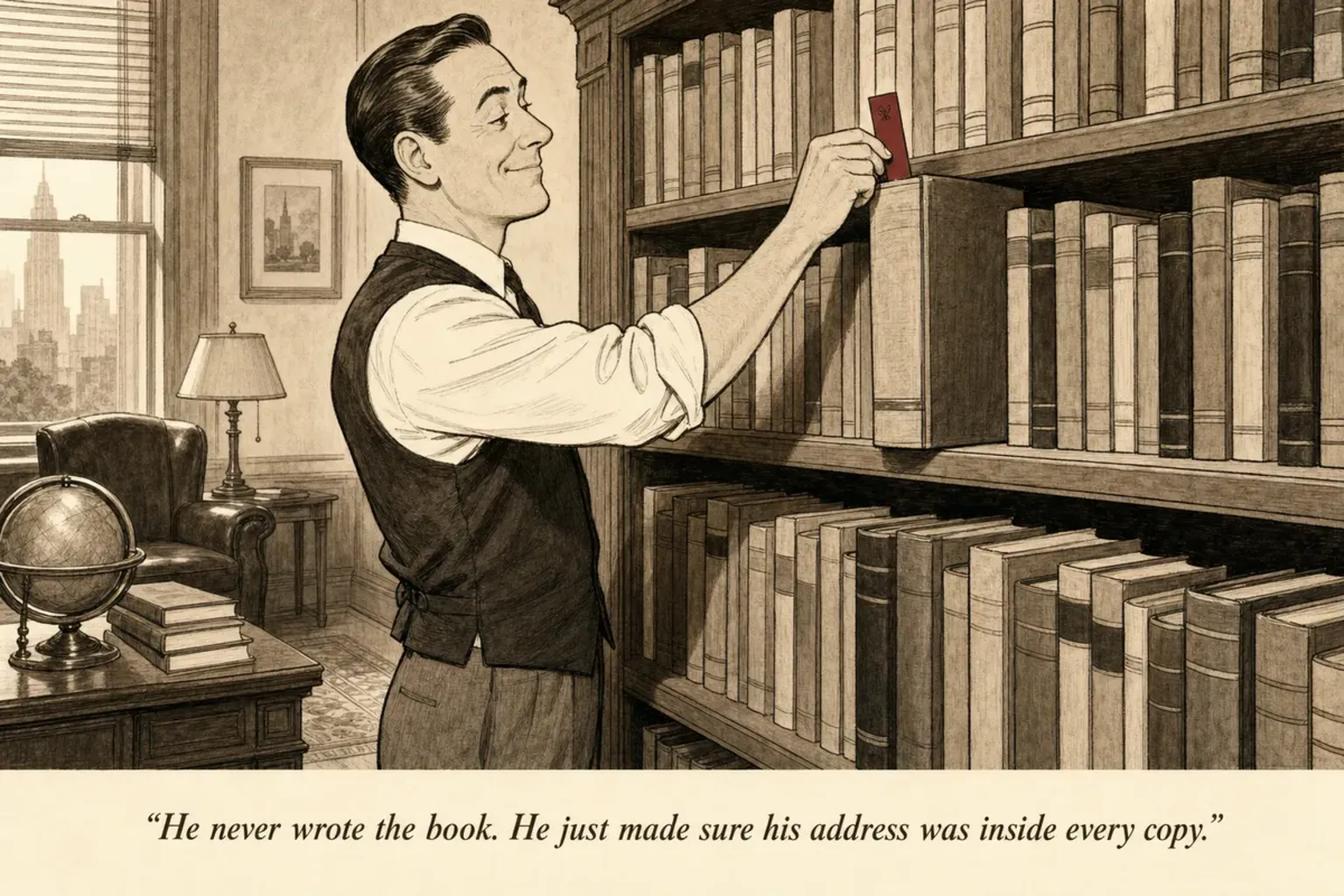
The Bounded Market
The insertable surface expands “partner” beyond creators to include published assets. The bounded market expands it further — to geography itself.
A neighborhood of twelve hundred homes in a mid-size city is a toll position waiting to happen. Not because the homes need a landing page — because they need gutter cleaning, dryer vent service, pest control, window washing, power washing, HVAC maintenance, and tree trimming. Eight thousand service events per year, flowing through dozens of uncoordinated vendors with no vetting, no volume pricing, and no one owning the relationship.
The operator’s intervention: aggregate demand from the bounded market, vet vendors, negotiate volume pricing in exchange for guaranteed route-dense work, and manage the recurring calendar. The homeowner gets vetted providers at a discount. The vendor gets guaranteed volume without Google Ads spend. The operator keeps the relationship, the data, and the margin — without owning a single truck.
The bounded market has a structural advantage no online position can match: the total addressable market is knowable on day one. Public property records — every county appraisal district publishes them — give you every address, owner name, home age, square footage, and assessed value before you spend a dollar on marketing. Twelve hundred parcels isn’t a guess. It’s twelve hundred rows in a spreadsheet.
The defensibility is geographic density. Once you own the relationships in a twelve-hundred-home neighborhood, a competitor can’t replicate the position without door-knocking the same twelve hundred homes. And you’re already inside.
The cold start follows the same Flipped JV logic from this chapter: lead with work, not asks. A free home maintenance safety checklist mailed to every address. A reflective curb-address painting offered door-to-door. Becoming the helpful neighbor on Nextdoor who answers “who do you recommend for [service]?” with vetted vendors for three months before launching anything formal. Build the reputation first. The membership pitch comes after trust, not before.
The math at modest scale: fifteen percent penetration in a twelve-hundred-home neighborhood is a hundred and eighty members. At fifty dollars per month average across a staggered service calendar, that’s nine thousand dollars per month — on a platform that runs on the same fifteen-dollar stack, with zero trucks, zero employees, and zero equipment.
The Pattern Library appendix has the Neighborhood Toll Position Launch Checklist.
The Operator’s Eye
Everything in this chapter so far assumes you’re looking for a creator — someone with an audience, a content surface, dead clicks you can monetize. That’s the standard playbook. But the operator’s eye sees toll positions that don’t require a creator at all.
I was standing in a rental car return lot at Lihue airport at quarter to five in the morning. Flight at 6:15. Three-leg day — Lihue to Honolulu to Las Vegas to Austin, arriving at 11:45 PM. The rental counter was closed. Ten cars idling in the dark, families on the curb, everyone doing the mental math on whether they’d make their flight.
Everyone in that lot saw a problem. A few probably thought, someone should start a valet service. Take the keys, return the car after the counter opens, charge $40. That’s the entrepreneur’s eye — and it’s a valid business.
The operator’s eye saw something different. The night before, in a cottage at Poipu Beach, someone Googled “Lihue airport rental car return early morning.” Try that search right now. Forum posts from 2019. A Reddit thread. No useful answer. Nobody owns the page.
That’s a demand-capture asset with zero competition. The search intent is real — every early-departure traveler at every resort airport has this anxiety. The fulfillment is trivial — one local person with a valid license who wants $40 before breakfast. The scale is programmatic — the same page template works for Kahului, Kona, Key West, Jackson Hole, Bozeman, St. Thomas.
The operator’s eye is the skill of seeing friction and translating it into a search query. Seeing a search query with bad results and recognizing it as empty digital real estate. Seeing one airport and immediately seeing thirty.
You develop this eye the same way Dorothea Lange learned to see photographs — by looking at the same world everyone else sees and noticing the gaps. Every friction point in your daily life has a search query attached to it. Most of those queries have poor results. Each one is a potential page.
You don’t need a creator to build your first position. You might just need a parking lot and a phone.
Next Friday: The entire toll position infrastructure runs on fifteen dollars a month.
Partner
Want to find better partners?
This article explored the partner dimension. The newsletter delivers qualification frameworks and outreach patterns weekly.
Unsubscribe in one click. Useful operator material only. Promotions, sponsors, and partner links will be disclosed.