Reader kit
The Un-Founder
An Operator's Playbook for Dormant Assets
The book's checklists and figures, set up to print and keep beside you while you work: what to look for before you contact an owner, what to confirm before money moves, and what to do in the first thirty days after you take over. Everything here is already in the book. This page just puts it on paper.
This page is for readers of the book. It's free, and you don't need to sign up to use it.
In the kit
- The Guardrails Checklist (Appendix C, its own printable page)
- The five-signal score (Appendix A, with an interactive scorer)
- The four-question triage (Chapter 4)
- The ownership ladder and the control ladder (Chapters 3 and 16)
- What actually transfers (Chapter 14)
- The Title Checklist (Appendix B)
- The thirty-day revival (Chapter 18)
- Rules change (dated note)
Each worksheet has its own print button. The book's disclaimer applies to all of it: nothing here is legal, tax, investment or financial advice.
Appendix C
The Guardrails Checklist
The book's working positions in one place, to run at every stage of a deal: the lines that don't move, then before you contact an owner, before an offer, before an option or lease, before money moves, the first thirty days, while you hold it, and when you sell or let it go. If the answer to any question is "no" or "I'm not sure," stop until you've sorted it out.
The Un-Founder · Appendix A
The five-signal score
A dormant property is one whose owner has stopped investing while the asset still shows signs of life. A dead property has lost the life too. Score each signal from 0 to 4, using only what's public. The total, out of 20, suggests what to do next.
Prefer to score on screen? The dormancy signals scorer adds it up as you go.
| Signal | Scores 0 | Scores 4 | Score |
|---|---|---|---|
| Owner drift | Owner active every day | Owner's attention clearly elsewhere; nothing from them in three months or more | |
| Signs of life | No audience activity in 30 days | Activity held steady, or grew, in the owner's absence | |
| Untouched revenue | Several revenue paths already running | Never monetized, and the audience is one sponsors already pay to reach | |
| Personality vacuum | The audience follows the owner's voice | The property runs on its own; a new steward would read as an improvement | |
| Price realism | The owner wants a fantasy number | The owner wants relief or good hands and is open to a fair structure | |
| Total | out of 20 | ||
What the total suggests
- 16–20: verify the numbers and make an approach this week.
- 11–15: rent the corner or run a test send before you talk price (Chapter 16).
- 6–10: add it to the pipeline file and rescore in two months. Drift compounds.
- 0–5: skip it.
Two combinations override the total
- Owner drift at 4 with signs of life at 0 means dead, not dormant.
- A personality vacuum at 0 means the audience follows the person, so partner with the founder instead of buying.
Everything here is observable without logging in to anything you don't own. Read what's public, then ask the owner. Every signal is a starting point: the real numbers come from the source systems, verified live with the owner's permission, and from the platform's terms, read at the time of the deal.
The Un-Founder · Chapter 4
The four-question triage
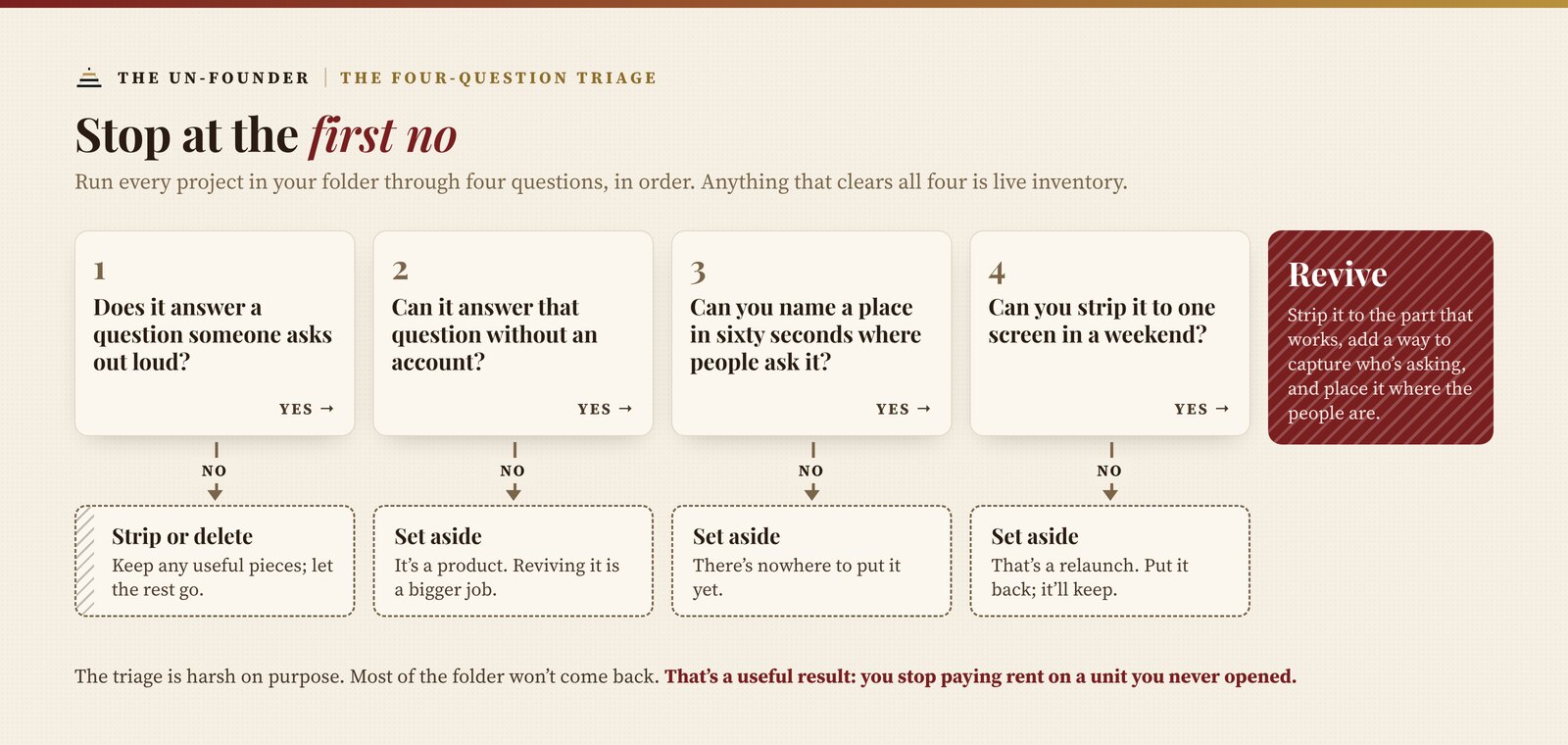
For your own folder of shelved projects, the cheapest dormant assets there are. Run every item through four questions, in order. Stop at the first no.
- 1. Does it answer a question someone asks out loud? What's the question, in the person's own words? If you can't write the question, it fails here, and most of the folder will.
- 2. Can it answer that question without an account? If the value depends on stored history, a team or constant syncing, it's a product, and reviving a product is a bigger job. Set it aside rather than deleting it.
- 3. Can you name a specific place in sixty seconds where people already ask that question? Not a category like "freelancers." A particular newsletter, community, channel or business. If you can't name one, there's nowhere to put it yet.
- 4. Can you strip it to one screen in a weekend? If reviving it would take a month, you're relaunching, not reviving. Put it back. It'll keep.
Revive, strip or delete
| Revive | It cleared the triage. Strip it down to the part that does the work, add a way to capture who's asking, and place it where the people are, with the host's agreement. |
|---|---|
| Strip | It failed as a product, but pieces of it are valuable: a clever function, a dataset, a sequence that converted, a checklist. Pull those into your buried catalog and let the rest go. |
| Delete | It answers a question only you ever had. Cancel the domain renewal and close the folder for good. |
Before you revive, repackage or license anything built for a client or an employer, confirm who owns it. If the contract is unclear, ask the client or a lawyer. Buried know-how is yours to reuse; the client's data, customer lists and confidential details inside it are not.
The Un-Founder · Chapters 3 and 16
The ownership ladder and the control ladder
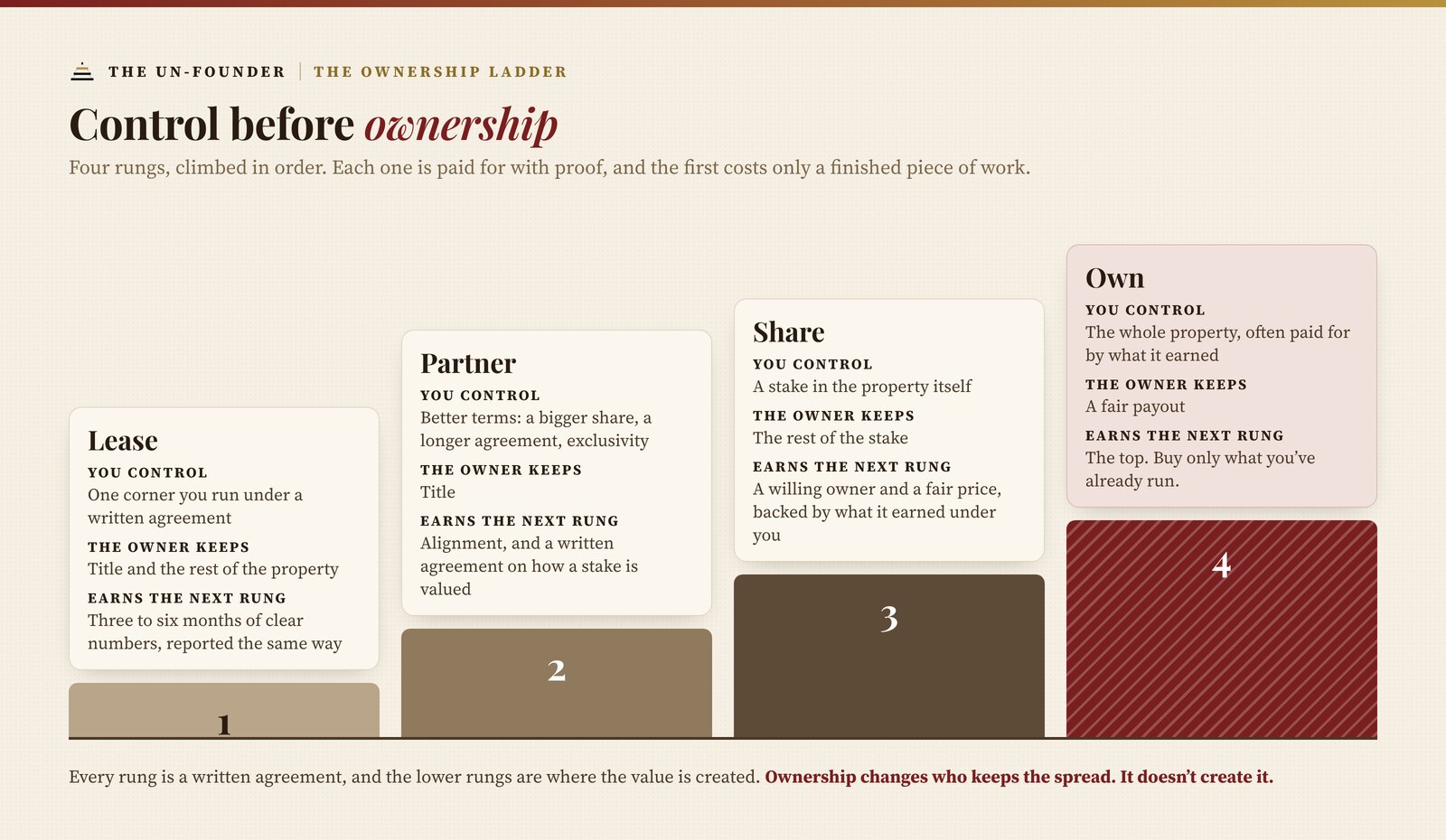
Control before ownership. Each rung of the ownership ladder pays for the next, and the price of each step is proof.
What earns the next rung
- Nothing to lease: a finished piece of work. An audit of the owner's archive, a diagnosis of what their community is missing, a specific plan for one corner of the property.
- Lease to partner: results in writing. Three to six months of clear numbers, reported the same way every month.
- Partner to share: alignment, and a written agreement on how a stake is valued and what happens if either of you wants out. This is where a lawyer stops being optional.
- Share to own: a willing owner and a fair price, backed by what the property has earned under you.
Four ways to get control without owning
Lightest to heaviest. Whenever the price is bigger than what the property has proven it can earn, rent the corner first.
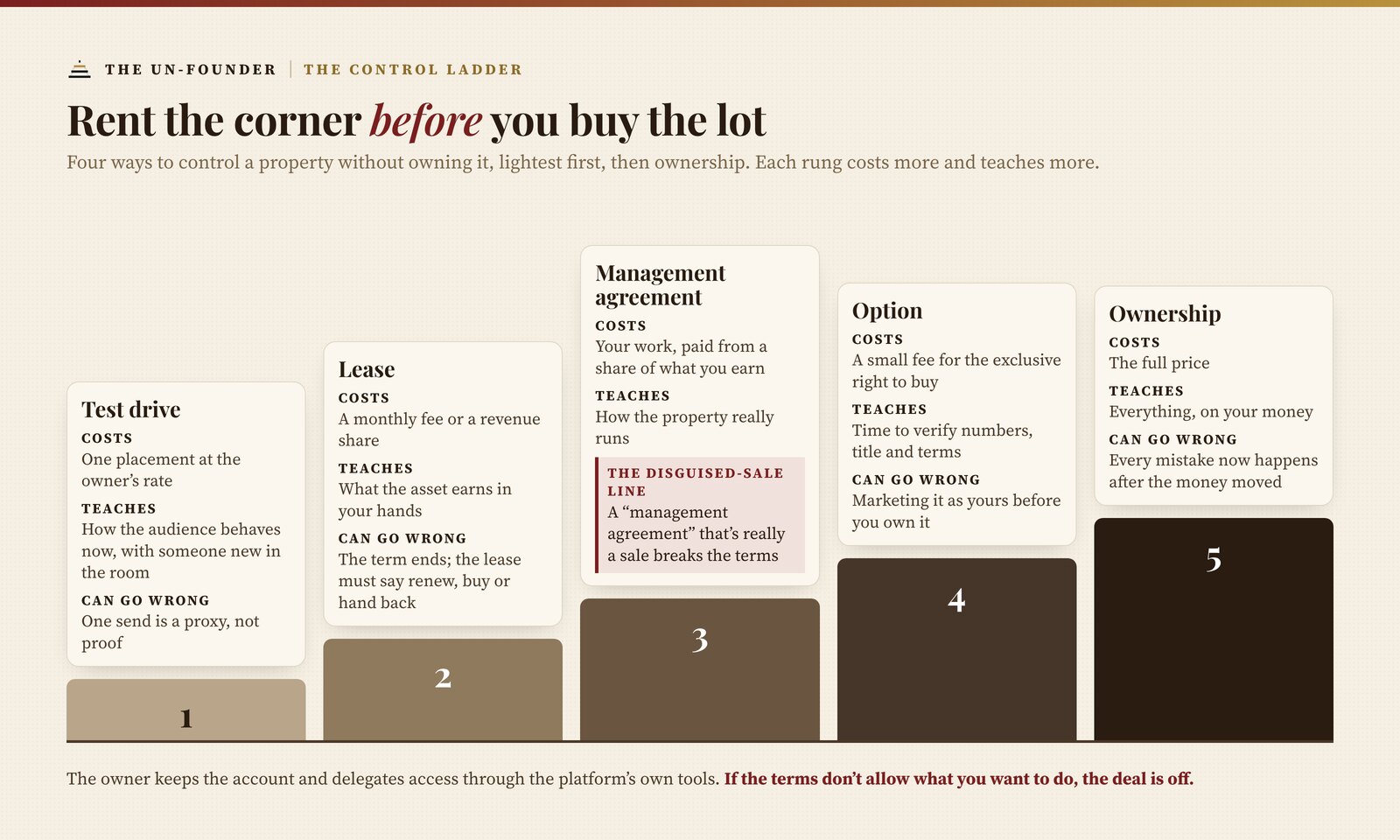
Every rung is a written agreement, and every rung has its own legal questions. Have a lawyer draft the agreement at each rung you reach, and never let a handshake stand in for one. An option or letter of intent should state the price, the period, the fee, the conditions, whether the fee counts toward the price, and whether you can assign it.
The Un-Founder · Chapter 14
What actually transfers
The owner thinks of it as one thing. In practice it's a bundle, and each part has its own owner, its own rules and its own way of changing hands. Some parts can't change hands at all. Write down every piece separately.
- Accounts on platforms: a video channel, a newsletter publication, a community space, a store listing, a social profile.
- A domain name, and the email addresses and DNS records that depend on it. Check the registrar's transfer process, authorization codes and lock periods before you set a closing date.
- Content: videos, articles, courses, images, recordings, templates.
- Brand: the name, the logo, any trademarks, registered or not.
- Code, if it's software, plus everything the code depends on.
- People data: subscribers, members, customers, users, and whatever the owner knows about them.
- Contracts and obligations: sponsors owed placements, customers owed access, affiliates owed commissions, vendors owed money.
- Money: balances on the platform, pending payouts, refunds that might still be claimed.
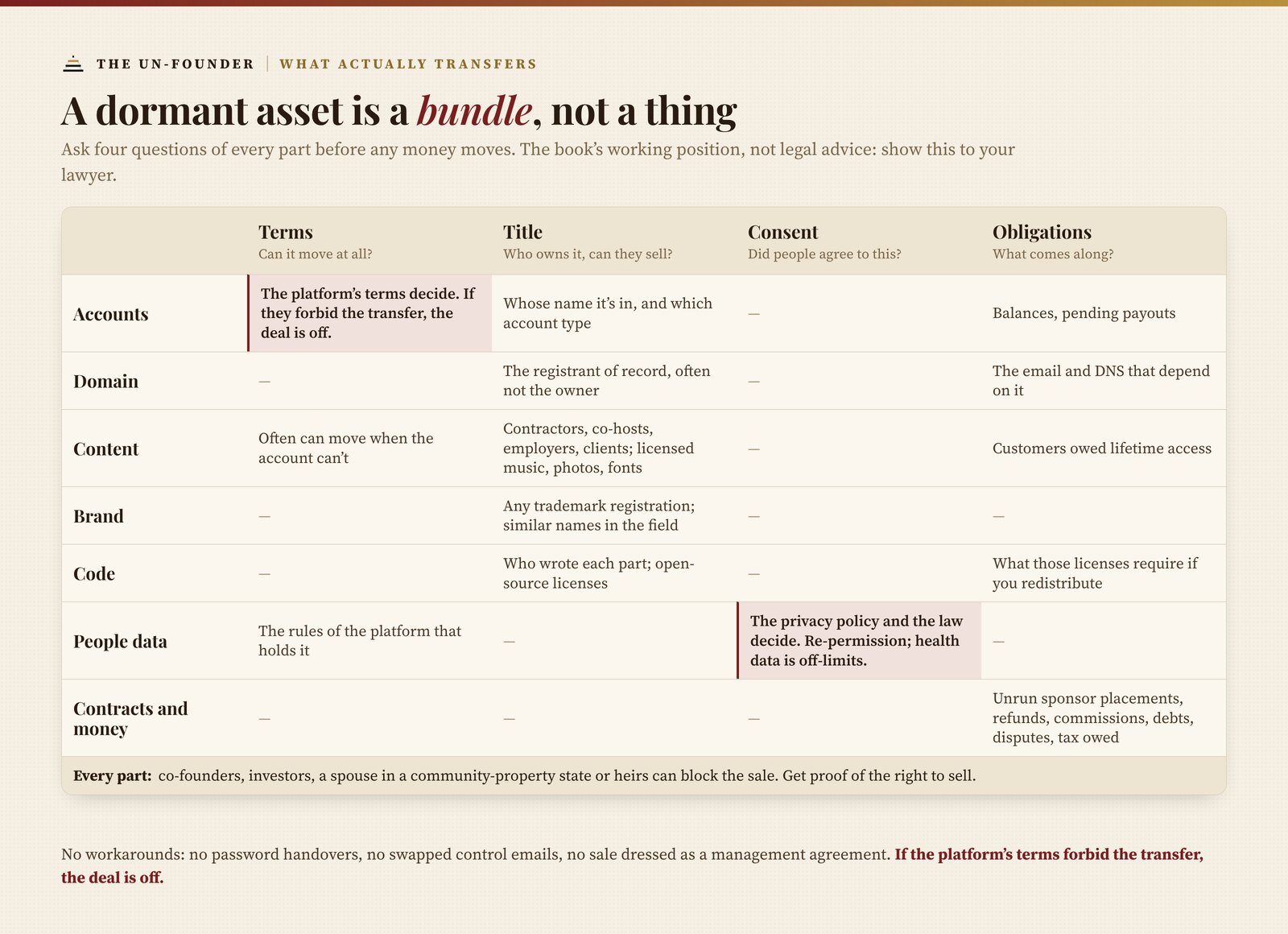
If the transfer would violate the platform's terms, the deal is off. No handing over a password, no swapping the email address that controls the account, no "management agreement" that is really a sale in disguise. When the account can't move, the content often can. This is the author's working position, not legal advice; have a lawyer review the property, the terms and the purchase agreement before any money moves.
The Un-Founder · Appendix B
The Title Checklist
Not legal advice, and not a form. This checklist gathers what Chapter 14 argues you must confirm before money moves. It's a list of questions for you and your lawyer, not a contract or a substitute for one. Have a lawyer licensed in your state draft the option, letter of intent and purchase agreement for any deal that matters to you. The book is written for readers in the United States; elsewhere, the questions apply but the answers may differ.
Work through it before you sign an option, again before you sign a purchase agreement, and a final time before escrow releases the money. If any answer is "no" or "I'm not sure," stop until it's resolved.
Can this be transferred at all?
- Have I read the platform's current terms for this kind of account, channel, group, list, store listing or domain, on the day of the deal, and saved a copy with the date?
- Do those terms allow a change of ownership? Some forbid it outright. Some allow it only for organization or brand accounts. Some have their own transfer process.
- Will the transfer happen through the platform's own tools, in the way the terms describe?
- If the terms don't allow what I want to do, have I walked away rather than looking for a way around them? No shared passwords, no "management agreement" that is really a sale, no handing over the email address that controls the account.
Does the seller own it and have the right to sell?
- Who is the registrant of record for every domain involved?
- Who owns the content: the words, videos, images, courses and code? Did the seller create all of it, or did employees, contractors, guest writers or a former employer create some of it?
- Who owns the trademarks, including the property's name and logo?
- Are there co-owners, business partners, investors or heirs whose agreement is needed? (See Chapter 14.)
- Is any of it held by a company, and does the person selling have authority to sell on the company's behalf?
- For physical goods: does a lender hold a lien on them, and is a bankruptcy trustee or a court involved?
- Has the seller shown proof of ownership and the right to sell, not just said so?
What comes with it that isn't the asset?
- Is any content, code, music, font or image licensed from someone else? Do those licenses transfer to a new owner?
- For software, what are the licenses of every dependency, and do they place obligations on me if I distribute it?
- Are there open sponsor commitments, prepaid placements or promised deliverables I would inherit?
- Are there refund obligations, subscriber prepayments, lifetime-access promises or support promises?
- Are there debts, liens or claims against the asset or the seller's business?
- Is there any dispute, takedown notice or platform strike on record?
- What's the property's reputation history: refund fights, public complaints, the tone of the last year of comments?
- For domains: what are the registrar's transfer steps, authorization codes and lock periods, and do they fit the closing date?
What about the people in it?
- For an email list: what did subscribers agree to when they signed up, and does the privacy policy allow the list to change hands? Is my plan to have the original sender introduce me and let subscribers choose to stay?
- For a community: what member data would I hold, and do the platform's terms and the privacy policy allow it?
- For software: what user data does the product hold, and what security obligations come with it?
- Do any of the people involved live in places with stricter privacy laws (the EU, the UK, California and others)? If so, has a professional reviewed the plan?
- For a book of business: does the field require a license, and do clients have to consent to any transfer? Is there any health information involved? (If so, stop.)
Are the numbers real?
- Have I seen the audience, traffic and revenue numbers live in the source systems, not in screenshots?
- Did I choose the date ranges myself?
- Are the key numbers written into the purchase agreement as the seller's representations, with a remedy if they're false?
How does the money move?
- Is the purchase price, schedule and any earn-out or seller financing written into an agreement a lawyer drafted?
- Is the closing payment held in escrow until I confirm I have control?
- If I'm using sponsor pre-sales, are they real placements with refunds or make-goods if the deal doesn't close, and has the seller consented to any placements sold into their audience before closing?
- Am I raising money from anyone who expects a return? If so, have I talked to a securities lawyer first? (Chapter 17.)
- Have I talked to a tax adviser about how the price is allocated and how I'll account for it?
After closing
- Do I have control of every login, domain, repository and payment setting, in my name, through the platform's own tools?
- Have I backed up everything I'm entitled to keep?
- Have I told the audience about the change (Chapter 18)?
- Have I kept a dated file of the terms I relied on, the seller's proof of ownership, the agreement and the escrow records?
The Un-Founder · Chapter 18
The thirty-day revival
One shape fits most properties. Adjust the days to the asset. The order matters, because some steps protect the others: back it up, fix what's broken, repair the sending reputation, tell people what changed, ship the first new thing, then measure how they respond.
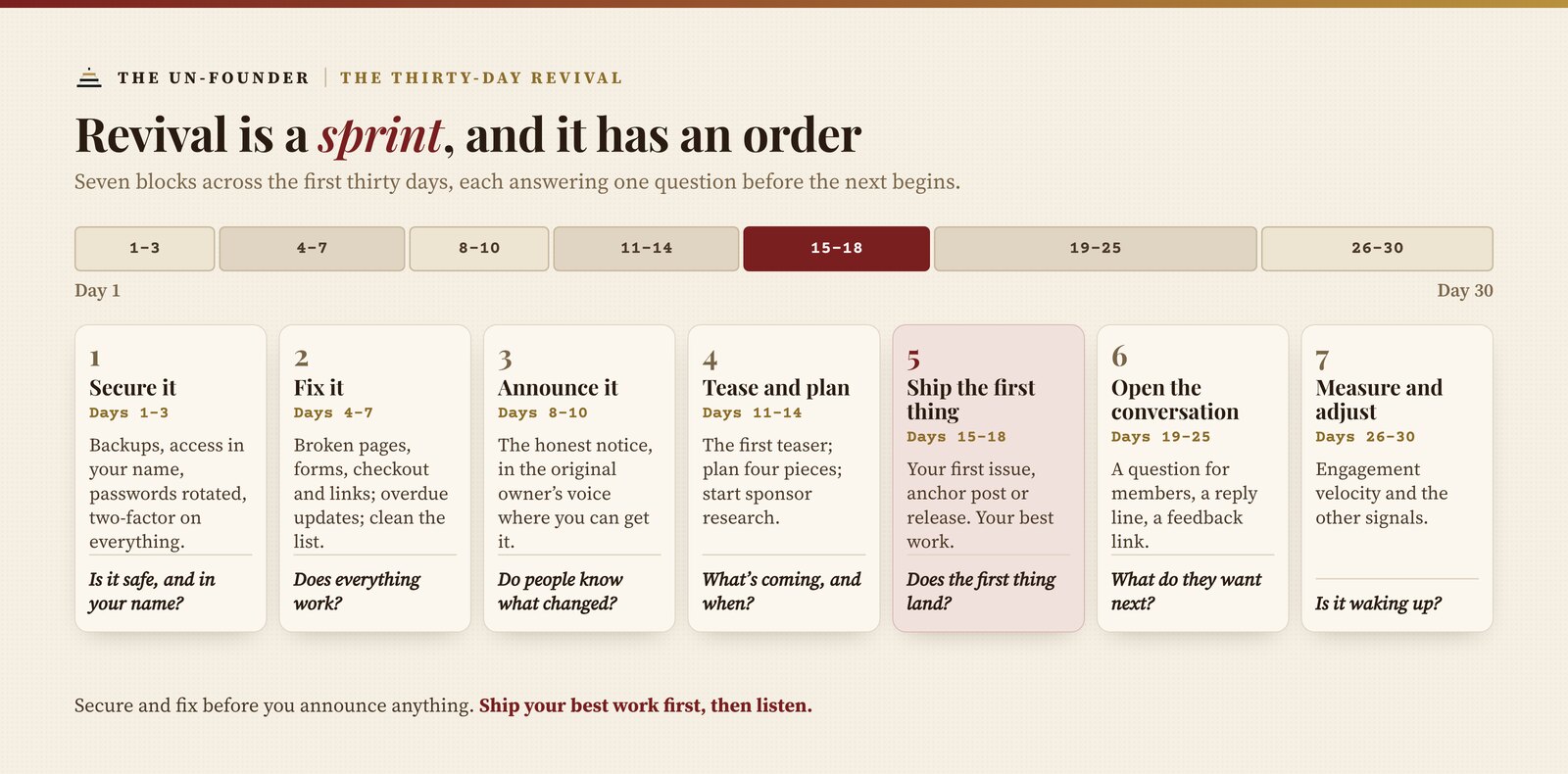
- Days 1–3: secure it. Backups. Access in your name through the platform's own tools. Passwords rotated. Two-factor on everything. Payment settings checked.
- Days 4–7: fix it. Broken pages, broken forms, broken checkout, dead links, overdue security updates. Clean the list. Review moderation settings in the community.
- Days 8–10: announce it. The honest notice, in the original owner's voice where you can get it.
- Days 11–14: tease and plan. First teaser. Plan the first four pieces of new content. Start sponsor research if the property carries sponsors.
- Days 15–18: ship the first thing. Your first issue, your first anchor post, your first release. Your best work.
- Days 19–25: open the conversation. A question for members, a reply-to-this line in the newsletter, a feedback link in the software. Listen for what they want next.
- Days 26–30: measure and adjust. Decide whether the property is waking up.
Is it waking up?
| Engagement velocity | New interactions in a week (replies, comments, posts, reactions, clicks) divided by the number of people you can actually reach. The mini-magazine article on tollstack.dev uses five percent as its line for the first two weeks. |
|---|---|
| Retained share | For re-permissioned lists, what fraction chose to stay. For communities, how many previously silent members came back at least once. For software, whether active users held steady through the update. |
If day thirty looks bad, ask
- Was it the property or the timing? If rival newsletters, forums and channels in the same space are quiet too, the audience isn't coming back for anyone.
- Was it the voice? If the audience wants the person, not the property, a partnership with the founder, a guest column or a slower handover can sometimes rescue it.
- Was it the promise? If the first piece missed, the fix is in the next four weeks. Ask them.
The people in a list, a community or a user base signed up with the old owner. Tell them about the change before you use their attention for anything new. For someone else's list, the original sender introduces you and gives subscribers a clear choice to stay or leave, and you mail only the people who stay. Sponsors come after you've shipped something good, not before.
Rules change · Last reviewed 25 October 2026
Platform terms and the law move
The book tells you to read a platform's current terms on the day of the deal and save a dated copy, because those terms change. So do the rules the book sends to a lawyer: privacy and anti-spam law for lists and member data, what a copyright transfer has to say, securities law for anyone raising money to buy, and licensing and client consent for books of business. For domains, check the registrar's current transfer steps and lock periods before you set a closing date.
This page doesn't track those changes for you, and nothing on it is legal advice. It's a reminder that terms you read last year aren't the terms in force today. Before any deal, read the current terms yourself and confirm the current rules with a lawyer licensed in your state.
When a change affects something the book says, we'll note it here with the date.
Kit updates
Get updates to the kit and the rules note, and hear when the next book is out. The kit stays free here either way, and the book is complete without it.
Signup opens soon.