Reader kit
The Un-Landlord
An Off-Hours Operator's Playbook
The book's worksheets and figures, set up to print and keep beside you while you fill the empty hours in buildings other people own: how to count a space's week, screen renters, price from the owner's bill, clear the lease and the permits, assemble the packet, run a trial and keep the calendar honest. Everything here is already in the book. This page just puts it on paper.
This page is for readers of the book. It's free, and you don't need to sign up to use it.
In the kit
- The Guardrails Checklist (Appendix B, its own printable page)
- The idle hours audit (Chapter 2 and Appendix A)
- The renter-fit questions and the screen (Chapter 3 and Appendix A)
- The three numbers (Chapter 4 and Appendix A)
- The five checks and the clear-to-ask sheet (Chapter 5)
- The packet and the nine questions (Chapter 6)
- The thirty-day trial tally (Chapter 7)
- The booking report and the owner agreement (Chapter 8)
- Changeovers, shelves and who gets the hour (Chapter 9)
- The card by the light switch and the incident log (Chapter 10)
- Who decides, room by room (Chapter 11)
- The weekly rhythm and the concentration rule (Chapter 14)
- Rules change (dated note)
Each worksheet has its own print button. The book's disclaimer applies to all of it: nothing here is legal, tax, accounting, insurance, investment or financial advice, and every number in the figures is an illustration, not a result or a forecast. Every building in the book belongs to someone else.
Appendix B
The Guardrails Checklist
The book's working positions in one place, to run at each stage of an arrangement: the lines that don't move, and what to check before you ask an owner, before the first renter, every month, and when an arrangement ends. If the answer to any question is "no" or "I'm not sure," stop until you've sorted it out.
The Un-Landlord · Chapter 2 · Appendix A
The idle hours audit
A pencil exercise that answers one question for one owner: how many hours of this space could a renter use, lawfully, without the owner noticing anything except a smaller bill? Draw one grid per space, not one per business. Fill a first draft from the posted hours on the door, then sit down with the owner and let them correct it. They will.
Shade in this order, one letter per layer
| O | The owner's hours. Every hour the business is open or the space is in use for its own purpose, including the standing things that aren't on the sign, like the Wednesday supper or the Tuesday staff meeting. |
|---|---|
| P | Prep and cleanup. The hour before opening and the hour after close, at least, plus delivery windows. Ask: "Who's in the building when the sign says closed?" |
| B | Changeover buffers. A gap between the owner's hours and any renter's block, and between one renter and the next. Thirty to sixty minutes is a common working assumption; the owner and the space decide the real number. |
| M | The owner's "maybe" hours. Inventory day, the deep clean, the hood-cleaning contractor, the holiday rush, the family wedding. Far better to leave them off the calendar than to sell them and take them back. |
| X | The lawful check. Cross out anything the space can't host for this renter's use: zoning or permit conditions, noise-ordinance hours, uses the lease doesn't allow, the occupancy limit, parking, building access that ends when the landlord's doors lock. |
| A | Available. What survives all five layers. Everything else is idle, which is a different thing. |
The week, in bands
Write a band of hours on each row and a letter in each day. Use the letters, not plain shading: six months from now, when the owner asks why Saturday afternoon was never offered, you'll want the why.
| Hours | Mon | Tue | Wed | Thu | Fri | Sat | Sun |
|---|---|---|---|---|---|---|---|
From hours to blocks
- Circle every run of at least four available hours that recurs weekly. Those are your blocks. Name each one the way a renter would say it: "Tuesdays and Thursdays, four to ten."
- The renter's cleanup lives inside the block. The check-out checklist and photos happen before the block ends; the buffer comes after.
- Standing blocks first. One renter every week for three months beats the same hours sold to three strangers.
- Leave the stranded hours. A ninety-minute gap is better given back to the owner as breathing room.
- Ask about the owner's fatigue limit. How many different people a week can the owner live with in their space? Offer fewer than the answer.
| Block 1 | |
|---|---|
| Block 2 | |
| Block 3 | |
| The owner's fatigue limit |
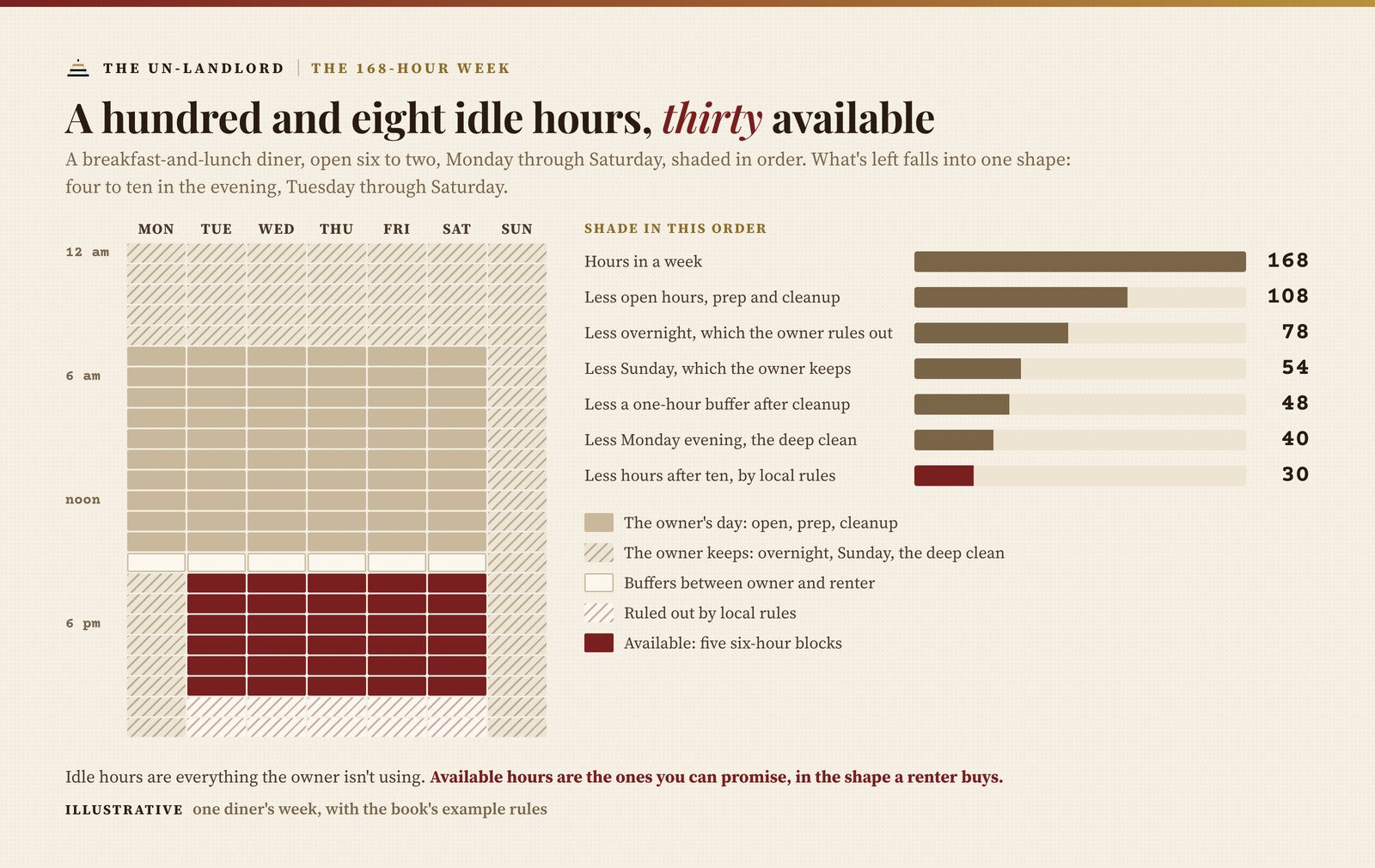
"Available" always means hours the space may lawfully be used for the renter's purpose, which only the city or county, the licensing body and the owner's lease can tell you. Call the zoning or permitting office before you count, not after you've promised anyone anything. The sidewalk shows you the dark hours; only the owner shows you the available ones.
The Un-Landlord · Chapter 3 · Appendix A
The renter-fit questions and the screen
Asked of everyone, in the same words, against the same written criteria, before a renter goes on the grid. Fit comes first and money last: a renter who needs a block the grid doesn't have, or a permit they don't hold, should hear a friendly no before anyone talks about rates.
The renter-fit questions
| What do you make or do here? | And do you earn your living from it? Livelihood renters protect the space because their income depends on it. | |
|---|---|---|
| Which block? | Is it the same every week? | |
| Which equipment? | What of the owner's do you need, and what will you bring? Anything of the owner's gets a training sign-off before first use. | |
| Permits and licenses | What do you hold for this work, and does your licensing body need anything from the host space? For food, the first call is to the health department. | |
| Insurance | Do you carry your own, and can you name the owner as an additional insured? | |
| People | How many, helpers included, will be in the space? | |
| Storage | What do you need to store, and how much room does it take? | |
| Competition | Does your work compete with the owner's trade? | |
| Worth | What's a block worth to you? This one feeds the pricing. | |
| References and walkthrough | Who can I call, and when can we walk through the space together? |
The screen, in order
- 1. Permits and licenses. Whatever their trade and their local authorities require for the work they'll do in this space. Copies on file.
- 2. Insurance. Their own general liability (and product liability where relevant), naming the owner as an additional insured. The owner's insurance agent says what limits the owner's policy and landlord require.
- 3. References. Two people who've seen them work: a kitchen they've rented before, a market manager, a gym that hired them.
- 4. A walkthrough. The renter, the operator and ideally the owner, in the space, for thirty minutes. Watch what they look at.
- 5. Fit with the space. Their block matches a circled run on the grid, and their equipment list matches what the house rules allow.
Say no to these, however good the money
- One-off parties and events.
- Anything that needs alcohol service under the owner's liquor license.
- Regulated uses the space isn't set up for.
- Renters who compete head-on with the owner, selling to the owner's own customers.
- Renters who want the owner's hours.
| Accepted or declined, and why | |
|---|---|
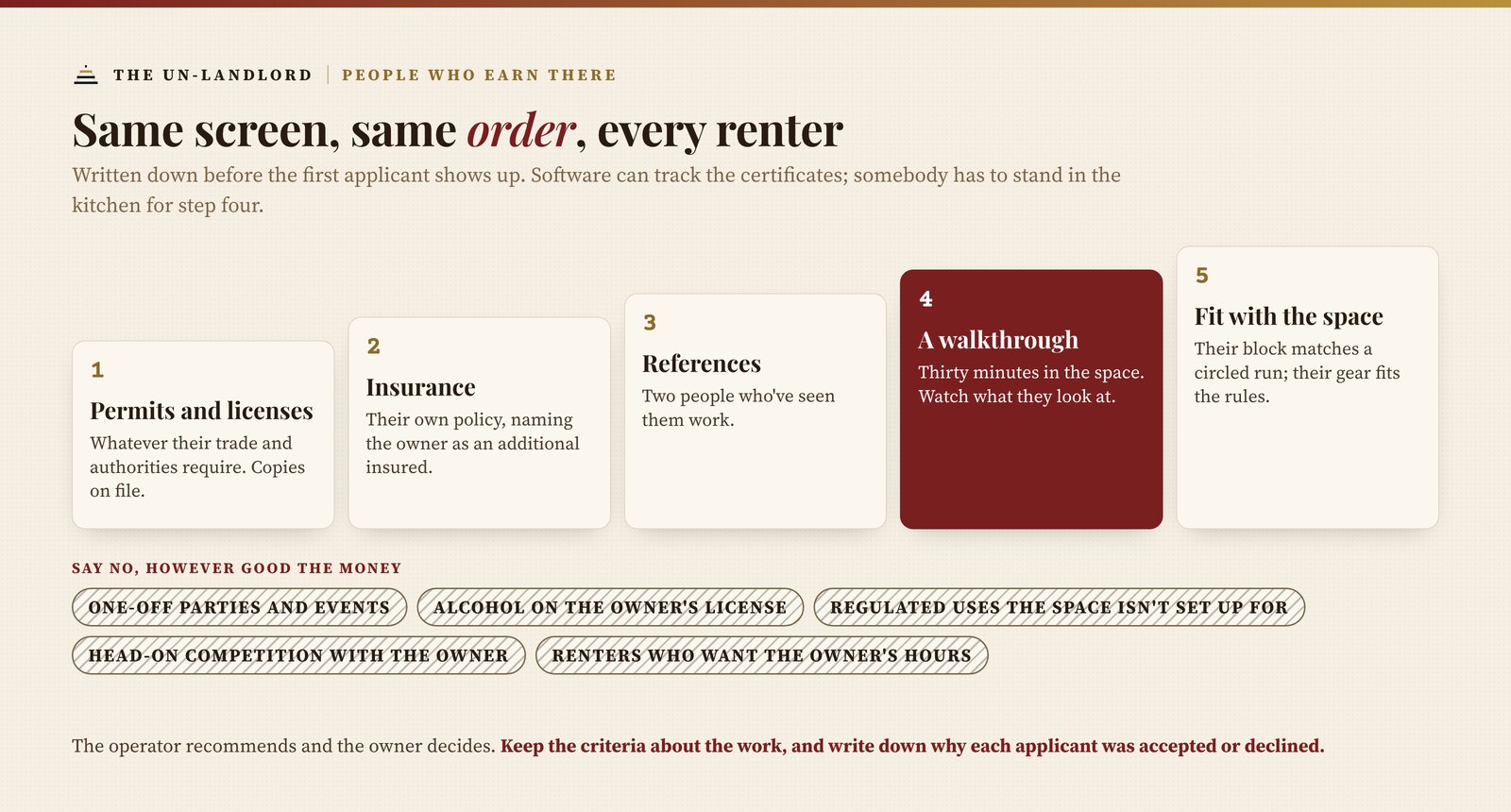
Apply the same written criteria to every applicant, and keep a short record of why each one was accepted or declined. Never screen on anything protected by civil-rights law; federal, state and local laws protect different characteristics, so ask a lawyer which apply where you work. Keep the criteria about the work. The operator recommends; the owner decides.
The Un-Landlord · Chapter 4 · Appendix A
The three numbers
Every rate has to survive three numbers at once. Start with the owner's bill and work backward to the hours you need. If no rate passes all three, walk away politely.
| 1. The owner's bill | A named monthly bill, in the owner's words: "the gas bill, about eight hundred a month." Ask for the bill, never for a rate. Ask, too, how much renters will push that bill up. | |
|---|---|---|
| 2. The renter's ceiling | What a block is worth to the renter, from their own margin. The rate has to leave them a living. | |
| 3. The local band | What comparable space rents for within a half-hour drive: posted rates, and calls to the places that don't post them. |
Work backward from the bill
| The owner's bill, a month | |
|---|---|
| ÷ the owner's share (e.g. 0.70) = monthly total | |
| ÷ 4.33 weeks = weekly total | |
| ÷ the hourly rate = hours a week | |
| Rounded up to blocks | |
| Check: under the renter's ceiling? | |
| Check: inside the local band? |
- Your share comes out of the total. The rate the renter sees is the whole price. Never add your share on top.
- Quote the block. "Six hours, Tuesday evening" at one price is easier to say yes to than an hourly rate with a calculator attached. Keep a minimum block length.
- Reward the standing booking with a small discount, checked against the bill first. Charge one-offs the full rate.
- Don't undercut the neighbors. Price inside the local band; a nearby shared kitchen is somebody's livelihood and maybe a future partner.
- Never fudge a number to make the deal close.
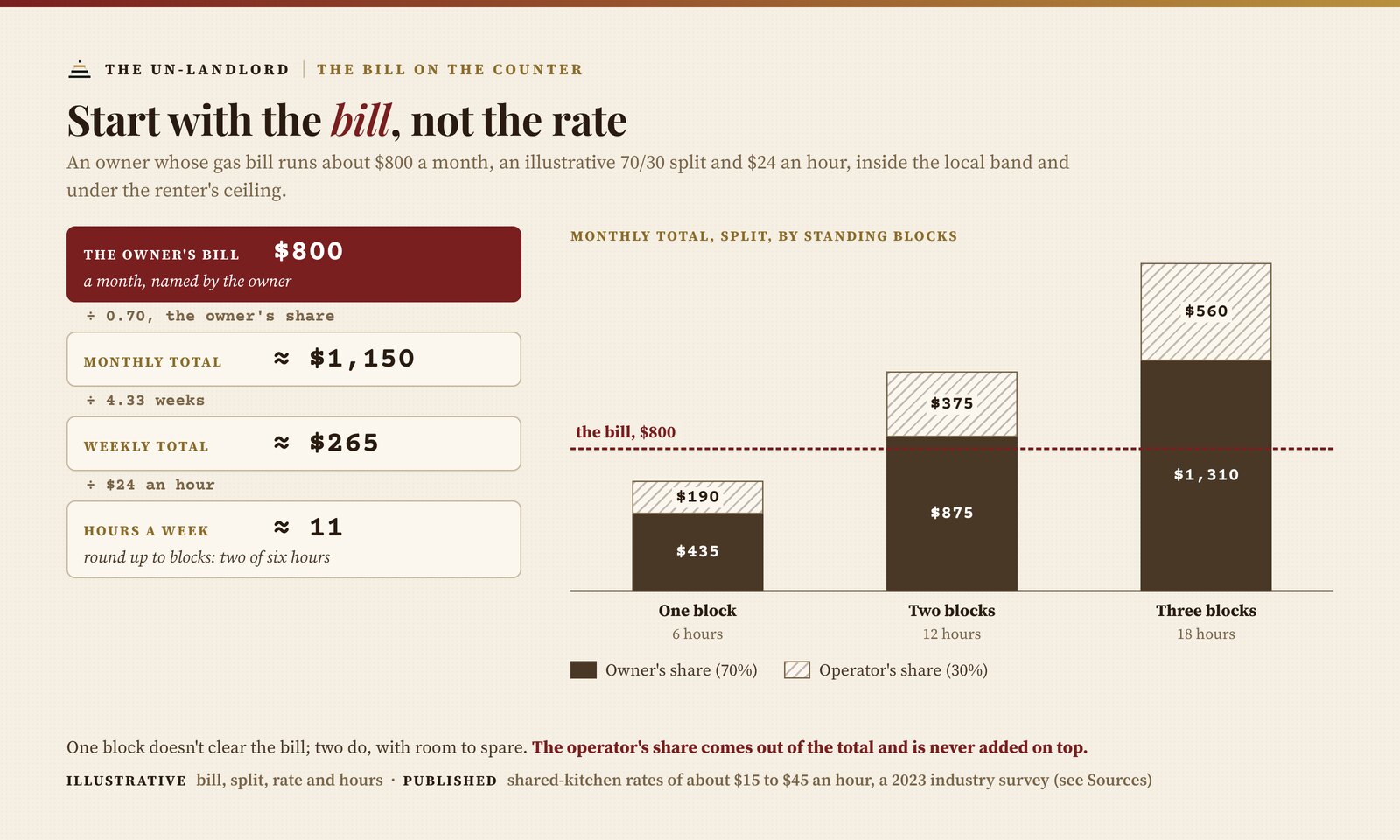
The split, the rate and the hours in the book are illustrations and a negotiation, not a standard. Some states and cities tax short-term use of space, and the rules for reporting rental income vary: the owner talks to their accountant before the first invoice goes out, and you talk to yours about the share.
The Un-Landlord · Chapter 5
The five checks and the clear-to-ask sheet
In order, each one a person to ask, before you name a single renter to the owner. Write down who you spoke to, the date and what they said. If the answer matters, ask for it in writing.
| 1. The lease | The document itself, amendments included. Assignment, subletting and licensing; the use clause; exclusives. Where consent is required, the owner asks the landlord in writing; a lawyer looks at the letter first. | |
|---|---|---|
| 2. Zoning and permitted use | The use classification, occupancy for the approved use, hours, noise and parking. | |
| 3. The licensing body | For a kitchen, the health department: what the host needs and what each renter needs. Read the dates on the hood-suppression and extinguisher tags while you're there. | |
| 4. The owner's insurance | The owner calls their agent before the first renter. Does the policy allow it? What does the agent need from renters, and at what limits? | |
| 5. The owner's other promises | A franchise agreement, a mortgage or business loan, a board or congregation, an association or a co-owner. |
The clear-to-ask sheet
| The space | Address, the owner, who owns the building | |
|---|---|---|
| The lease | Clause numbers on use, subletting and licensing; consent needed, requested, received; where it's filed | |
| Zoning | Use classification, the office, the person, the date, the answer | |
| The licensing body | Which agency, what host and renters each need, the date of the call, every inspection tag's date | |
| Insurance | The agent's name, the date the owner told them, what they require from renters | |
| Other promises | Franchise, loan, board, association: none, or what each requires | |
| Open questions | Anything only a lawyer can answer | |
| Status | Clear, clear with conditions, or stop |
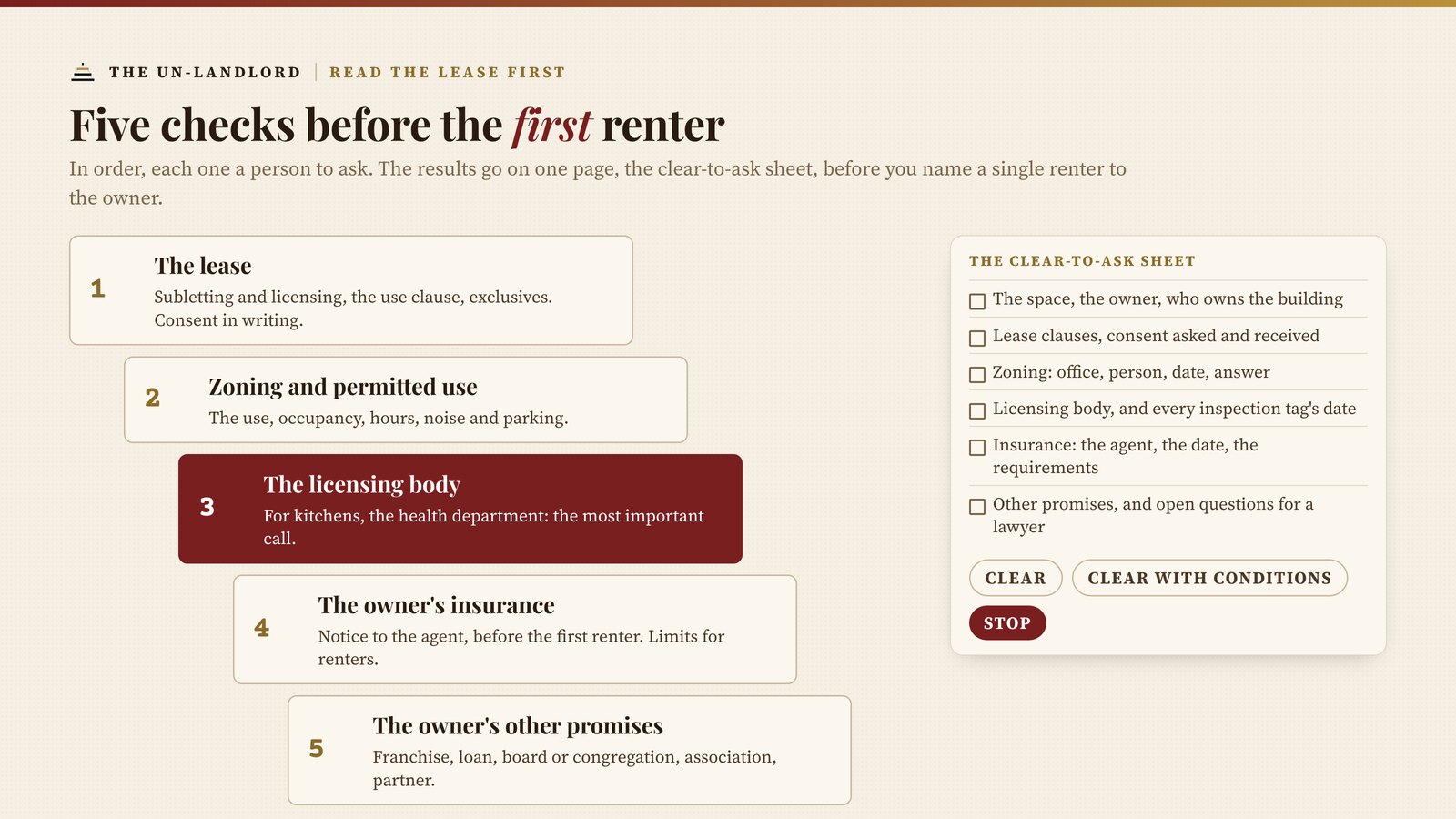
Never arrange use of a space behind a landlord's back, or in breach of a lease, a franchise agreement, a loan covenant or an association's rules. Whether an hourly or block arrangement is a license, a sublease or something else depends on the agreement's wording and the law of the state, and calling it a license doesn't settle the question. A lawyer drafts the use agreement. Update the sheet whenever anything changes: a new lease, a new agent, a new county rule.
The Un-Landlord · Chapter 6
The packet and the nine questions
The same set of documents for every renter in every space, adjusted only for what the space needs. Tick each item for each renter before the first block, trials included.
| Item | On file | Expires |
|---|---|---|
| 1. The certificate of insurance | ||
| 2. Permits and certifications, each with its expiration date | ||
| 3. The house rules (one page) | ||
| 4. Equipment sign-off and log | ||
| 5. Check-in photos | ||
| 6. The cleaning checklist and check-out photos | ||
| 7. The access protocol: personal codes, never a shared key | ||
| 8. The deposit, set in the agreement and held by the owner | ||
| 9. The incident form | ||
| 10. The renewal calendar | ||
| 11. The owner's one-page summary |
Beside the packet sits the written use agreement between the owner and each renter. A lawyer drafts it.
The house rules, on one page
- The block: when it starts, when it ends, and that the renter is out with the space reset by the end.
- Equipment, by name: what the renter may use, what they may not, and what needs training first.
- Storage: which shelf, how it's labeled, what may stay overnight.
- Noise, parking, trash and grease.
- Cameras: where they are, and the notice that says so.
- Food safety, allergens and labeling are the renter's responsibility under their own permit.
- No alcohol service under the owner's license, ever.
- Who to call: emergency services first in an emergency, then the operator, who calls the owner.
Nine questions, nine answers
| Who is he? | The screen, the permits and the references on file | |
|---|---|---|
| Is he insured? | The certificate, naming the owner | |
| What if he breaks my mixer? | The equipment sign-off, the log, the deposit, his insurance | |
| Who cleans? | The checklist and the check-out photos | |
| Who has a key? | No renter. Personal codes that expire with the block | |
| What if the inspector comes? | His permits on site, and the house rules' call list | |
| What if he leaves the walk-in open? | The checklist, the photos, the thermometer reading | |
| What if he's still here at five? | The block's end time and the code that stops working | |
| What if I want my kitchen back? | The notice terms in the agreement |
If any question on the left doesn't have an answer on the right, the packet isn't done.
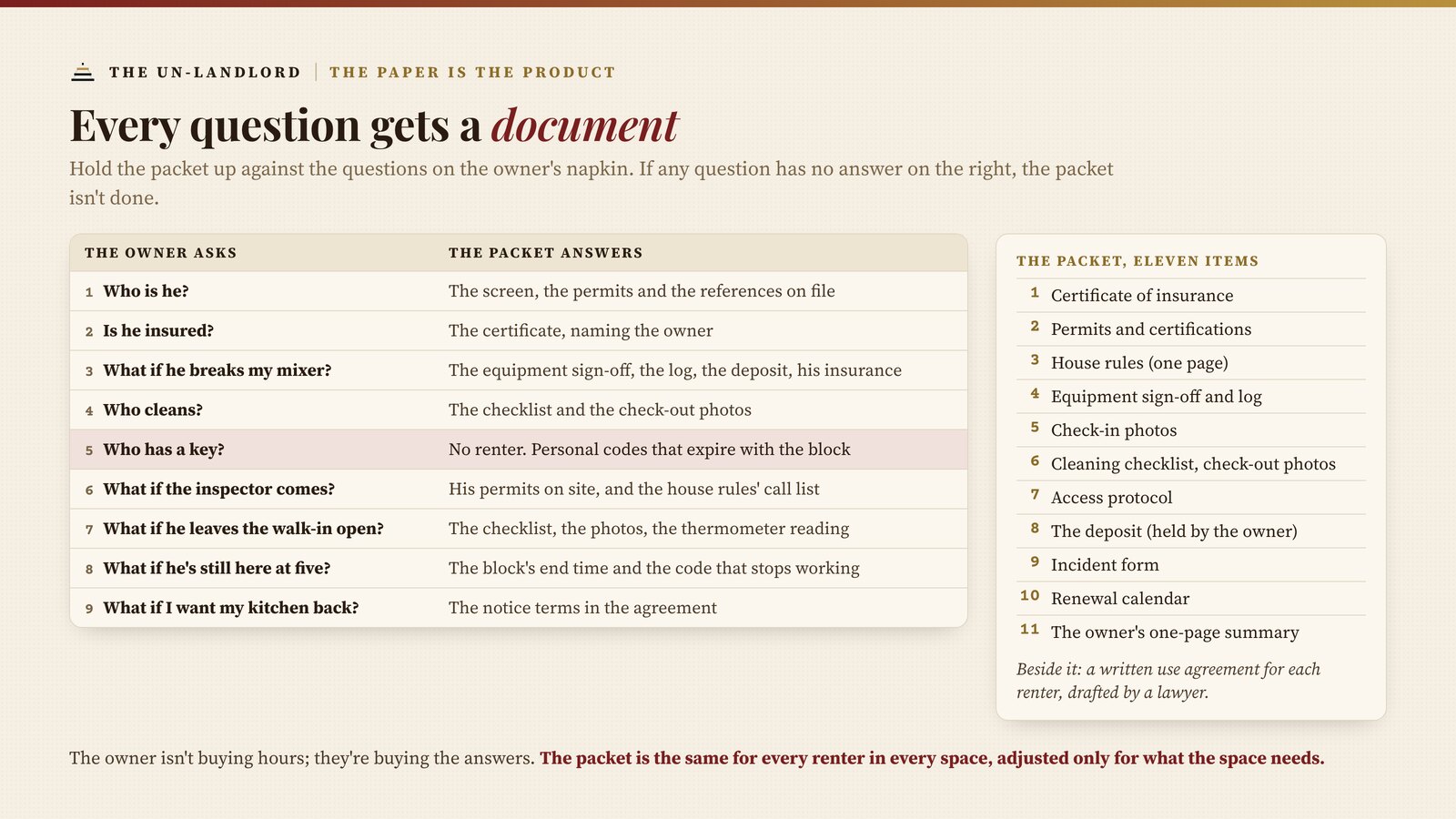
The packet items are headings with commentary, to show what each document needs to cover. They aren't forms to copy. Rules on cameras and recording vary by state and city: post notice, check the law before recording any audio, and never put a camera in a restroom or changing area. The written use agreement is drafted by a lawyer licensed where the space is.
The Un-Landlord · Chapter 7
The thirty-day trial tally
One renter, one or two standing blocks, thirty days, a written start and end date, the full packet, the real rate, and the review booked before the first block. Count as you go: one line per block. A tally kept after each block is evidence; a tally reconstructed from memory is a story.
| Start date | End date | ||
|---|---|---|---|
| Review date and time | Standing block |
| Block | Booked / used, on time? | Check-out score | Incidents | Owner's words | Renter's words | From outside | Paid on time? |
|---|---|---|---|---|---|---|---|
The review: thirty minutes, at the owner's place
- Owner, renter and operator at the same table, with the tally in front of everyone.
- The owner speaks first. Then the page, line by line, without commentary. Then the renter. Then the fixes.
- Did the owner's share make a real dent in the bill they named?
- Five minutes alone with the owner before the meeting ends.
- Don't sell. If you find yourself arguing for a yes, the trial has already given you its answer.
The answer, in writing
| Stop | An acceptable result. Why: the renter, the space, the block or the price? | |
|---|---|---|
| Continue as is | The fixes folded in; the agreement's notice terms take over; the next review set a few months out. | |
| Add a second renter | Only once the first runs cleanly, on a different block, with the same packet. One change at a time. |
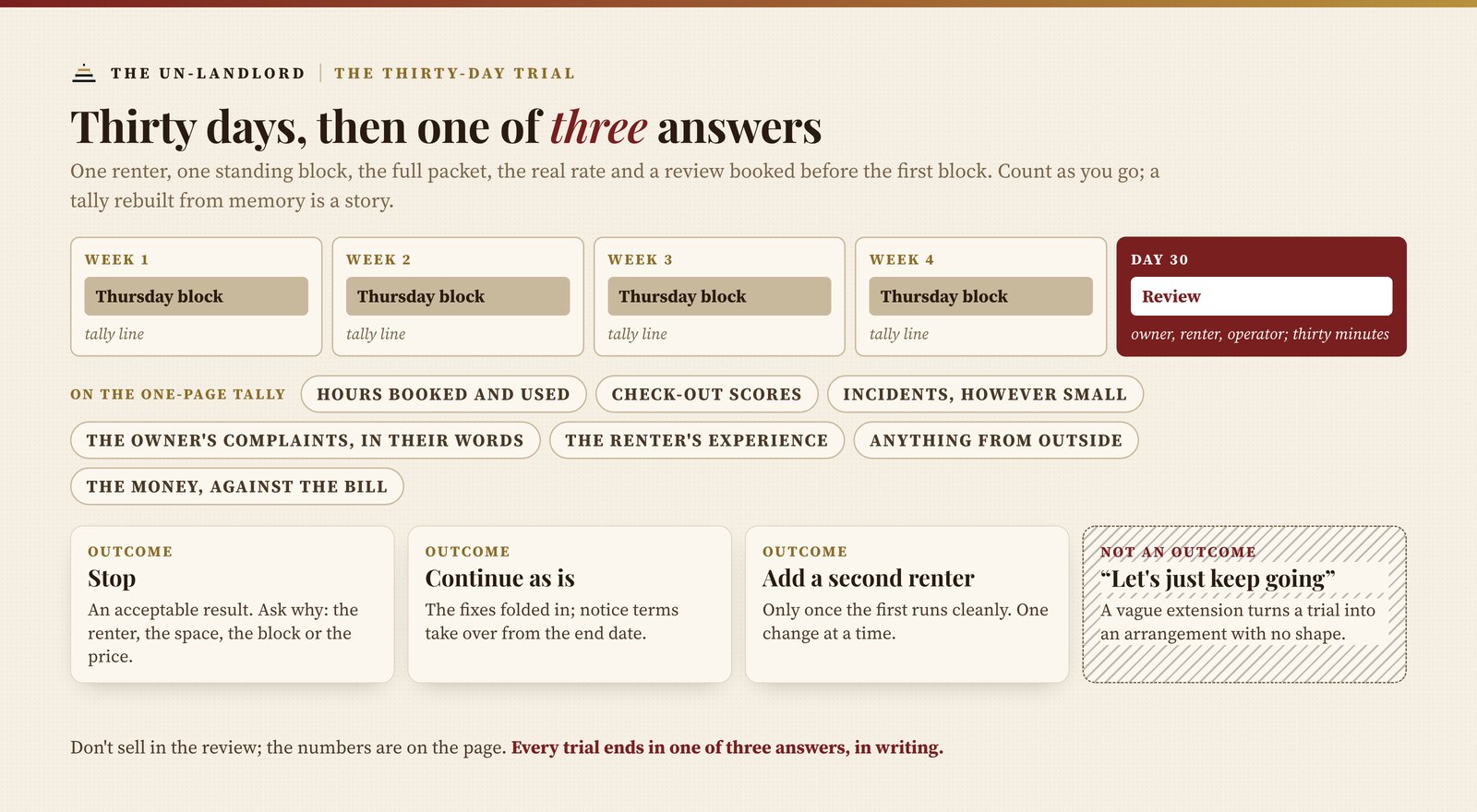
A trial is a real arrangement from the first hour. The renter's insurance and permits are on file, the owner's insurance agent has been told, the landlord's written consent is in hand where the lease requires it, and every one of the five checks is clear before the first block. Calling it a trial doesn't change what the law, the lease or the insurer expect. "Let's just keep going and see" is not an outcome.
The Un-Landlord · Chapter 8
The booking report and the owner agreement
Once a month, the calendar becomes a report. The owner sees the same report you do and checks it against their own bank statement; build it so that check takes ten minutes. Renters pay the owner directly, deposits sit with the owner, and the owner pays your share against this report.
| Date | Renter | Hours booked | Hours used | Rate | Amount due | Paid, per the owner's records |
|---|---|---|---|---|---|---|
| Cancellations and no-shows, with what the written policy says they owe | ||||||
| What renters paid the owner this month | ||||||
| The operator's share, at the agreed percentage, on what renters actually paid | ||||||
The agreement with the owner: the headings
Signed before the first renter books. The clauses are the lawyer's job.
| Your share | A percentage, stated as a number, and exactly what it's calculated on. | |
|---|---|---|
| The term | How long it runs and how it renews. | |
| Notice | How either side ends it, and how much warning each one gets. | |
| The owner's rights | The final say on every renter, their own time blocked first, and hours taken back with the stated notice. | |
| Standing bookings if you leave | Whether they carry on with the owner, move to a new operator or end, and whether your share stops on your last day or runs for a stated period. | |
| The renters | The relationship belongs to the renter. Neither of you trades them like inventory. | |
| Disclosure | Renters know an operator arranges and manages the bookings; the owner knows exactly what the operator earns. |
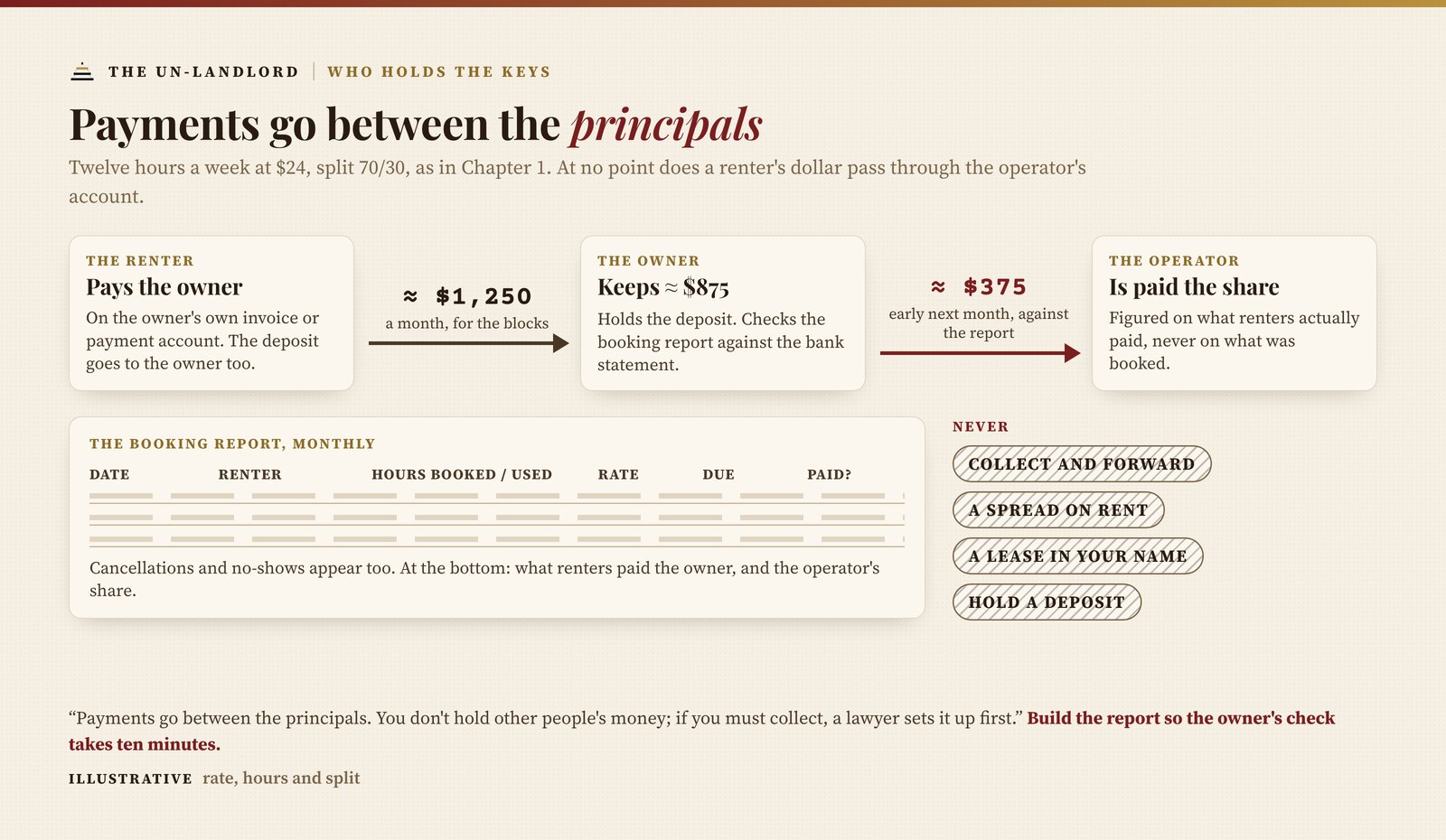
Payments go between the principals. You don't hold other people's money; if you must collect, a lawyer sets it up first. Don't keep a spread on rent the owner doesn't know about, and don't take a lease or any rent obligation in your own name. In treatment rooms and other healthcare spaces, the arrangement changes: a fixed rate for the time, and your own pay set as a flat monthly fee from the owner, reviewed by a healthcare lawyer, never a percentage.
The Un-Landlord · Chapter 9
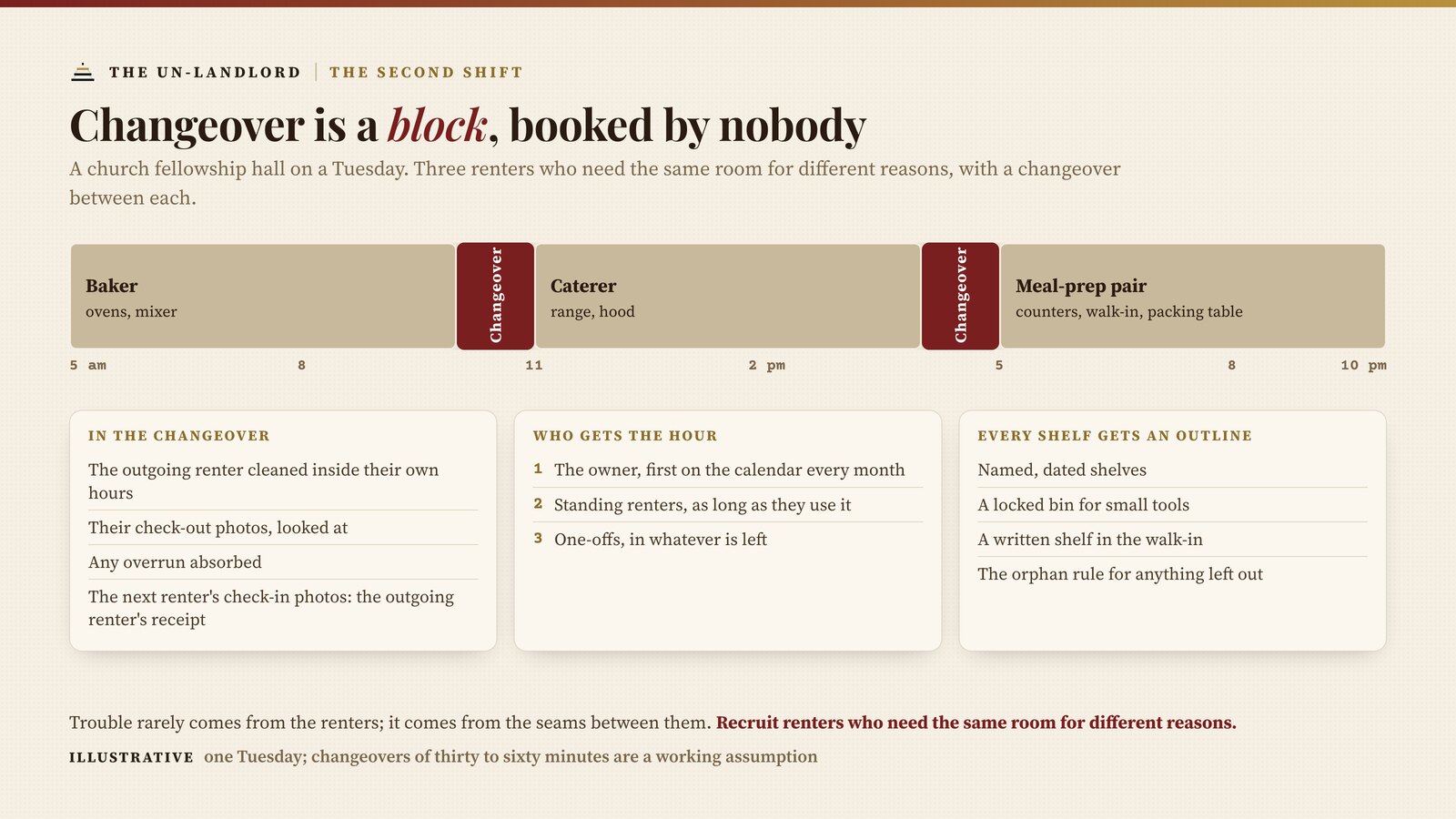
Changeovers, shelves and who gets the hour
Trouble rarely comes from the renters. It comes from the seams between them. Put the changeover on the calendar as its own block, booked by nobody, and give everything an outline.
The day, with changeovers
| From–to | Renter or changeover | Equipment | Cold storage |
|---|---|---|---|
In every changeover
- The outgoing renter finished cleaning inside their own hours and ran the checklist.
- Their check-out photos were looked at.
- The next renter's check-in photos are taken: the outgoing renter's receipt.
Every shelf gets an outline
- Labeled shelves. Named and dated, and only those.
- A locked bin for small tools, under the renter's own lock.
- Cold storage with limits. A shelf written down as a shelf; the owner's product first; food stored where the owner's food-safety plan and the renter's permit say it goes.
- The orphan rule. Anything left out is photographed and set aside, with a fixed time to claim it.
Who gets the hour
- 1. The owner, first on the calendar every month.
- 2. Standing renters, as long as they use it. A use-it rule says what happens after a set number of missed blocks in a quarter.
- 3. One-offs, in whatever is left.
- Contested blocks get a written waitlist in the order requests arrived. Never auction a block; if it's worth more, price it higher for everyone, openly.
- Friction that happens twice earns one line in the house rules, sent to every renter and posted by the door.
- The owner's fatigue limit: ask how many different people they're comfortable with before you book a second renter, and again at every monthly review.
In a shared kitchen, allergen cross-contact, ingredient labeling and food safety are each renter's legal responsibility under their own permit, and the health department's subject. The operator doesn't give food-safety advice and never tells a renter the space is free of any allergen. Look up your county health department's guidance on shared-use or commissary kitchens and build the shelves around what it says.
The Un-Landlord · Chapter 10
The card by the light switch and the incident log
The first page of the plan is a card: laminated, one side, posted by every light switch and at the back door. Renters read it during the walkthrough; check at every monthly visit that it's still on the wall and still correct.
Who to call, in order
| 1. Emergency services | |
|---|---|
| 2. The operator | |
| 3. The owner | |
| 4. The owner's repair and refrigeration vendors | |
| 5. Gas and power emergency lines | |
| 6. The alarm company, if there is one |
Emergency services first. Photos before you touch anything.
The incident log
Everything goes in, including the small things. Walk through it once a month with the owner, next to the booking report, looking for patterns.
| Date | Block | Who was there | What happened | Photos | What was done | Closed? |
|---|---|---|---|---|---|---|
Decided on a quiet afternoon
- Damage. Photos first; the owner's own repair vendor does the work; small costs from the deposit the owner holds, under the written policy; larger ones to the renter's insurer.
- No-shows and late cancellations. A written policy, applied the same way to every renter.
- The mess. The checklist and the photos decide. A strike limit, written down, and then done.
- An inspection during a block. The renter answers for their own operation under their own permit. Nobody coaches anyone on what to tell an inspector.
- A renter competing with the owner. Back to what the agreement said, raised once, plainly, in writing.
- The owner wants the hours back. All the notice the agreement promised, and more when you can, and help renters land.
- A dispute between renters. The house rules first; then each renter separately, with the photos and the log.
- Dropping a renter. In writing, with the reason and the date, under the notice the house rules promised. Never mid-block, short of a safety problem.
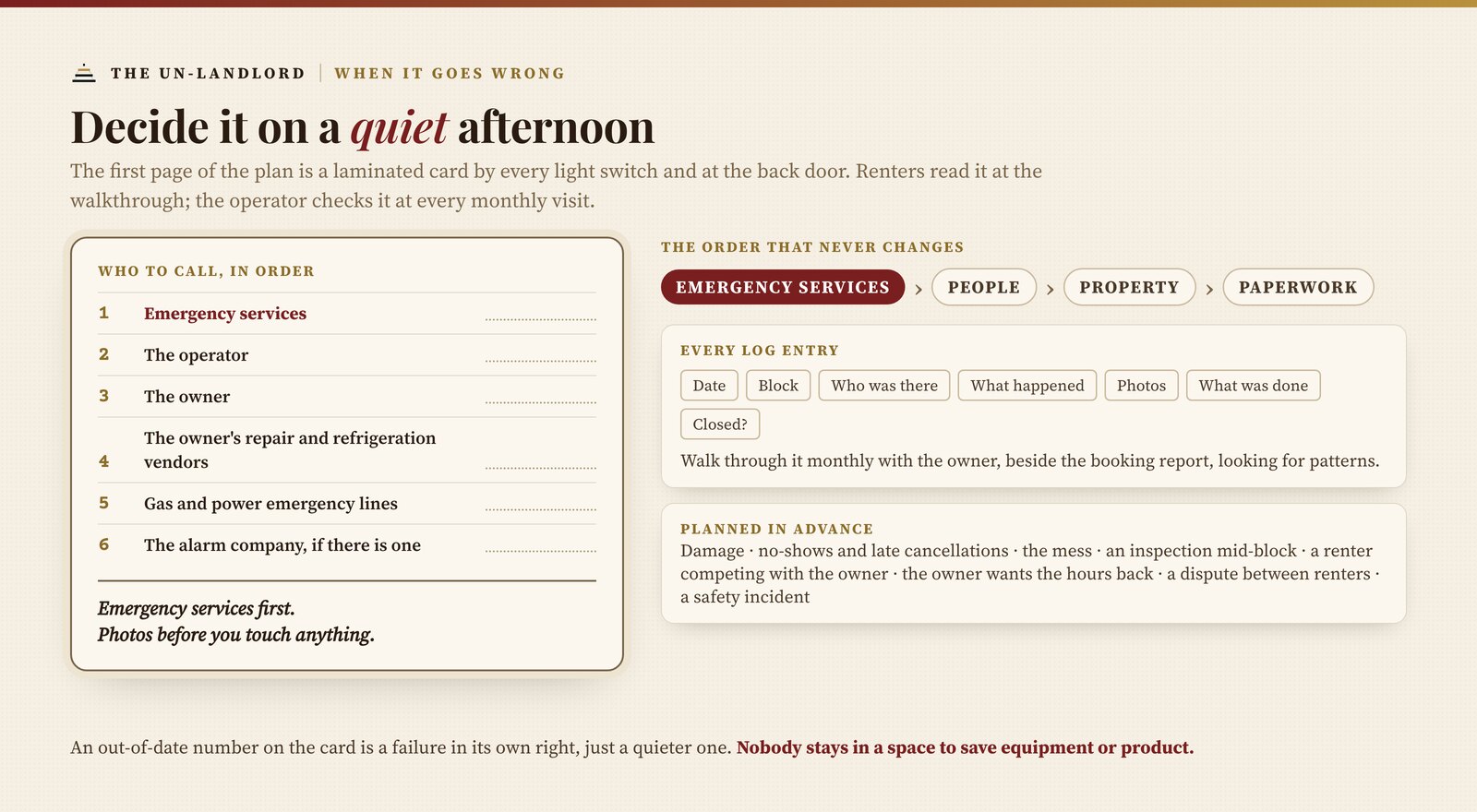
Safety comes first, and in order: emergency services, then people, then property, and only then the paperwork. Nobody stays in a space to save equipment or product. After any loss that may be insured, don't admit fault or promise payment on anyone's behalf, and ask the renter and the owner to do the same until the insurers have talked. Write facts in the log, not conclusions. What a deposit may cover is set by the written policy, drafted by a lawyer, and the owner applies it.
The Un-Landlord · Chapter 11
Who decides, room by room
The method doesn't change from building to building. What changes is who says yes, and what rulebook sits behind the yes. Ask the same two questions every time: who decides, and what are they allowed to decide?
| Churches, lodges and nonprofits | A board, council, vestry or trustees, sometimes a regional office. Bring one page to their meeting; the vote goes in the minutes. Get their list of what they won't host in writing. Their accountant and board answer the tax questions first. Renters pay through the treasurer. | |
|---|---|---|
| Schools and public buildings | The facility-use policy, fee schedule and insurance rules already exist. Don't insert a private share. You may help renters through the official process for a separate fee the renter agrees to, where the district allows outside help. | |
| Offices on Fridays and evenings | The lease and the building first, with the building manager on the call list. Rent the room, not the office. Confidential files locked away; guest wifi only. | |
| Studios and booths | Agree in writing what the renter may offer and what stays the owner's. List the gear the renter may touch; check-out photos include the settings. | |
| Treatment rooms and chairs | Only renters licensed for the same work, with their own records, supplies and insurance. A fixed rate for the time, never a percentage or anything tied to referrals. Your own pay is a flat monthly fee from the owner. A healthcare lawyer reviews it all before anything is signed. |
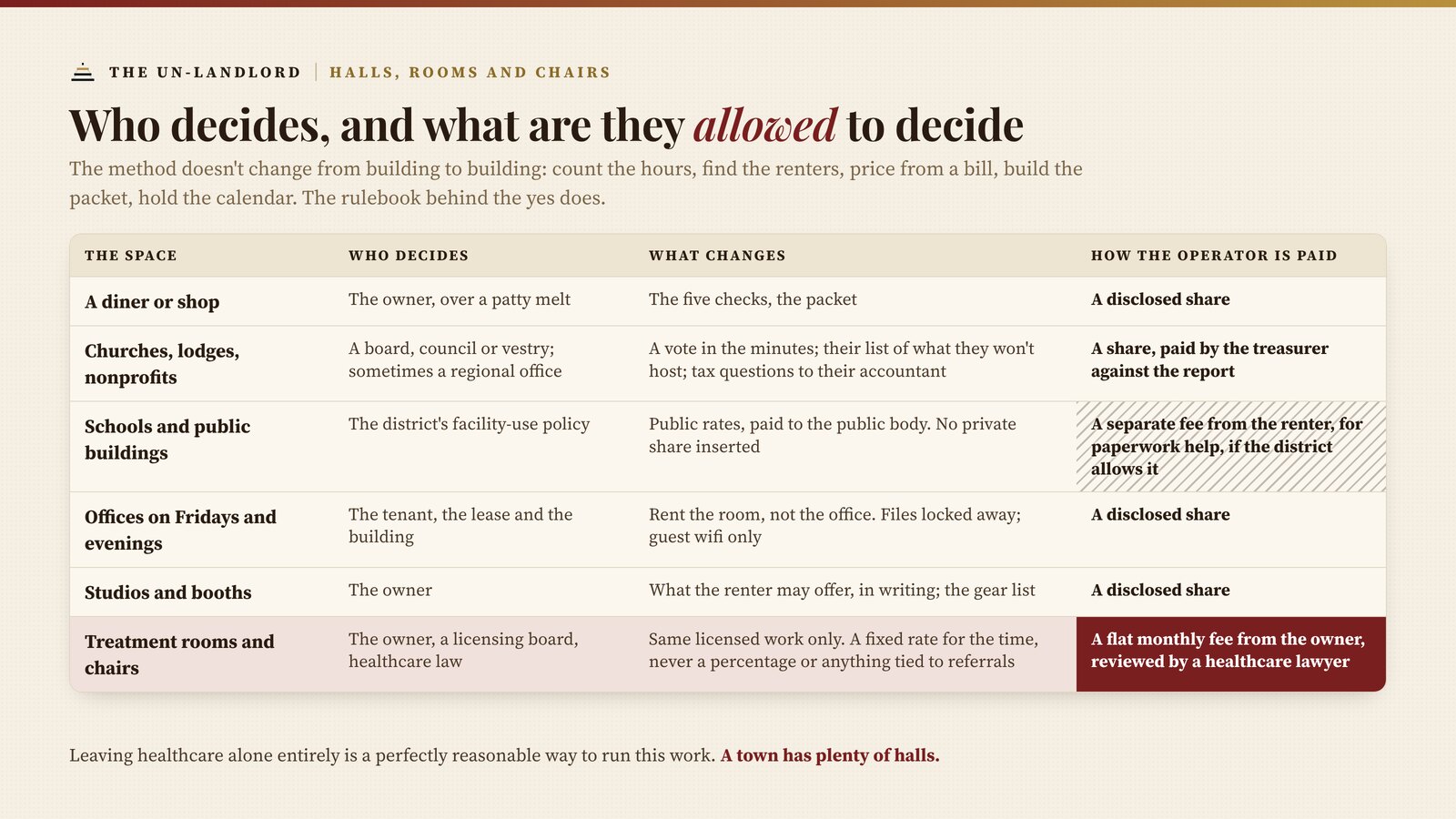
In healthcare, space arrangements between providers can fall under federal and state anti-kickback, self-referral and fee-splitting rules. Boards that license other trades may have their own rules on renting rooms and chairs; ask them. Leaving healthcare alone entirely is a perfectly reasonable way to run this work. A town has plenty of halls.
The Un-Landlord · Chapter 14
The weekly rhythm and the concentration rule
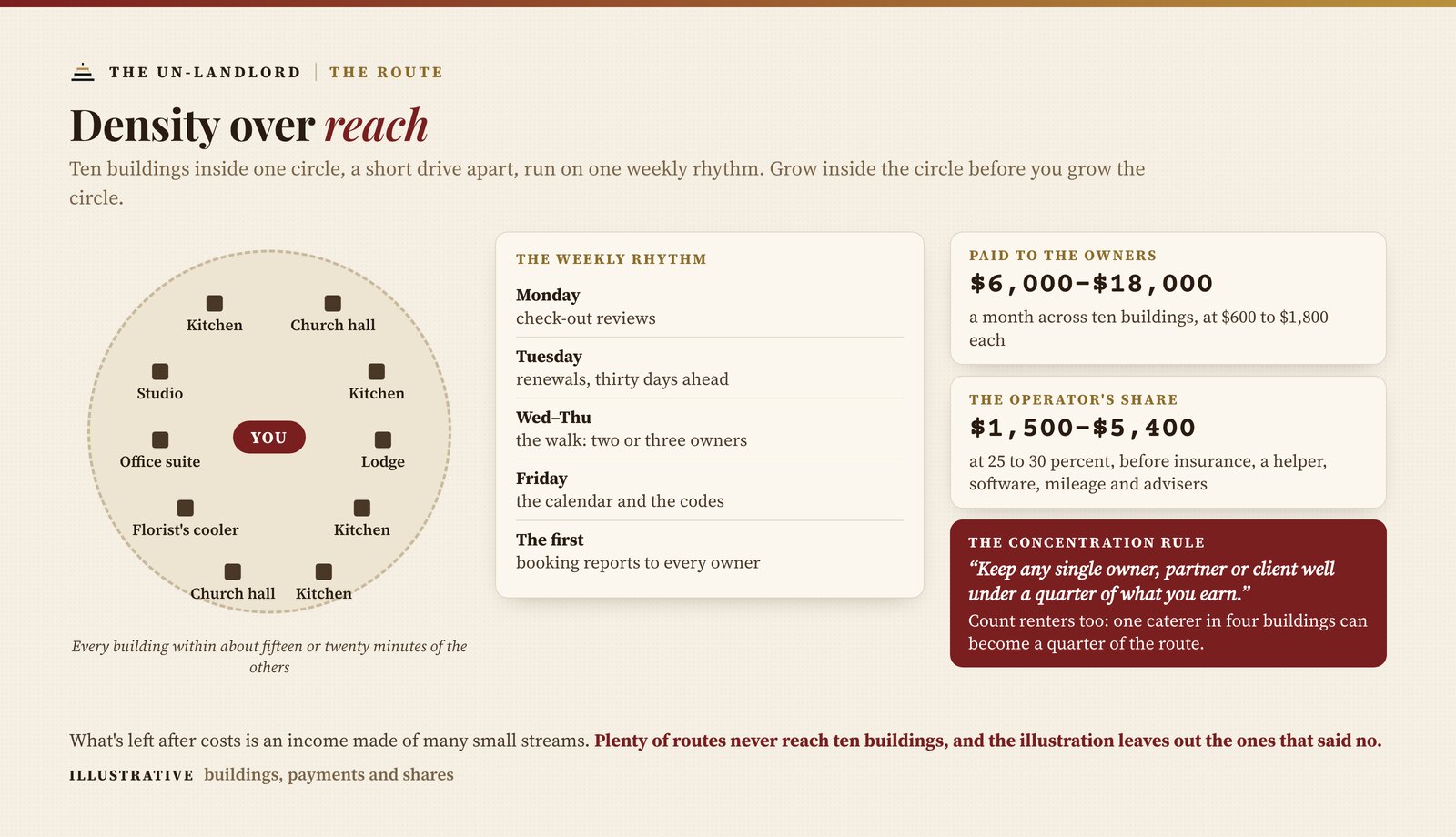
Keep every building within a short drive of the others and grow inside the circle before you grow the circle. Move the days; keep the habit.
| Monday | Check-out reviews. Every block from the past week: checklist and photos. | |
|---|---|---|
| Tuesday | Renewals. Look thirty days ahead at every certificate, permit and required inspection. | |
| Wednesday and Thursday | The walk. Two or three owners in person: the bill, the renters, and "is this still worth it to you?" | |
| Friday | The calendar. Next week's blocks confirmed, codes issued per renter per block, conflicts settled, the waitlist updated. | |
| First of the month | The booking reports. The same format for every owner, who pays the operator's share against it. |
The concentration rule
"Keep any single owner, partner or client well under a quarter of what you earn." Count renters too: one caterer booking blocks in four of your buildings can become a quarter of the route.
| Owner or renter | Buildings | Share of what you earn | Notice period |
|---|---|---|---|
When you hire a helper, ask your accountant whether that person is an employee or a contractor under your state's rules, and your agent how they're covered. The helper never takes a payment from a renter. Licensing your method to operators elsewhere, with fees, your name and meaningful control or help, can fall under franchise or business-opportunity rules: see a franchise lawyer before you offer the kit for a fee in any form, and never tell a prospective operator what a route earns.
Rules change · Last reviewed 16 November 2026
The lines the book sends to a lawyer move
Many questions in the book end with "ask a lawyer," "ask the health department" or "ask the owner's insurance agent," because the answers vary by state, county and city and change over time. They include whether an hourly arrangement is a license or a sublease, zoning and occupancy rules, shared-use and commissary kitchen permits, cottage-food rules, insurance requirements for renters, anti-kickback, self-referral and fee-splitting rules for healthcare spaces, state board rules on renting chairs and rooms, car-sharing and vehicle-rental laws, camera and recording laws, civil-rights rules on screening, taxes on short-term use of space, unrelated business income and property-tax exemptions for nonprofits, workers' compensation for helpers, and franchise and business-opportunity rules for licensing the method.
This page doesn't track those changes for you, and nothing on it is legal advice. It's a reminder that a rule you checked last year isn't checked this year. Before an owner signs an agreement or a renter walks in, confirm the current rule with a lawyer licensed in your state and with the offices that regulate the space.
When a change affects something the book says, we'll note it here with the date.
Keep reading
Three free articles that go further into this book's ground.
- The Toll Position: Revenue That Doesn't Require Your Time or Your AudienceYou do not need an audience, product, or SaaS. Build infrastructure inside existing traffic and collect the toll when value moves.
- How the Money Moves: The Monetization Mechanics Behind a Toll PositionEight revenue layers sit between a subscriber click and your bank account. Most operators only use two. Here are all eight.
- Found Money: Revenue Already Hiding in Your Existing InfrastructureAudit what you already built before adding another partner. Most toll positions have $500-$2,000/month hiding in sequences, placements, and segments.
A new free article goes out every Friday. Read the newsletter →