Partner
The Expertise-Marketing Gap — Why the Best Partners Have the Worst Funnels
Score any potential partner on two axes — craft expertise and marketing ability. The gap between them predicts everything.
October 07, 2026 · 10 min read
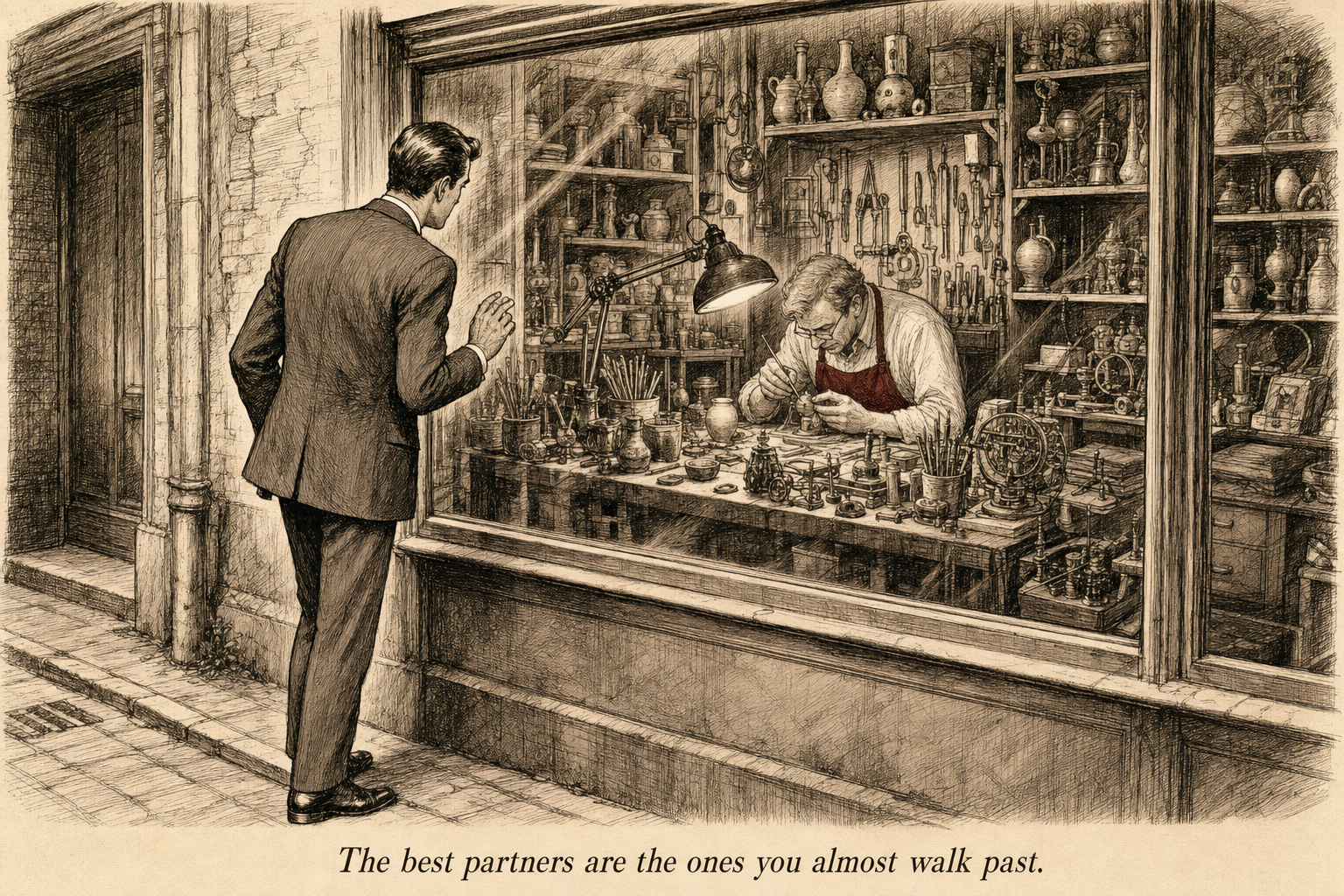
In Ratatouille, the best chef in Paris is a rat who can’t talk to customers.
Remy can create a dish that makes a food critic flash back to his childhood in Provence. He can taste a combination of ingredients and know — before the first plate is served — exactly what’s missing. His craft expertise is off the charts.
His marketing ability is zero. He’s a rat. He can’t design a menu. He can’t write a Yelp response. He can’t stand in the dining room without causing a health code violation.
The entire movie is about the gap between what Remy can do and what Remy can sell. Linguini — the gangly, talentless human who becomes Remy’s front end — is the bridge. He doesn’t cook. He presents. He is, in the language of this newsletter, the operator.
That gap — the distance between someone’s craft expertise and their marketing ability — is the most reliable predictor of partner quality I’ve ever found. More reliable than audience size. More reliable than niche. More reliable than the scorecard in Chapter 8 (which I still use, but this diagnostic runs first).
Two numbers
The framework is embarrassingly simple. Rate any potential partner on two axes:
Craft expertise (1–10). How good are they at the thing they do? Not how famous they are for it. How good. A fitness creator who has genuinely transformed hundreds of bodies scores higher than a fitness creator who repackages other people’s programs with better lighting. A financial educator who managed a real portfolio scores higher than one who reads Investopedia articles on camera.
You can usually tell within thirty minutes of consuming their content. The specific detail is the giveaway. Amateurs speak in generalities. Experts mention the exception, the edge case, the thing that works 80% of the time but fails when the client has a pre-existing condition. The depth is unmistakable once you know to look.
Marketing ability (1–10). How effectively do they convert their expertise into revenue? This isn’t about their audience size — it’s about their infrastructure. Do they have a landing page or just a Linktree? Do they have an email sequence or just a signup form? Do they have segmentation or do they blast the same email to everyone? Do they track conversions or do they hope?
Marketing ability is visible in the description links. Check five of their recent YouTube videos, podcast episodes, or newsletter issues. Count the dead clicks. A raw checkout link is a 2. A basic landing page with email capture is a 5. A segmented funnel with an A/B-tested pre-sell sequence is an 8 or 9 — and that person probably doesn’t need you.
The gap is the number that matters.
A creator who scores 9 in craft expertise and 3 in marketing ability has a gap of +6. That’s a massive opportunity. They’re brilliant at what they do and terrible at converting that brilliance into revenue. They know it, too. They’ve tried to fix it. They’ve hired a VA who set up a Mailchimp account and then nothing happened. They’ve bought a course on funnels and felt their eyes glaze over by module three. They are standing on the bank of the river, looking at the other side, unable to build the bridge themselves.
That’s your partner.
A creator who scores 7 in craft and 7 in marketing has a gap of zero. They’re competent at both. They might benefit from optimization, but they don’t need you. The conversation is harder. The deal is harder. The leverage is lower.
And a creator who scores 4 in craft expertise and 8 in marketing ability has a gap of −4.
That’s the person you walk away from. Fast.
The Reverse Gap
Here’s the anti-pattern that will save you months of wasted effort.
When marketing ability exceeds craft expertise, you are looking at someone who is better at selling than at delivering. They’ve built the funnel. They know the copy frameworks. They understand urgency and scarcity and social proof and conversion optimization. In some cases, they know these things better than you do.
And they will be the worst partner you ever have.
The Reverse Gap partner will second-guess your landing page copy — because they think they know better (and they might). They’ll rewrite your email sequences without telling you. They’ll want access to your analytics dashboard. They’ll have opinions about your subject lines, your A/B test methodology, and your send cadence. They’re not a creator who needs an operator. They’re a competing operator who happens to also create content.
The leverage dynamic inverts. In a healthy toll position, the operator brings marketing infrastructure the creator can’t build. In a Reverse Gap partnership, the creator already has that infrastructure — or thinks they do. Your value proposition disappears. You become a vendor, not an operator. And vendors get replaced.
The Reverse Gap also correlates with a quality problem. A creator whose marketing exceeds their expertise is, by definition, better at selling than at delivering. Their audience may have high churn. Their refund rates may be elevated. Their comments section may be full of “this wasn’t what I expected.” You’re building infrastructure on top of a product that doesn’t hold up — and when it doesn’t, the operator gets blamed alongside the creator.
Check the refund rate before you build the bridge.
The proof point you can run right now
Open YouTube. Find three creators in any niche you’re interested in operating in. For each one:
-
Watch two of their videos. Score craft expertise 1–10. Are they teaching from real experience or recycling other people’s frameworks? Can they handle the edge case?
-
Check five description links. Score marketing ability 1–10. How many dead clicks? Is there a landing page? An email sequence? Any evidence of testing?
-
Calculate the gap.
The creator with the widest positive gap is your strongest prospect. Not the one with the most subscribers. Not the one with the best production value. The one who is great at their craft and terrible at capturing the value of it.
You just ran the diagnostic that most operators skip entirely. They chase audience size. You’re measuring the gap — the space where your infrastructure creates the most lift.
Hybrid Content
This article continues for subscribers.
The full implementation — the steps, the templates, the math — is delivered via the newsletter.
Unsubscribe in one click. Useful operator material only. Promotions, sponsors, and partner links will be disclosed.
Partner
Want to find better partners?
This article explored the partner dimension. The newsletter delivers qualification frameworks and outreach patterns weekly.
Unsubscribe in one click. Useful operator material only. Promotions, sponsors, and partner links will be disclosed.