Build
The Operator's Agent Stack: Automation That Compounds
A five-agent stack can monitor metrics, draft reports, research products, and protect operator time without adding headcount.
September 14, 2026 · 7 min read
Around month eight, I hit the wall.
Five active toll positions. Fifteen email sequences running simultaneously. Three experiments in various stages of completion. Two partners who needed monthly reports. A weekly metrics ritual that was creeping from 15 minutes to 45 minutes because I had to check five dashboards instead of two.
I wasn’t drowning. But I was treading water. Every hour I spent maintaining existing positions was an hour I couldn’t spend improving them. The optimization — the thing that makes toll positions compound — was the first casualty of scale.
Then I built my first agent.
Not a chatbot. Not an assistant. A purpose-built AI system with one job: monitor my email metrics across all five positions and flag anything that crossed a threshold. That’s it. One job. But that one job — which was costing me 30 minutes per day to do manually — now happened while I slept. And the flags were more accurate than my tired-Friday-afternoon eyeballs.
That agent freed 30 minutes daily. I spent those 30 minutes on the optimization work I’d been neglecting. RPS went up 15% in 60 days. Not from working harder. From working on the right things because a machine handled the surveillance.
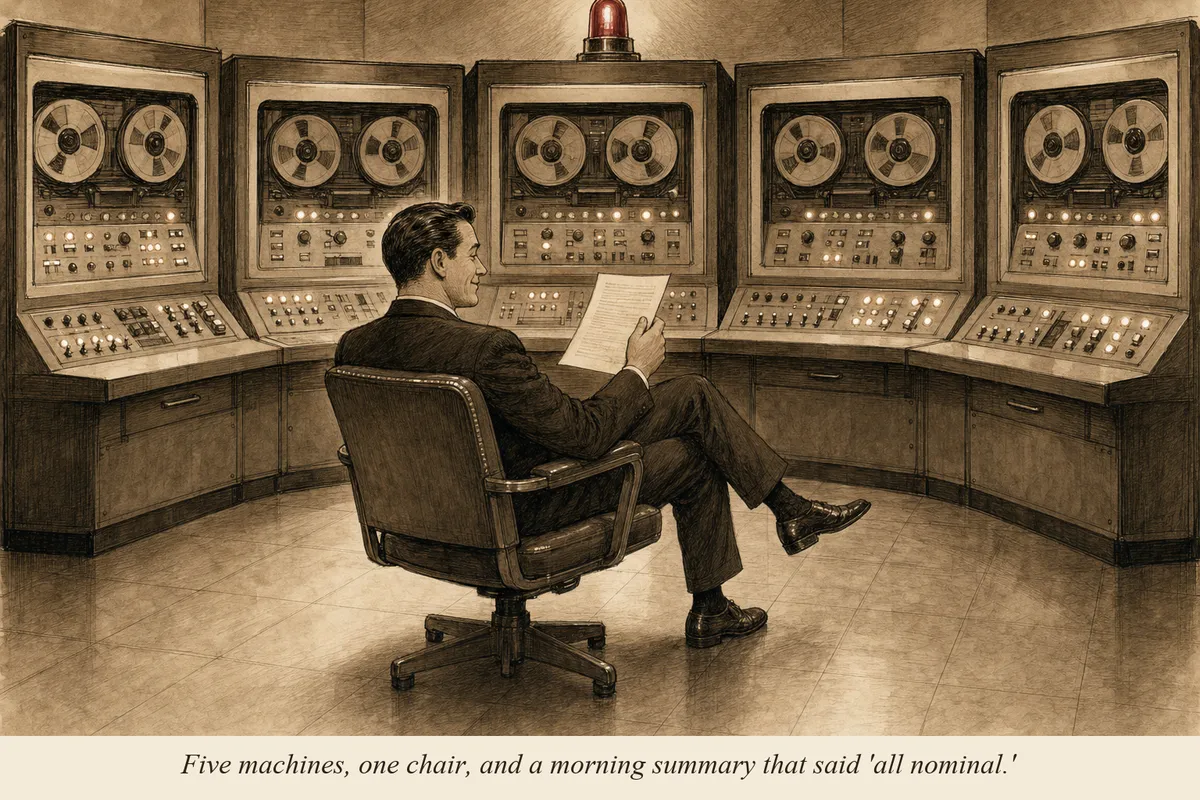
The five agents (and what stays human)
After two years of iterating, my agent stack has five purpose-built systems. Each one handles a specific category of work that is high-volume, pattern-recognizable, and low-consequence-if-slightly-wrong.
Agent 1: The metrics monitor
What it does: Pulls performance data from all active positions daily. Compares against thresholds. Flags anomalies. Produces a morning summary.
What it replaces: The manual dashboard-checking portion of the weekly metrics ritual — transformed from weekly to daily without additional time cost.
Specifically: Deliverability drops, unusual unsubscribe spikes, CTR declines, revenue anomalies, segment size changes. If nothing crosses a threshold, the morning summary is one line: “All positions nominal.”
What stays human: Interpreting the flags. Deciding what to do about them. The agent surfaces the problem. The operator diagnoses the cause and chooses the fix.
Agent 2: The content optimizer
What it does: Analyzes email performance data and suggests specific improvements — subject line variants, CTA rewrites, product placement changes.
What it replaces: The creative ideation portion of optimization. Instead of staring at a low-performing email and wondering “what would work better,” the agent generates 5 variants based on what has worked in similar contexts.
Specifically: “Email 4’s subject line is underperforming by 12% vs. sequence average. Based on your top-performing subjects in this niche, here are 5 variants to test: [list].”
What stays human: Choosing which variant to test. Approving the final copy. Ensuring voice match with the creator’s tone. Evaluating whether the suggestion makes strategic sense (the agent optimizes for metrics; the operator optimizes for relationship).
Agent 3: The sequence architect
What it does: Given a new product, a target segment, and your historical performance data, generates a draft email sequence — complete with timing, product placement, and CTA structure.
What it replaces: The 4-6 hours of initial sequence writing for each new product rotation.
Specifically: “New product entering rotation: [description]. Target segment: [tag]. Based on comparable product sequences in your experiment log, recommended structure: 5 emails, Day 1/3/5/8/12, value-first with monetization on emails 2 and 4, estimated RPE of $0.12-$0.18 based on segment RPS.”
What stays human: Reviewing the draft for voice accuracy, strategic alignment, and 4-to-1 ratio compliance. The agent writes fast first drafts. The operator ensures quality.
This article continues for paid subscribers with Agents 4 and 5 (Research Agent and Reporting Agent), how the agents communicate with each other, the specific tools and platforms for building the stack, cost analysis (spoiler: under $50/month), what to automate next at 8+ positions, and the critical errors to avoid when delegating to AI.
Hybrid Content
This article continues for subscribers.
The full implementation — the steps, the templates, the math — is delivered via the newsletter.
Unsubscribe in one click. Useful operator material only. Promotions, sponsors, and partner links will be disclosed.
Build
More on building toll infrastructure?
This article covered one piece of the build dimension. The newsletter delivers a new install pattern every week.
Unsubscribe in one click. Useful operator material only. Promotions, sponsors, and partner links will be disclosed.