Build
The Un-SaaS Ch. 15 — The Anti-Patterns
Twelve mistakes that kill toll positions before they compound. Each one looks reasonable in the moment and costs months to fix.
October 02, 2026 · 12 min read

Chapter 15 of 26
This is a chapter from The Un-SaaS: A Toll Stack Engineer's Handbook. Each Friday, we're publishing a chapter as a bonus for our readers.
In software engineering, the most valuable documentation isn’t the happy path. It’s the failure modes.
Every production system has a runbook that says “if X happens, do Y.” The runbook isn’t there because someone thinks X will happen today. It’s there because X did happen, once, at 3 AM, and nobody wants to rediscover the fix under pressure.
Toll positions have their own runbook. Three anti-patterns that kill partnerships, erode revenue, and turn what should be a quiet, compounding portfolio into a stress generator. Each one is seductive — it looks like ambition or efficiency from the inside — and destructive.
I’m going to name them, show you what they look like in practice, and give you the diagnostic so you can catch them early.
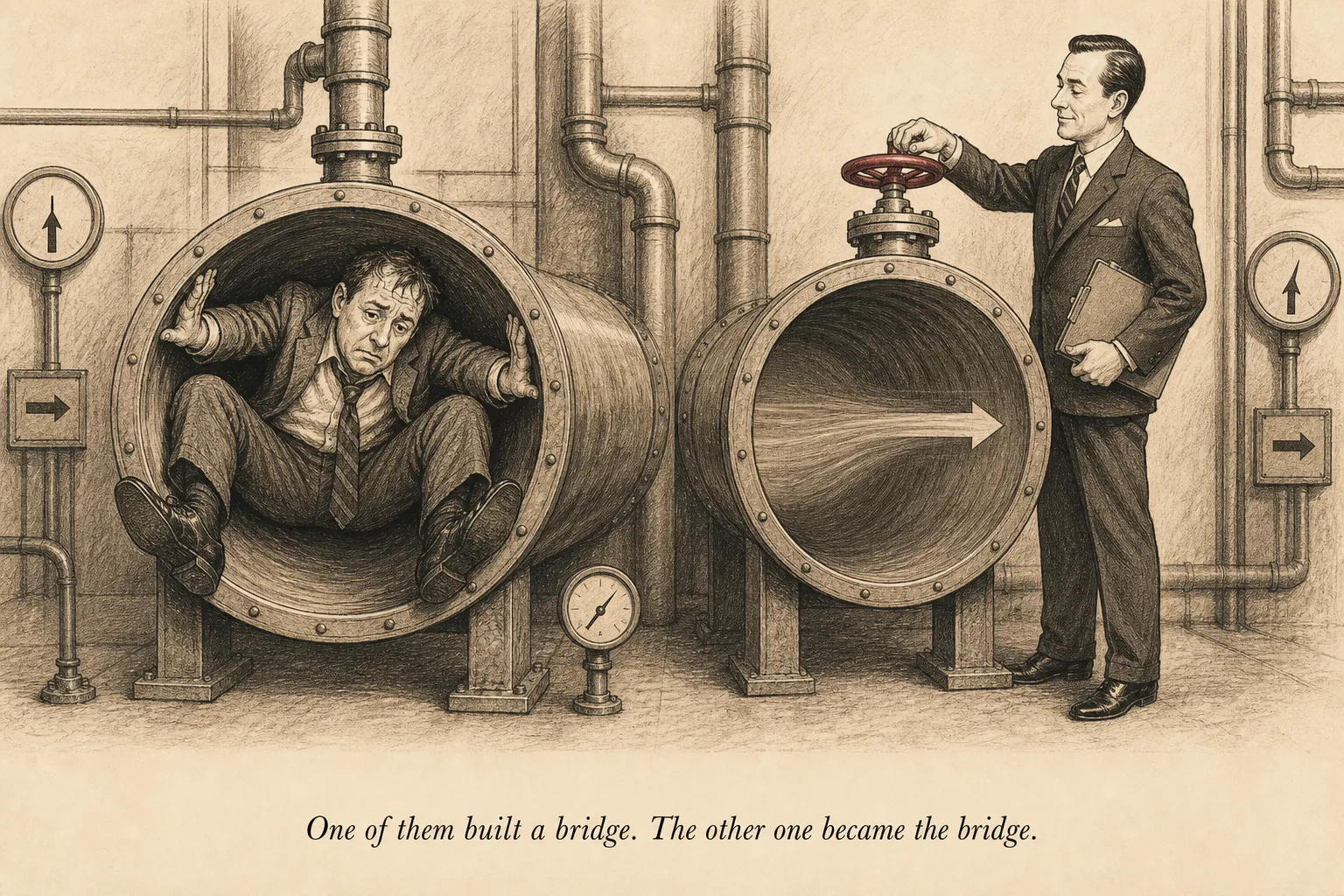
Anti-Pattern 1: The Bottlenecker Trap
A bottlenecker is an operator who inserts themselves into every decision, every communication flow, and every relationship in the partnership. They become the single point of failure — not because the infrastructure requires it, but because their ego does.
Here’s what the Bottlenecker Trap looks like:
The operator starts by building the landing page and email sequence. Standard toll position. Then they notice the partner’s YouTube thumbnails could be better, so they start redesigning thumbnails. Then they notice the partner’s course outline has gaps, so they start suggesting curriculum changes. Then they notice the partner’s social media strategy is inconsistent, so they start drafting social posts.
None of these things are toll position work. All of them feel productive. And each one tightens the operator’s grip on the partnership until the operator is the partnership — which means the partnership fails the 90-day yachting test.
The Bottlenecker violates the control principle in reverse. Instead of controlling the infrastructure (which is your job), you’re controlling the partner (which is not). The partner starts to resent the dependency. The operator starts to burn out from the workload. The toll position — the thing that’s supposed to be a quiet, autonomous asset — becomes a second job.
The progression is predictable. Stage one: helpful suggestions. You notice the partner’s video descriptions could be structured better. You suggest reordering their links. You draft a product recommendation script. This feels helpful. The partner appreciates it.
Stage two: scope creep. The partner starts asking your opinion on which products to recommend. You start weighing in on their content calendar. You suggest promoting a specific merchant because the commission is higher. You are now influencing business decisions that should be theirs.
Stage three: control. You’re sending weekly “optimization recommendations” that are really instructions. You’re approaching merchants on the partner’s behalf to negotiate deals they didn’t ask for. You’re sitting in the middle of every conversation, filtering information, shaping terms.
Stage four: collapse. The partner feels managed instead of supported. They route around you — send a direct message, make a side deal, cut you out of a conversation. The relationship fractures. Not because you did bad work. Because you did too much work in the wrong territory.
Here’s the dangerous part: the Bottlenecker Trap feels like job security. “They can’t function without me” sounds like indispensability. It’s actually fragility. The operator who passes the thirty-day test can run five positions simultaneously. The bottlenecker can barely run two — because they’re personally embedded in every conversation, every decision, every adjustment.
The fear driving it is transparent: if the partner and the merchant talk directly, they’ll cut me out. So the operator inserts themselves into every conversation to make themselves “essential.” This is exactly backward.
The more you insert yourself, the more friction you create. The more friction, the more people want to route around you. The less you insert yourself — the more you build the bridge, optimize the bridge, and let the traffic flow — the more irreplaceable you become. Not because of your presence, but because of the data, the optimization history, and the cross-network intelligence that no one else has.
The diagnostic: Ask yourself: “If I disappeared for thirty days, would the toll position keep running?” If the answer is yes — emails fire, landing page converts, revenue splits — you’re an operator. If the answer is no — because the partner expects you to approve their thumbnails, review their curriculum, and draft their social posts — you’re a bottlenecker.
The fix: Draw a hard line between your infrastructure (landing page, email, analytics, experiments) and their business (content, product, brand, audience). Offer opinions when asked. Don’t volunteer control. Write a one-page scope document that explicitly defines what you will do and what you will not do. When the scope is fuzzy, every new request feels like it could be in scope. When the scope is documented, you can say “that’s outside our agreement” without confrontation.
Your value is the bridge, not the river.
Anti-Pattern 2: The Daisy Chain
A daisy chain is a structure where multiple middlemen sit between the traffic source and the revenue, each taking a cut, and nobody has a direct relationship with both the partner and the subscriber.
Here’s what a daisy chain looks like:
An operator partners with a creator. The creator’s audience clicks through to a landing page. The landing page captures an email. The email promotes a product — but the product isn’t the creator’s product. It’s an affiliate product from a marketplace. The marketplace takes 20%. The affiliate network takes 10%. The operator takes 15%. The creator takes nothing because they’re not even aware the operator is monetizing their traffic through a third-party marketplace.
Nobody is doing anything illegal. Everyone is violating trust.
The daisy chain breaks the Toll Stack model in three ways. First, the revenue layers are thin — by the time three middlemen take their cuts, the per-subscriber economics don’t compound. Second, the partner relationship erodes — if the creator discovers you’re monetizing their audience through products they never approved, trust is destroyed. Third, the data moat disappears — you don’t control the product, the checkout, or the customer relationship. You’re a middleman’s middleman.
The cost isn’t just the commission compression. It’s the data loss. Every intermediary is a data boundary. The network tracks clicks. The sub-network tracks conversions. The product company tracks revenue. But the behavioral intelligence — who bought what, when, and why — never makes it back to you. The experiment log requires closed-loop data. In a daisy chain, the loop is broken. You send an email and watch the click leave your system. Whether it converts, what the buyer purchased, how much they spent — that data lives in someone else’s dashboard.
And it’s the relationship loss. The product company doesn’t know you exist. They know the network. When you want to negotiate a direct deal at 40-50% — the strategic partnership rate that changes the economics — there’s no relationship to negotiate from.
Daisy chains aren’t malicious. They’re emergent. Nobody decides to build a circular chain of middlemen. Each participant acts locally rational: the operator joins a network because it’s easy. The network aggregates operators for scale. Sub-networks fill gaps. In aggregate, they produce a chain where nobody has a direct relationship and everyone’s margin gets compressed.
The diagnostic: Draw your revenue flow. If the money passes through more than two parties (subscriber → operator → partner/merchant), you’re probably daisy-chaining. If you’re monetizing a partner’s audience with products the partner doesn’t know about or hasn’t approved, you’re definitely daisy-chaining.
The fix: Work with principals. The creator who generates the traffic. The merchant who sells the product. Use networks to discover products and test demand — that’s their legitimate function. But once a product proves itself, break out. For your top three to five products — the ones driving 80% of revenue — identify the actual company behind the affiliate link. Approach them directly. “I have X subscribers who buy your product. Here are the numbers. Let’s do this without the middlemen.”
You don’t need to leave the network for every product. Long-tail, low-volume products are fine running through a network. The economics don’t justify a direct relationship for a product generating $50 a month. But for your core revenue drivers, a direct relationship replaces the chain with your bridge, your data, and your commission rate.
The Tenancy Solution
The bottlenecker and the daisy chain are different failure modes, but they share the same root cause: structural tenancy on demand you don’t own.
In both cases, the operator depends on someone else’s audience. The bottlenecker depends on the partner’s patience. The daisy chain depends on a chain of intermediaries who can be cut at any point. Both positions crack under the same force: the person who owns the audience deciding they’d rather not share.
There’s a substrate where the operator can flip this entirely. Instead of attaching to a partner’s traffic, you originate the demand. The service provider — the person who does the physical work — becomes the interchangeable part. The customer relationship stays with you.
Consider local home services. Dryer vent cleaning, gutter cleaning, window washing, pressure washing. Every house in a neighborhood needs all of these on a predictable seasonal cycle. The buying universe is knowable — county property records tell you every homeowner, their address, the year the house was built. You build the content surface, the email list, the seasonal triggers. When October hits, you email homeowners about gutters. You dispatch the fulfillment partner. You bill the customer. The spread is yours.
The structural inversion: in a standard toll position, the creator is the landlord and you’re the tenant. You rent access to their audience. In this model, you’re the landlord. You own the customer relationship, the billing, the service history. The fulfillment partner rents the right to be dispatched. If they poach a customer, they lose dispatch volume. If you replace them, the customer doesn’t notice.
This isn’t a replacement for the standard toll position. It’s a complement — a way to build positions where the tenancy problem can’t arise because you own the demand from the start. An operator who runs three partner-attached positions and two landlord tolls has both the scale of borrowed audiences and the defensibility of owned ones.
Anti-Pattern 3: The Line You Don’t Cross
There’s a line between “optimizing a partner’s revenue infrastructure” and “manipulating a partner’s audience.” The line isn’t always obvious, but the consequences of crossing it are always severe.
Here’s what crossing the line looks like:
False urgency. Adding countdown timers to offers that don’t actually expire. “Only 3 spots left” when there are unlimited spots. Fake scarcity. This erodes subscriber trust, produces short-term revenue spikes followed by long-term engagement collapse, and makes you the kind of marketer you got into the Toll Stack to avoid being.
Misrepresenting the partner. Writing email copy that sounds like it’s from the creator when it’s from you. Using the partner’s name, voice, or brand in ways they haven’t approved. The subscriber should know (or at least not be deceived about) who is communicating with them.
Promoting garbage. Recommending products you know are bad because the commission is high. This is the fastest way to destroy a list. A single bad recommendation erodes trust that took months to build. The 4-to-1 rule only works if the “1” is a genuinely good recommendation.
Over-emailing. Sending more emails than the subscriber signed up for. If your landing page says “weekly insights,” don’t send daily promotions. Consent is not a one-time checkbox — it’s an ongoing agreement between you and the subscriber.
Data misuse. Selling subscriber data to third parties, sharing behavioral data with merchants who didn’t earn it, or using cross-network intelligence in ways that would make subscribers uncomfortable if they knew.
One operator shared subscriber email addresses with a merchant as a “bonus” to negotiate a higher commission rate. The merchant loaded those emails into a cold outreach campaign. Subscribers received emails they never signed up for, from a company they’d never heard of, and traced it back to the operator’s list. The commission bonus from the data share: $2,400. The estimated revenue lost from degraded list performance: $18,000 over six months. Open rates dropped 15 percentage points. The most engaged, highest-value subscribers left first — because they were the ones paying enough attention to notice the violation.
The math on crossing the line is always negative.
The diagnostic: Before sending any email, running any promotion, or making any claim, ask one question. “If the subscriber saw exactly how this works behind the scenes, would they feel respected or manipulated?” If the answer is anything other than “respected,” don’t send it.
The fix: There isn’t one. Once you cross the line, you’ve lost the trust that makes the model work. The fix is to never cross it. Build the line into your operations so firmly that crossing it requires a deliberate, conscious choice — not a gradual drift.
When to Fire a Partner
Sometimes the anti-pattern isn’t yours. It’s the partner’s.
A partner who demands approval over every email you send is creating a bottleneck. A partner who introduces a middleman between you and their checkout is creating a daisy chain. A partner who pressures you to make false claims about their product is pushing you across the line.
The Toll Stack is a portfolio, not a marriage. You can fire partners.
Here are the signals that justify ending a partnership:
Revenue declining for three consecutive months without a diagnosable cause. If the partner’s traffic is dropping and they’re not addressing it, the position is dying. Move on.
Partner interference with your infrastructure. If the partner demands access to your email system, insists on approving every experiment, or tries to take over the landing page — they’re not a partner anymore. They’re a client, and you’re not in the client business.
Ethical concerns. If the partner’s product quality declines, if they start making claims their product doesn’t support, or if their audience complaints start showing up in your unsubscribe data — exit before their reputation damages yours.
Traffic quality poisoning. If subscribers from a specific partner underperform across all metrics — low open rates, low click rates, high unsubscribes, low conversion — they’re diluting your overall list quality. Bad subscribers don’t just produce less revenue. They hurt your email deliverability scores, which affects every other partnership’s performance. If subscribers from this partner open at less than half the rate of your portfolio average for 90+ days, the traffic quality is a liability.
Concentration risk. If a single partner grows to more than 25% of your monthly revenue, the portfolio is unbalanced. You don’t necessarily fire the partner — but you urgently need to add new partners to dilute the concentration.
When you exit, exit cleanly. Lead with data, not emotion. Don’t ghost. Don’t let things fade. A clean exit protects your reputation in the niche and leaves the door open for future reconnection. “We worked together, it didn’t work out, but they were professional about it” is a positive referral signal. “They ghosted me and I had to figure out my own infrastructure” is a pipeline killer. Every exit is a potential referral. Handle it accordingly.
The deal memo includes a 30-day exit clause for exactly this reason. Use it when you need it. Don’t let loyalty to a partner override the structural health of the portfolio.
The Operator’s Oath
I don’t have a formal code of ethics for toll position operators. But if I did, it would be three lines:
Build infrastructure, not dependency. Your toll position should run without you for ninety days. If it can’t, you’re bottlenecking.
Work with principals, not intermediaries. Know who generates the traffic and who sells the product. Be in relationship with both. No daisy chains.
Respect the subscriber. Every email, every offer, every claim — the subscriber would feel respected if they saw the plumbing. If they wouldn’t, fix the plumbing.
Everything else is optimization.
Next Friday: The shape of the first three months — what to build, what to measure, and what to ignore.
Build
More on building toll infrastructure?
This article covered one piece of the build dimension. The newsletter delivers a new install pattern every week.
Unsubscribe in one click. Useful operator material only. Promotions, sponsors, and partner links will be disclosed.