Scale
When the Platform Changes: Surviving YouTube Algorithm Shifts, Email Policy Updates, and Everything Else You Can't Control
Platform metrics change. Operators survive by trusting owned click data, calm partner communication, and infrastructure that absorbs shocks.
September 26, 2026 · 6 min read
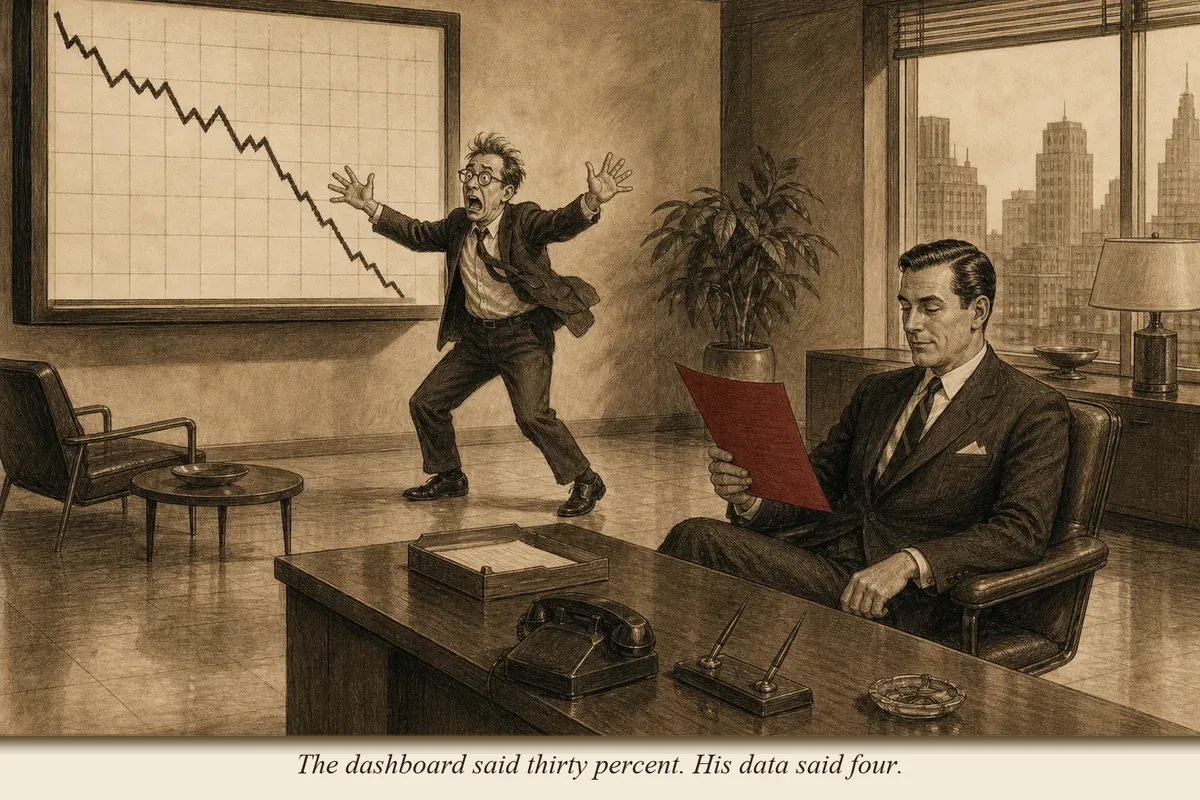
February 2024: YouTube changed how it counts video impressions. Overnight, a creator I worked with saw their view counts drop 30%. Not because fewer people watched — the same humans watched the same videos. YouTube just changed how it counted.
The creator panicked. “My channel is dying.”
I pulled the actual traffic data from my redirect layer. Link clicks from their descriptions? Down 4%. Not 30%. Four percent. The algorithm change affected displayed metrics dramatically and actual behavior barely at all.
But for three weeks — until the creator calmed down and looked at the real numbers — I was managing a partner who thought the sky was falling. That’s what platform changes do: they create panic disproportionate to their actual impact. And panic makes people do stupid things — like pulling links, changing content strategies, or “pausing” partnerships that are working fine.
The operators who survive platform changes aren’t the ones who avoid them. You can’t avoid them. They’re the ones who built systems that absorb changes — and relationships strong enough to ride out the panic period without making reactionary decisions.
The three types of platform changes (and which ones matter)
Type 1: Metric changes (impact: cosmetic)
What happened: The platform changes how it reports numbers. View counts shift. Impression definitions change. Analytics dashboards get redesigned.
Real impact: Usually minimal. The underlying behavior (people watching, clicking, buying) rarely changes because a dashboard changed. The metrics look different but the traffic flows the same.
What to do: Nothing operational. But communicate proactively with your partner: “I noticed YouTube changed their impression counting. Here’s what our actual traffic data shows — clicks are stable. The dashboard looks scary but the reality is fine.”
The danger: Partners who don’t understand the difference between metric changes and behavioral changes will panic. Your job is to be the calm one who has independent data (from your own infrastructure) that tells the true story.
Type 2: Algorithm changes (impact: moderate)
What happened: The platform changes how content is distributed. A creator’s videos get fewer recommendations. Newsletter deliverability shifts. Podcast rankings reshuffle.
Real impact: Moderate. Algorithm changes do affect traffic — typically 10-30% fluctuation for individual creators. But they tend to be temporary (2-6 weeks) before stabilizing at a new baseline, and they rarely affect all creators in a niche equally.
What to do:
- Quantify the actual traffic change from your redirect data (not the platform’s reported metrics)
- Assess whether it’s a temporary fluctuation or a sustained trend (3+ weeks of decline = trend)
- If temporary: do nothing. Ride it out.
- If sustained: conversation with the partner about content adaptation. And start evaluating backup partners in the same niche (portfolio diversification at work).
The danger: Operators who overreact to a 2-week algorithm dip — restructuring deals, pulling placements, pivoting strategies — waste time and damage relationships. Most algorithm changes reverse or stabilize within 4-6 weeks.
Type 3: Policy changes (impact: potentially severe)
What happened: The platform changes its rules. New terms of service. New restrictions on affiliate links. New email sending policies. New privacy regulations affecting tracking.
Real impact: Potentially significant. Policy changes can eliminate entire strategies overnight. Apple’s iOS privacy changes killed email open-rate tracking accuracy. Google’s cookie deprecation threatens retargeting. Platform TOS changes can ban certain link types.
What to do:
- Understand the actual policy (not the fear about the policy — read the actual documentation)
- Assess direct impact on your infrastructure (does this literally break something, or does it change a metric?)
- If it breaks something: fix it within 7 days. Don’t delay.
- If it changes a metric: adapt your measurement approach without changing your strategy
- If it eliminates a capability entirely: find the alternative approach (there’s always one)
The danger: Operators who hear “Google is killing cookies” and panic about their entire retargeting strategy — without checking whether their specific implementation is affected. Many platform changes come with transition periods, alternatives, and workarounds that are less dramatic than the headline.
The absorption architecture
The reason some operators survive platform changes effortlessly while others scramble: their infrastructure was designed to be platform-independent from the start.
Principle 1: Own your data layer. Your subscriber list, behavioral tags, and purchase data live in YOUR systems (email platform, your database) — not in the traffic source platform. If YouTube disappears tomorrow, your 4,000 subscribers still exist, still have their tags, still receive your emails. The traffic source changes. The asset doesn’t.
Principle 2: Route through your infrastructure. Every click passes through your redirect layer — which means you have independent traffic data that doesn’t depend on any platform’s analytics being accurate. When YouTube’s dashboard says one thing and your data says another, trust yours.
Principle 3: Diversify across platforms. The portfolio article covered partner diversification. Platform diversification is the same principle: don’t have all 5 partners on the same platform. If 3 are YouTube + 1 newsletter + 1 podcast, a YouTube algorithm shift affects 60% of your portfolio, not 100%.
Principle 4: Maintain independent communication channels. Email is your owned channel. You don’t need YouTube’s algorithm to reach your subscribers — you email them directly. That’s the fundamental insurance policy. Whatever happens on any traffic source platform, your relationship with captured subscribers is direct and platform-independent.
Historical platform changes and what actually happened
YouTube’s 2022 algorithm shift (Shorts prioritization):
- Fear: “Long-form content is dead, views will crater”
- Reality: Long-form views dipped 15-20% for some creators, stabilized within 8 weeks
- Impact on toll positions: Minimal. Description links are on long-form videos. Click rates were unchanged.
Apple iOS 14.5 (email privacy, 2021):
- Fear: “Open rate tracking is dead, email marketing is over”
- Reality: Open rates became less reliable as a metric. Click rates, conversion rates, and revenue were completely unaffected.
- Impact on toll positions: Adapted measurement to emphasize CTOR and RPE instead of open rate. Zero revenue impact.
Google’s third-party cookie deprecation (ongoing):
- Fear: “Retargeting is dead”
- Reality: First-party data (your own email list, your own pixel) is unaffected. Third-party data sharing between platforms is restricted. Operators who built their own data infrastructure are fine.
- Impact on toll positions: Minimal for operators with owned infrastructure. Significant only for those relying on third-party data platforms.
The pattern: every platform change feels catastrophic in the first two weeks of headlines and Twitter panic. By week 6, operators who own their infrastructure are back to normal. Those who don’t own their infrastructure — who depend on the platform for data, distribution, AND measurement — are the ones who get hurt.
The partner panic protocol
Your partner will panic. That’s guaranteed. Here’s the protocol:
Within 24 hours of the change:
- Send proactive communication: “I noticed [platform] announced [change]. I’m monitoring our actual traffic data and I’ll have a clear picture within 3-5 days.”
- DO NOT speculate about impact before you have data
Within 7 days:
- Send a brief data update: “Here’s what our actual metrics show: [specific numbers]. Traffic is [stable/slightly down/significantly affected].”
- If stable: “No action needed. I’ll continue monitoring.”
- If down: “Here’s my plan to adapt: [specific steps].”
Within 30 days:
- Full assessment: “The change has stabilized. Here’s the before/after comparison. Here’s what I’ve adjusted in our infrastructure to optimize for the new reality.”
The protocol does three things: it positions you as the calm expert, it demonstrates you have independent data (you’re not guessing from the same dashboard they’re staring at), and it prevents panic-driven decisions during the emotional first week.
The 10-year perspective
Platforms will change — repeatedly, unpredictably, and in ways nobody can forecast. The operators who build 70-year model businesses don’t build ON platforms. They build THROUGH platforms. The platform provides traffic. Your infrastructure captures the value from that traffic. When the platform changes, the traffic fluctuates — but the captured value (subscribers, data, relationships) remains.
Build for absorption. Not prediction. Nobody can predict the next algorithm change. Everyone can build infrastructure that survives one.
Scale
Ready to go from one position to a portfolio?
This article explored scaling. The newsletter delivers portfolio expansion patterns and operational frameworks weekly.
Unsubscribe in one click. Useful operator material only. Promotions, sponsors, and partner links will be disclosed.