Reader kit
The Un-Agency
A Services Operator's Playbook
The book's checklists and figures, set up to print and keep beside you while you work with a client: which gaps will stay open, what to ask in a paid diagnostic, how to score the bench, what to check before an install goes live, and what has to be in writing. Everything here is already in the book. This page just puts it on paper.
This page is for readers of the book. It's free, and you don't need to sign up to use it.
In the kit
- The Guardrails Checklist (Appendix C, its own printable page)
- Payment model comparison (Chapter 13 and Appendix A, a calculator)
- The gap permanence filter (Chapter 4)
- The paid diagnostic (Chapter 14)
- The bench scorecard (Chapter 11)
- The install checklist (Chapter 12)
- What goes in writing (Chapter 18 and Appendix B)
- The work audit (Chapter 19)
- Rules change (dated note)
Each worksheet has its own print button. The book's disclaimer applies to all of it: nothing here is legal, tax, employment or financial advice.
Appendix C
The Guardrails Checklist
The book's working positions in one place, to run at each stage of a client relationship: the lines that don't move, and what to check before you pitch, before you agree terms, before you route work to the bench, before you touch customer data, before you white-label a product, before your first hire, before you license your method, and ongoing. If the answer to any question is "no" or "I'm not sure," stop until you've sorted it out.
Chapter 13 · Appendix A
Payment model comparison
Put a flat monthly fee, a straight revenue share and a base plus a share side by side for the same machine, across the revenue it might produce. It opens on Chapter 13's illustration: a system producing about $30,000 a month in year one and $45,000 in year two, a 20 percent share against a $3,000 base plus 12 percent. You can see where the lines cross and what the floor is worth in a slow month.
The Un-Agency · Chapter 4
The gap permanence filter
Run it before you build anything. Score each factor from zero (clearly temporary) to ten (clearly permanent), then average the five.
| Identity | 0: "I'm building a company." 10: "I do the craft." | |
|---|---|---|
| Interest in the systems | 0: actively learning them. 10: none at all. | |
| Hiring direction | 0: operations and marketing roles. 10: more practitioners, or nobody. | |
| Reaction to your offer | 0: "We'll build that ourselves." 10: "Please handle it." | |
| The gap over time | 0: closing as they grow. 10: widening as they grow. | |
| Average | Add the five scores and divide by five. |
Reading the average
- Seven or higher. A permanent gap, one that widens as the business grows. The kind of arrangement that can last.
- Four to seven. Proceed, but watch for the signs below and write your agreement for the possibility that the gap closes.
- Below four. A temporary gap with an expiry date, whether anyone writes it down or not. It can still be a good client for a shorter arrangement: more up front, a shorter term, and a clean handover built in.
Signs to listen for
- Temporary: they talk about "building out our systems," they're hiring for operations, marketing or growth, they're comfortable with the technology, the business model points toward in-house operations, and they answer your proposal with a slight defensiveness.
- Permanent: their identity is the craft, they outsource everything that isn't the core work, they've been successful for years without it, growth has widened the gap, and they answer with relief.
Write for the day they hire in-house
- A notice period. Thirty to ninety days before your share ends.
- A handover fee or tail. A one-time transition payment, or a reduced share for a set period after they take over.
- Clear ownership of what stays and what goes. They keep their customers, data and accounts. You keep your method, your templates and any code you licensed for the term, unless they buy it outright. Decide this before the build.
- Your record of what worked. The client gets a copy of their own data; the know-how is yours.
- A plain-language non-solicit, if you want one. Narrow and reasonable. These clauses vary by state and are unenforceable in some; ask a lawyer before you rely on one.
Relief means permanent. Defensiveness means temporary. Even a permanent-gap client can change when the business is sold, a child takes over the marketing or a new partner arrives, so every agreement says what happens if the work comes in-house.
The Un-Agency · Chapter 14
The paid diagnostic
A paid review of the client's current setup, with a written report at the end, priced as a real piece of work. Keep it small and specific: a few hours, a defined list of what you'll look at, and a delivery date.
The intake, before the first conversation
Ten or so questions the owner can answer in a few minutes. Business information only; you don't need customers' personal details to diagnose a business, and you shouldn't collect them at this stage.
- How many customers do they have on file?
- What do they sell, and at what prices?
- What have they tried before?
- Which numbers do they already track?
- What would a good year look like?
The review, ten questions in order
- 1. How many new people show up each week, and is that number rising or falling?
- 2. What share of them become customers?
- 3. What does an average purchase come to, and is it changing?
- 4. How often does a customer buy again?
- 5. How many customers leave, and why?
- 6. Where does each step of the customer's path lose people? Measure arrival, sign-up, the first email opened, the click, the purchase and the second purchase separately, each against a sensible benchmark.
- 7. Which step has the biggest gap? Fix that one first. A fix near the top multiplies through every step below it.
- 8. What already exists that nobody's using? The quiet customer file, the product nobody mentions, the list nobody mails.
- 9. What would break if the good news arrived all at once?
- 10. What does the owner actually want? More revenue, more time, a business they can sell, a quieter phone.
The report, a few pages, written for the owner
- What you looked at.
- The three to five biggest findings, ranked by the size of the gap.
- For each one, an estimated range of what fixing it could be worth, with the assumptions written next to it.
- What you'd build first, and how you'd propose to be paid for it.
- Walk the owner through it in person or on a call. Don't email it and wait.
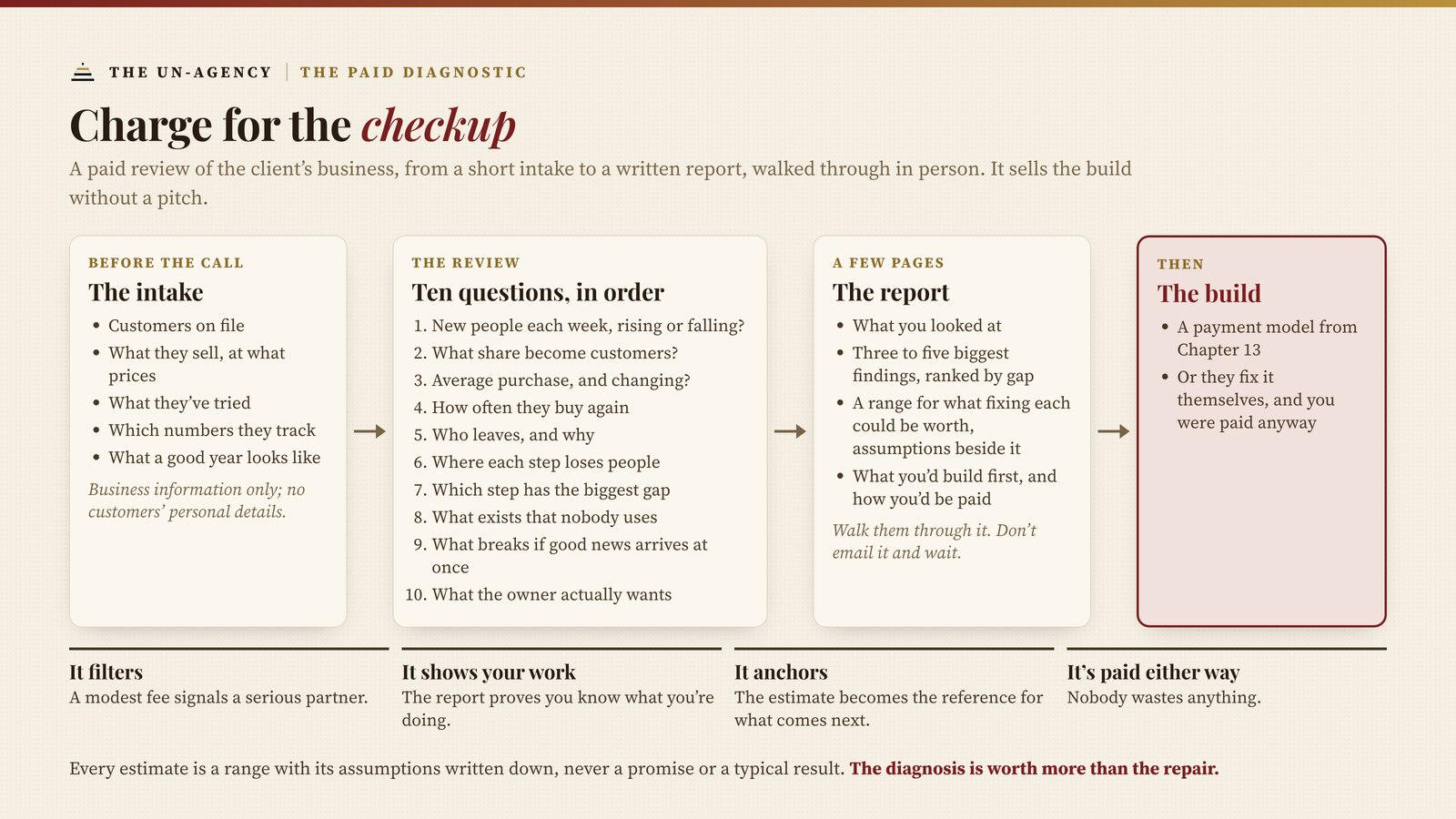
Every estimate is a range with its assumptions written down, never a promise or a typical result. Benchmarks come from sources you can name or your own documented work. Results from other clients must be real and permissioned, or clearly labeled as hypothetical. For a healthcare, legal or financial client, stay on the business side and away from patient, client or account records unless the right agreements and tools are in place.
The Un-Agency · Chapter 11
The bench scorecard
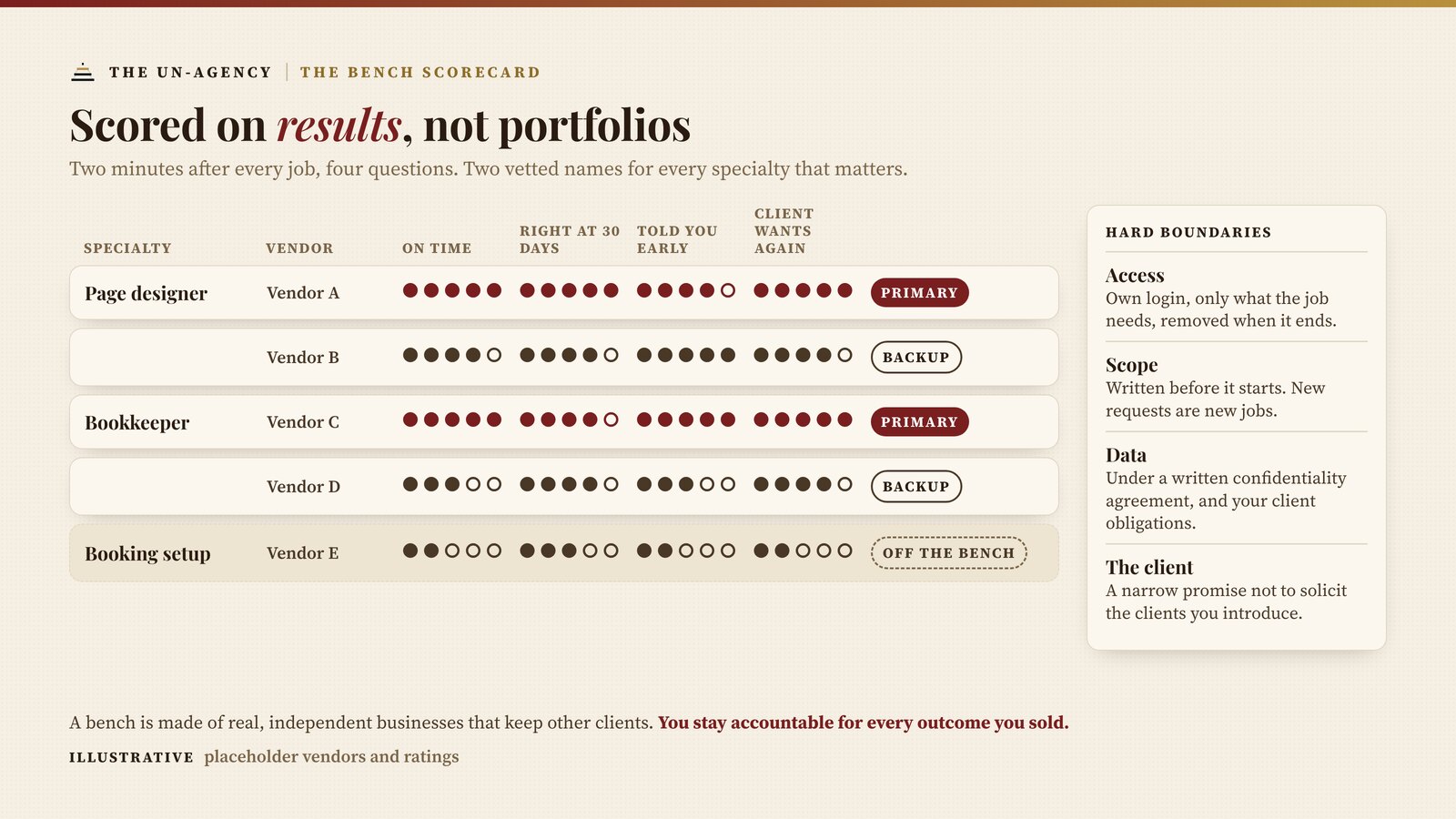
A set of vetted independent businesses, each good at one thing, scored on results, replaceable, and bound by the same obligations to your client that you are.
The path onto the bench
- Start with evidence you've seen. Work you've watched produce results for a client you know. Ask your clients who they've used and whether they'd use them again.
- Check the basics. Properly licensed and insured for the work, where that applies, and basic security habits for anyone handling data.
- Give them a small paid trial. A real piece of work, clearly scoped, with a deadline and a definition of done, paid at their rate.
- Write down what you saw.
After every job: two minutes, four questions
| Vendor and specialty | Arrived when promised? | Right first time, still right a month later? | Told you about problems early? | Would the client want them again? |
|---|---|---|---|---|
Two names for everything that matters
For every specialty a client depends on, keep at least two vetted names. Route most of the work to your best one, and send a steady trickle to the second so they stay warm and you stay current on their quality.
Hard boundaries instead of trust
- Access. Only the access a job needs, through the vendor's own login, removed when the job ends. Never share your own credentials or a client's.
- Scope. Every job written down before it starts: what's included, what isn't, when it's done. New requests become new jobs.
- Data. Client data only under a written confidentiality agreement and the same data-protection obligations you signed with the client. Keep vendors away from patient information entirely.
- The client relationship. In plain language and narrowly, the vendor doesn't solicit the clients you introduce. Don't rely on a broad non-compete.
Independent means independent. Whether someone is a contractor or an employee is decided by how the work really happens, not the label in the agreement. If you set their hours, train them in your way of working and they work only for you, you may have an employee. Build the bench from real businesses that choose their own methods and keep other clients, and talk to an employment lawyer and an accountant in your state before you rely on one-client freelancers. You stay accountable for the result either way.
The Un-Agency · Chapter 12
The install checklist
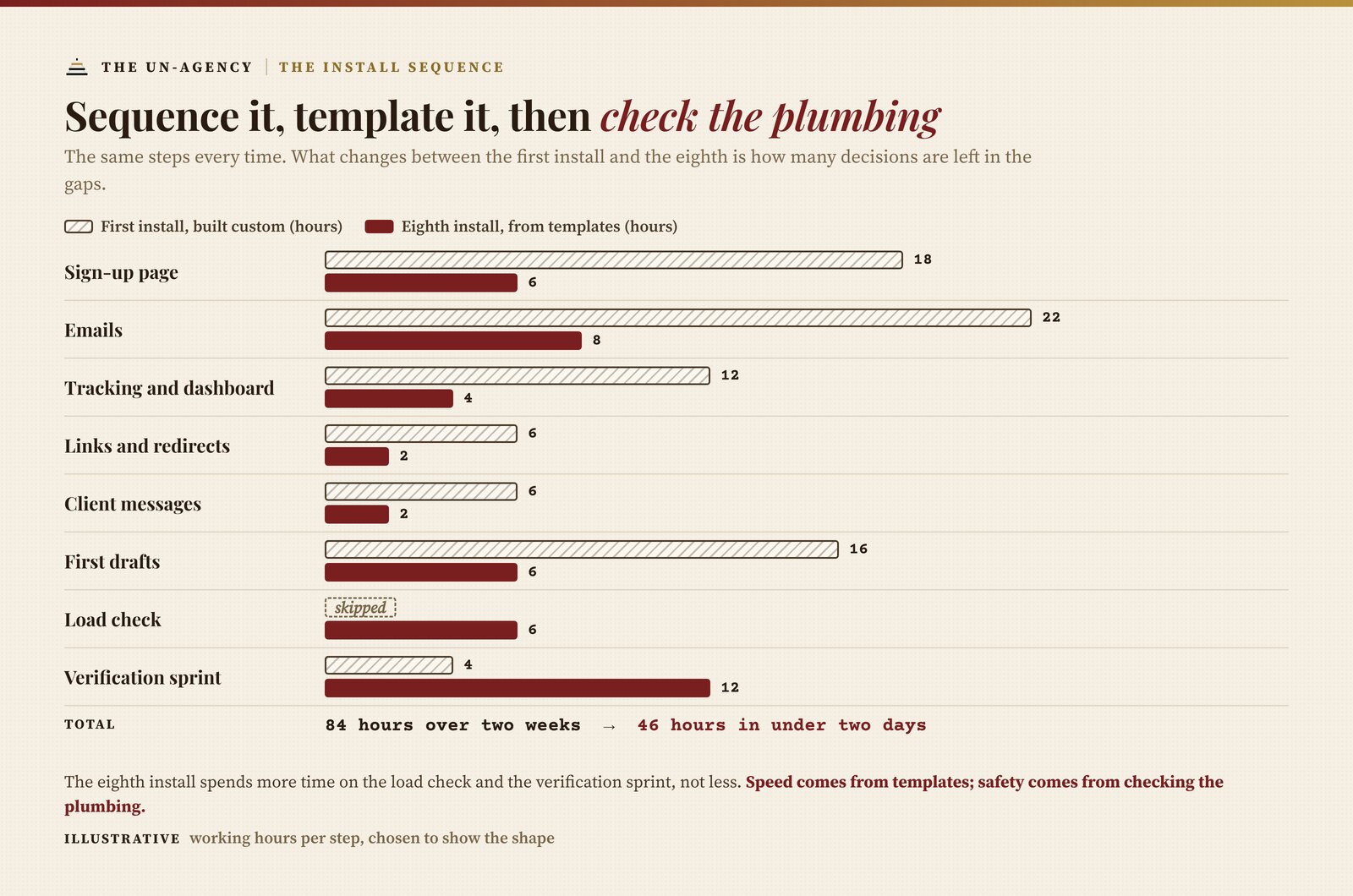
Sequence first, then template each step so it only asks the questions that differ from client to client.
Template each step
- The sign-up page. A skeleton. Each new client changes five things: name and voice, headline, the few lines about what they'll get, a bit of proof, and colors and images.
- The emails. A scaffold with each email's job written at the top: a welcome, something useful, a gentle recommendation, a real offer, a check-in for the quiet ones.
- The tracking and dashboard. Built once as a template you import and connect. Spend your time checking that the numbers match reality.
- The links and redirects. A naming convention, and a script or checklist that turns a client's name and a list of addresses into the whole configuration.
- The client messages. The welcome note, the "here's what I need from you" list, the launch announcement, the first-week report, the thirty-day review invitation.
- The first drafts. An AI tool can draft from your scaffold and a clear brief. You still read every word and rewrite anything that sounds like anyone could have written it.
The load check, before launch
- Who actually sends the emails, and from what account? Use a proper sending service set up for the client's domain, not a consumer inbox.
- Where do replies land, and who reads them?
- Can every kind of customer get through checkout or booking? Try it as a new customer and a returning one, and on a phone.
- What happens to the payment account on the best day? Ask the client to confirm with their payment provider that a spike won't freeze it. Test any payment-plan link too.
- Is the calendar ready? If a campaign books forty appointments in two days, can the business serve forty people?
The verification sprint, a day or two before going live
- Click every link.
- Submit every form with a real email address you control, and watch the tracking record each step.
- Send yourself every email in the sequence and read it on a phone.
- Buy or book something, and refund it.
- Confirm the client can see the same dashboard you can.
- Write the breakage notices in advance: if the checkout link fails, what does the customer see and what email goes out? If a message goes out wrong, what's the correction and who approves it?
What stays slow on purpose
- The first conversation with each new owner, where you learn what their customers care about.
- The read-through of every word that goes out under their name.
- The first week after launch: watch the numbers every day and answer every question the owner has.
The Un-Agency · Chapter 18 · Appendix B
What goes in writing
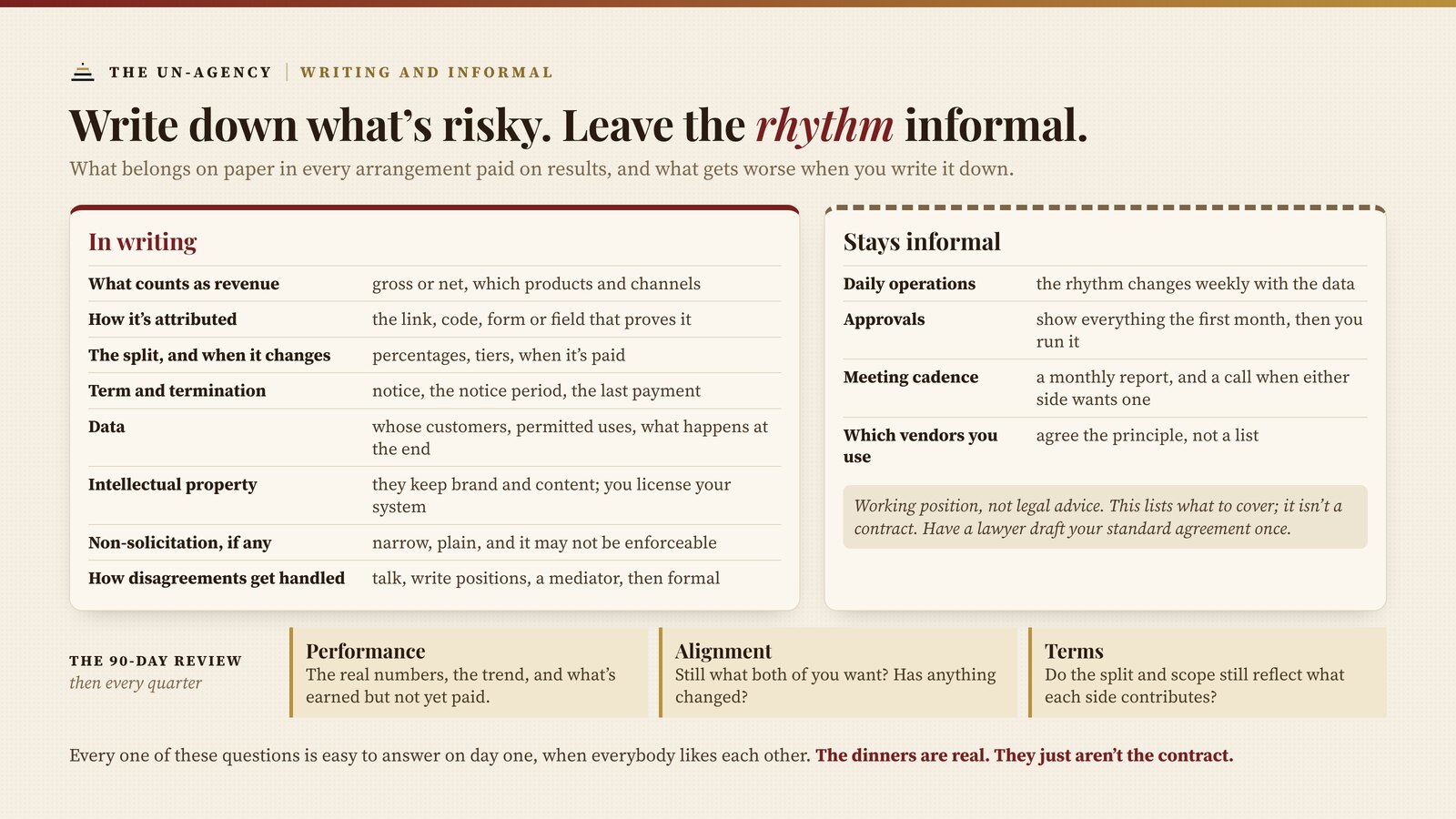
A list of what to cover, not a contract. Write down the things where ambiguity creates real risk, and leave informal the things where writing them down would create friction.
In writing, in every arrangement paid on results
- What counts as revenue. Gross or net of refunds and chargebacks; which products, channels and kinds of sale.
- How it's attributed. A tracking link, a code, a form, a field in checkout. If attribution is vague, every month becomes an argument.
- The split, and when it changes. Percentages, tiers or milestones, and how and when payment is calculated and made.
- Term and termination. How long it runs, how either side ends it, how much notice, what happens during notice and when the last payment is due.
- Data. Whose customers these are, what you may do with their information, what you share back, and what happens to it at the end.
- Intellectual property. The client keeps their brand and content. You usually keep your system and license it to them for the term.
- Non-solicitation, if you use it at all. Narrow, in plain words, knowing enforceability depends heavily on where you are.
- How disagreements get handled. Talk within a week; then each side writes down its position; then a mediator you both accept; only then anything formal.
The revenue-share terms, precisely
- Revenue definition. How refunds, chargebacks, discounts and taxes are treated.
- Attribution. The attribution period, and what happens when two channels touch the same sale.
- Rates and tiers. Milestones measured on collected revenue, and whether tiers reset.
- Reporting and verification. Who produces the numbers, when, from which system, and each side's right to check them.
- Payment. Timing, method and currency; where possible a platform that splits the money at the moment of sale. Payments go between the principals. You don't hold other people's money.
- Review clause. Milestones or dates to revisit the structure, with changes only by mutual agreement.
- Term and ending. What happens to revenue from customers acquired before the end, and whether it converts to a flat maintenance fee or ends outright.
The vendor agreement mirrors the client promise
- Independent business, and the relationship actually works that way.
- Scope, deliverables, deadlines and acceptance tied to the client promise they support.
- Only the client data the job needs, under the obligations you accepted, returned or deleted at the end.
- Your standards, how work is reviewed, and your right to replace them.
- Paid by you, not the client, unless all three agree otherwise in writing. Work product assigned or licensed to you.
- Proof of license and insurance where the work requires them.
Stays informal
- Daily operations. How often you check the numbers, when you test, which experiments you run.
- Approvals. For the first month you show them everything before it goes out. After that, you run it unless something changes.
- Meeting cadence. A short report every month, and a call whenever either side wants one.
- Which vendors or products you use. Agree on the principle, not a list.
When they hand you their paper
- A revenue definition that quietly excludes the revenue you'll create.
- A subcontracting ban you can't live with.
- A termination clause that lets them keep your system without paying for it.
The ninety-day review, then every quarter
- Performance. The numbers month by month with the trend; the client's share, when it landed and what's earned but not yet paid out. Explain any gap before they ask.
- Alignment. Is this still what both of you want? Has anything changed in their business, team or plans? Are you each doing what you said you'd do?
- Terms. Do the split and scope still reflect what each side contributes?
- Send a one-page summary afterward.
These are patterns, not forms, and not legal advice. Have a lawyer licensed in your state draft your standard agreements once, and go back for anything unusual: exclusivity, equity, licensing your method, meaningful sums, regulated data, another company's lawyers or another country. If patients' health information is anywhere nearby, you need a business associate agreement and compliant tools, or you don't touch it.
The Un-Agency · Chapter 19
The work audit
Three signs you've hit the solo ceiling
- You're turning away good work because of capacity, not fit.
- Your response times are slipping.
- Improvement has stopped: fewer tests, or none.
All three and you're overdue. Two, and it's time to plan. One, and you have a few months.
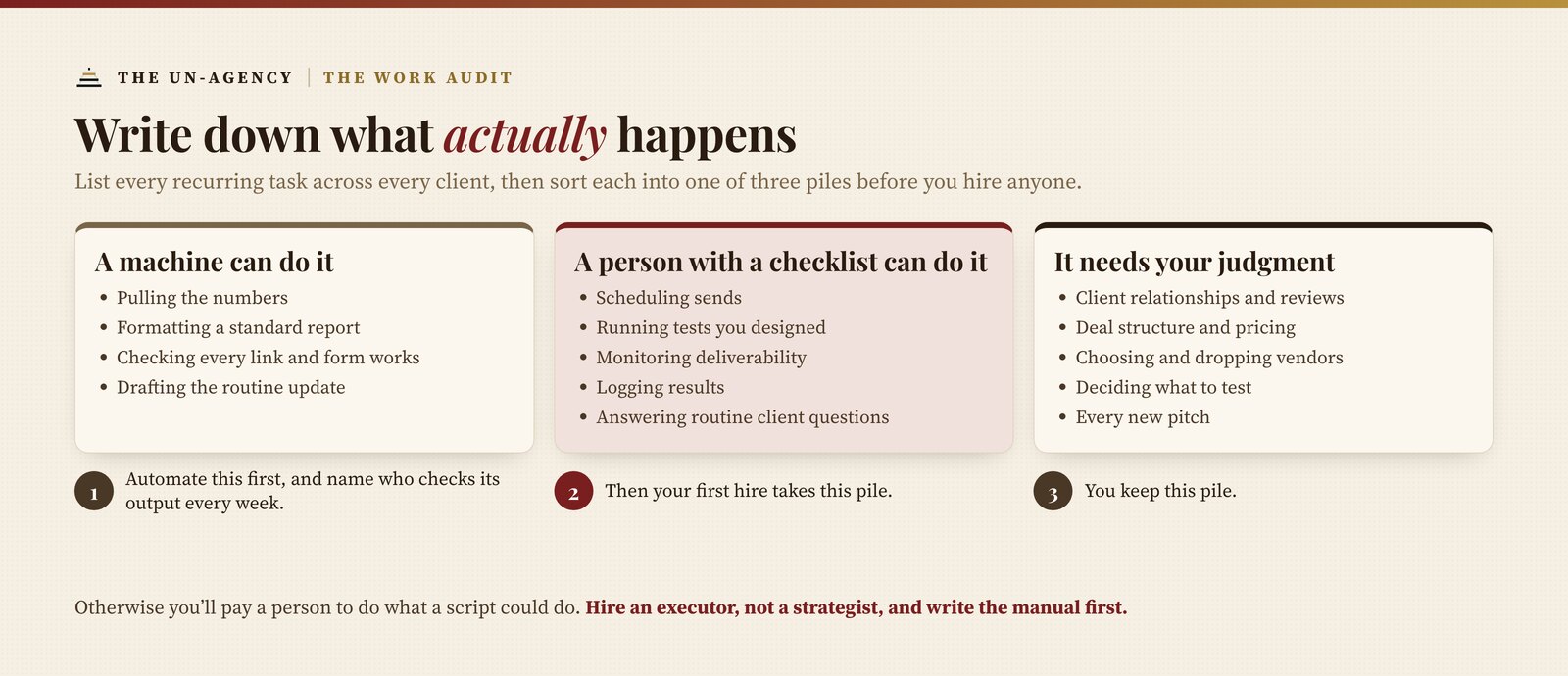
Sort every recurring task
Spend an hour listing every recurring task across every client, week by week. Not what should happen. What does. Then put each one in a pile.
| A machine can do it | Pulling numbers, formatting a standard report, checking every link and form works, drafting the routine update. |
|---|---|
| A person with a checklist can do it | Scheduling sends, running tests you designed, monitoring deliverability, logging results, answering routine client questions. |
| It needs your judgment | Client relationships and reviews, deal structure and pricing, choosing and dropping vendors, deciding what to test, every new pitch. |
Automate the first pile before you hire for the second, and name the person (for now, you) who looks at its output every week. Your first hire takes the second pile. You keep the third.
The operations manual, before you hire
- A daily checklist. What gets checked every morning.
- A weekly checklist. The metrics review, the test log, the send calendar.
- A monthly checklist. Client reports, revenue reconciliation, list health.
- Tools and access. Where each thing lives, with credentials in a password manager and access granted person by person.
- Escalation rules. Anything touching deal terms, a vendor relationship or an unhappy client comes to you.
- Quality standards. A template for every recurring output, with a good example attached.
Your first operations person is a real hire. Whether they're an employee or a contractor depends on how the work actually happens. Before you hire, talk to an employment lawyer or a payroll provider and an accountant. If any part of their pay is a revenue share, it still has to satisfy minimum-wage and payroll rules for an employee.
Rules change · Last reviewed 25 October 2026
The lines the book sends to a lawyer move
Several questions in the book end with "ask a lawyer," "ask an accountant" or "ask a broker," because the answers differ by state and change over time. Worker classification (federal and state tests differ, and some states apply a strict one), non-compete and non-solicit rules, franchise and business-opportunity rules for licensing a method, money-transmission rules if you ever hold a client's money, sales tax on services and digital products, privacy laws, and the consent rules for commercial email, calls and texts.
This page doesn't track those changes for you, and nothing on it is legal advice. It's a reminder that a rule you checked last year isn't checked this year. Before you sign a revenue share, hire your first person or offer your method to another operator, confirm the current rule with a professional licensed in your state.
When a change affects something the book says, we'll note it here with the date.
Kit updates
Get updates to the kit and the rules page, and hear when the next book is out. The kit stays free here either way, and the book is complete without it.
Signup opens soon.