Payment Model Comparison
You built the machine and you run it. Now the client asks how you'd like to be paid. Most operators answer with whatever they were paid last time: a retainer, or a commission rate somebody else set.
This tool puts three answers side by side for the same system: a flat monthly fee, a straight share of the revenue it produces, and a modest base plus a smaller share. Enter what the system brings in, and it shows what the client pays you under each, what the client keeps, and the revenue at which one model overtakes another.
The flat fee defaults to the same $3,000 as the base, so you can see what the share adds on top. Leave the baseline at zero for a share of everything the system produces. If you're paid on the lift, enter what the client earned before the system ran; the share then applies only above it, and the revenue you enter above should be the client's total after.
| Model | Year one, a month | Year two, a month | Two years |
|---|
"Client keeps" is the revenue through the system minus what they pay you, before their own costs.
Slow months sit on the left, good ones on the right. Hover or tap the chart to read a month.
Show the numbers as a table
| Revenue per month | Flat fee | Revenue share | Base plus share |
|---|
The underlined figure in each row is the model that pays you most at that level.
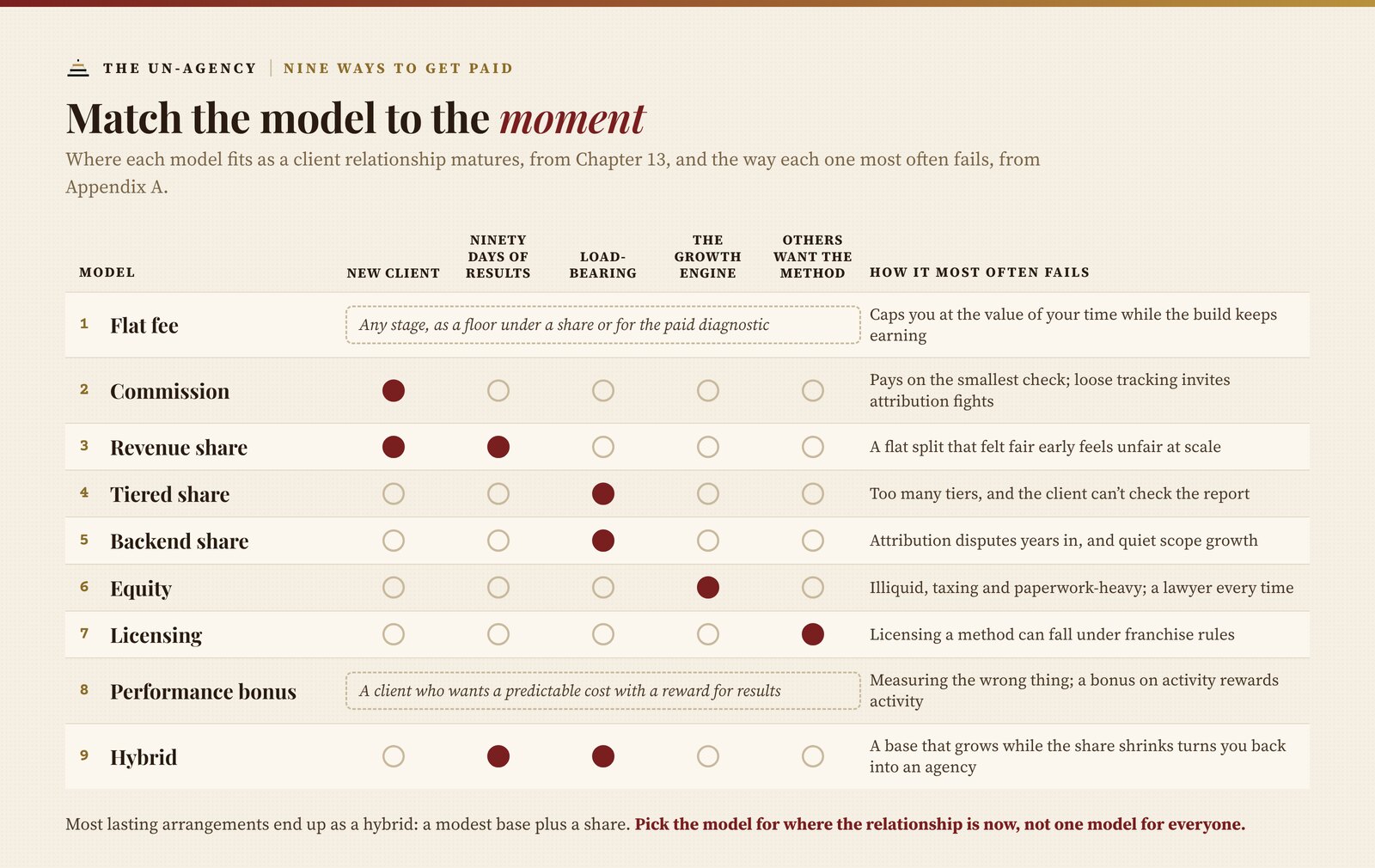
The book lists six more models this tool doesn't chart, because they don't reduce to one line: commission, tiered share, backend share, equity, licensing and performance bonus. Match the model to where the relationship is now, not to your preference.
This calculator follows Chapter 13, "Nine Ways to Get Paid," and Appendix A of The Un-Agency: A Services Operator's Playbook by Bill Eisenhauer. The book's illustration: a system producing around $30,000 a month in its first year and $45,000 in its second. A straight 20 percent share pays about $6,000 and then $9,000 a month; a $3,000 base plus 12 percent pays about $6,600 and then $8,400. Over two years the totals land close together. The difference is the floor: under the hybrid, a slow month never drops you below $3,000.
These numbers are illustrations of a structure, not expectations. Your results depend on the client, the market and the work, and many arrangements produce much less. Nothing here is legal, tax or financial advice. Any revenue share, bonus or equity deal needs a written agreement before work starts, covering what counts as revenue, how a sale is attributed, the rate, the baseline if you're paid on lift, reporting, your right to see the numbers and how it ends. Revenue shares are taxable and have reporting consequences for both sides; ask a tax adviser.