Reader kit
The Un-Publisher
A Media Operator's Playbook
The book's checklists and figures, set up to print and keep beside you while you work: walking a property for unsold surfaces, pinning down the owner's terms before the first sale, reporting to a sponsor, and checking a purchase before you make it. Everything here is already in the book. This page just puts it on paper.
This page is for readers of the book. It's free, and you don't need to sign up to use it.
In the kit
- The Guardrails Checklist (Appendix C, its own printable page)
- The Deal-Room Calculator (Appendix A, interactive)
- Five questions and the surface audit (Chapter 2)
- The broker term sheet (Chapter 9, Appendix B)
- The sponsor report and the route book (Chapter 13)
- Walk the rights stack (Chapter 14)
- Sponsors first: the validation checklist (Chapter 17)
- The comment gate (Chapter 18)
- Rules change (dated note)
Each worksheet has its own print button. The book's disclaimer applies to all of it: nothing here is legal, tax or financial advice, and every number in the figures is an illustration, not a result or a forecast.
Appendix C
The Guardrails Checklist
The lines drawn across the book, gathered in one place to run before each deal: before you contact anyone, before you sell a placement, before and after it runs, rights and licensing, lists and consent, buying a property, and money and taxes. When something in your deal isn't covered, or a question makes you hesitate, ask a lawyer licensed where you work before you go ahead.
Appendix A
The Deal-Room Calculator
The appendix's six steps, worked for you: check the owner's clicks against their opens, price the worst case, compare with what the sponsor pays elsewhere, set the working price from the last real sale, check the room for all three seats, and show the owner what's being left on the table. It starts with the appendix's illustrative newsletter. Put in the real numbers from the property in front of you.
The Un-Publisher · Chapter 2
Five questions and the surface audit
A surface is any place where attention already lands, that somebody else owns, and that nobody has sold. Run each one through five questions before you get excited.
Five questions for any surface
- Does attention land here? Not "could it," but "does it, now, in numbers the owner can show you?" Prefer the owner's own analytics to anyone's estimate.
- Would a paid message make this better for the audience, or at least not worse? If you can't say in one sentence why the audience would be glad to see the right message here, move on.
- Is it a dead end? The best surfaces sit where the content stops and nothing begins: the last page of a book, the final minute of an episode, the confirmation email after a purchase.
- How long does it last? A social post is gone in a day. A podcast episode, a book, a course or an evergreen page keeps working for years, and is worth pricing differently.
- Who owns it, and would they say yes? You don't put anything on it without that person's written permission. If you can't name the owner and imagine their yes, it's a place you noticed, not a surface you can sell.
Walk one property
Walk through it as a brand-new member of its audience would, from the first moment to the fortieth, and write down every place attention lands. For a newsletter: the signup page, the confirmation email, the welcome email or sequence, the regular issue (header, sponsor slot, body, footer), the archive pages, the "recommended" block, the renewal or upgrade email, and the unsubscribe page. For a podcast: the episode listing, the show notes, the pre-roll, the mid-roll, the closing minute, the episode's web page and the host's newsletter. Next to each, write three things.
| Surface | Seen by, per month | What sits there now | Anyone paying? |
|---|---|---|---|
Here's the walk for one illustrative newsletter. Most owners have never seen their inventory laid out on a single page, and the page itself is often the most persuasive thing you'll show them.
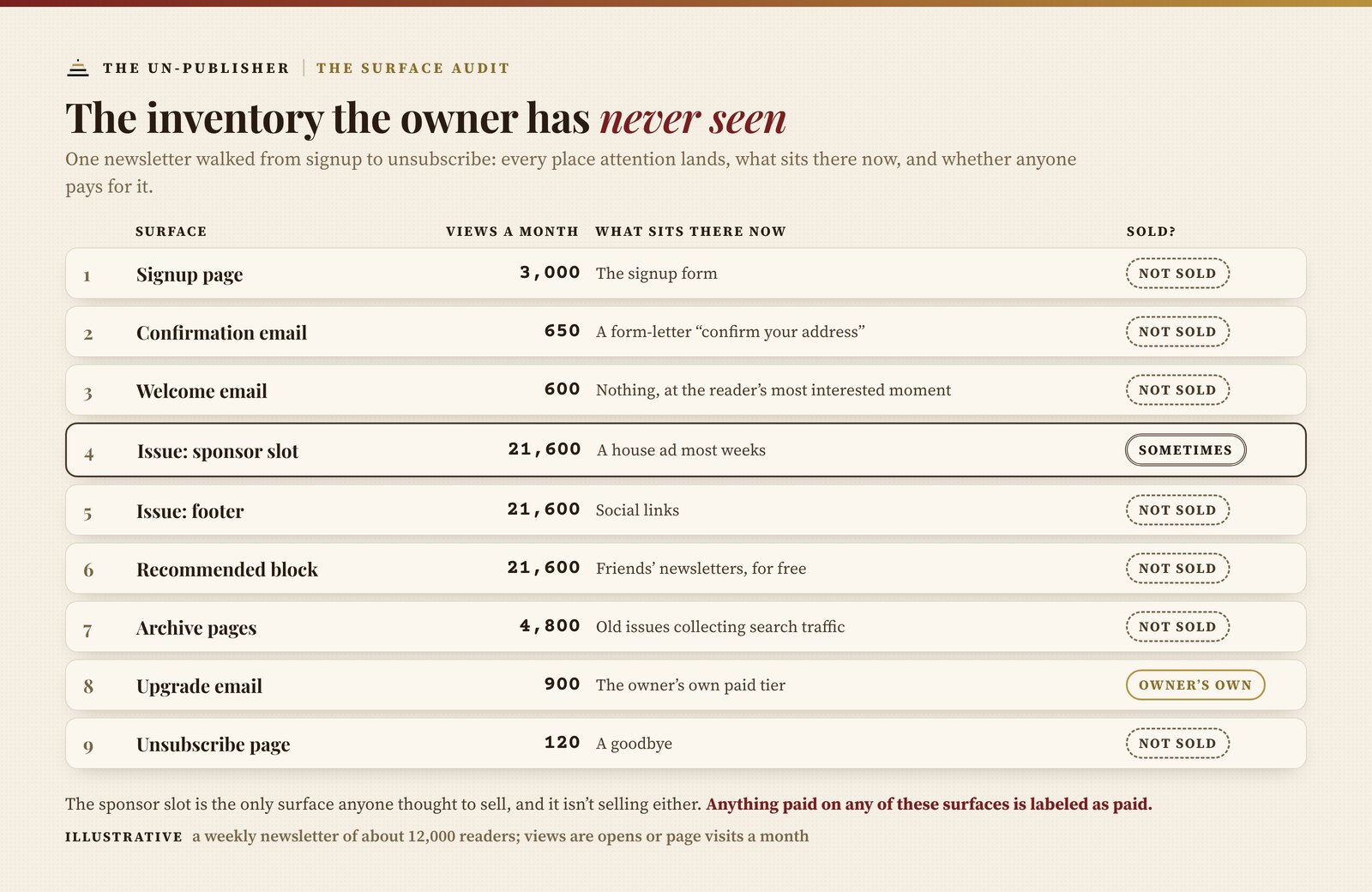
A surface isn't yours to sell until its owner says so in writing, and anything paid that goes on it is labeled as paid, where the audience will notice. If a placement only works when the audience doesn't realize it's paid, don't sell it.
The Un-Publisher · Chapter 9 · Appendix B
The broker term sheet
Your margin is locked the day you agree to the owner's floor, so the agreement with the owner comes before you sell a single slot. This is a list of what to pin down, not a contract. A lawyer drafts your standard version once, and you reuse it.
- Inventory. How many issues or episodes a month, how many sponsor slots in each, what kinds of placement, which slots the owner reserves for their own use, and how many business days of lead time they need to insert a sponsor.
- The floor. A dollar amount per placement that goes to the owner no matter what you sell it for. Write it as a number, not a percentage.
- Resale. You may sell any unreserved slot at any price at or above the floor. Pick a model: a spread (you keep everything above the floor) or a split (you share what's above it at a stated percentage). Multi-issue blocks never go below the floor per issue.
- Exclusivity. Either you're the only one selling the owner's space, or you aren't and the owner promises not to undercut you.
- Click reporting. Within two business days of each send: delivered count, opens, and unique clicks on each sponsor link, with permission to share them with the sponsor. Don't sign without this one. Without it there's no sponsor report, and without the report there are no renewals.
- Copy and approval. You or the sponsor draft. The owner approves or requests changes within two business days, and silence past that counts as approval. Vetoes happen before a slot is sold.
- Inbound forwarding. Sponsor inquiries that reach the owner's inbox are forwarded to you within two business days and count as your sales.
- Term and exit. Six months, then month to month, with thirty days' notice from either side. Placements already sold are honored after notice.
- Money. Who invoices the sponsor, and the date the owner's share is paid. Payments go between the principals. You don't hold other people's money; if you must collect, a lawyer sets it up first, and the owner's share stays separate from your own funds.
- Make-goods. What happens if a send fails, runs late or clearly under-delivers: a free repeat, a credit, or a partial refund, and who decides which.
- Disclosure. Every placement is labeled as sponsored where readers will see it.
Before you sign
- Run a small payment through the invoicing or payment tool you'll use, in the direction it will really flow.
- Check that the platform the property runs on allows third-party sponsorship sales and this kind of placement.
Phrases to watch for
"We'll take care of you," "fees to be agreed," "reasonable efforts," "industry-standard reporting." Each one is a term that hasn't been settled. Ask for the number, the date or the definition, and get it written down.
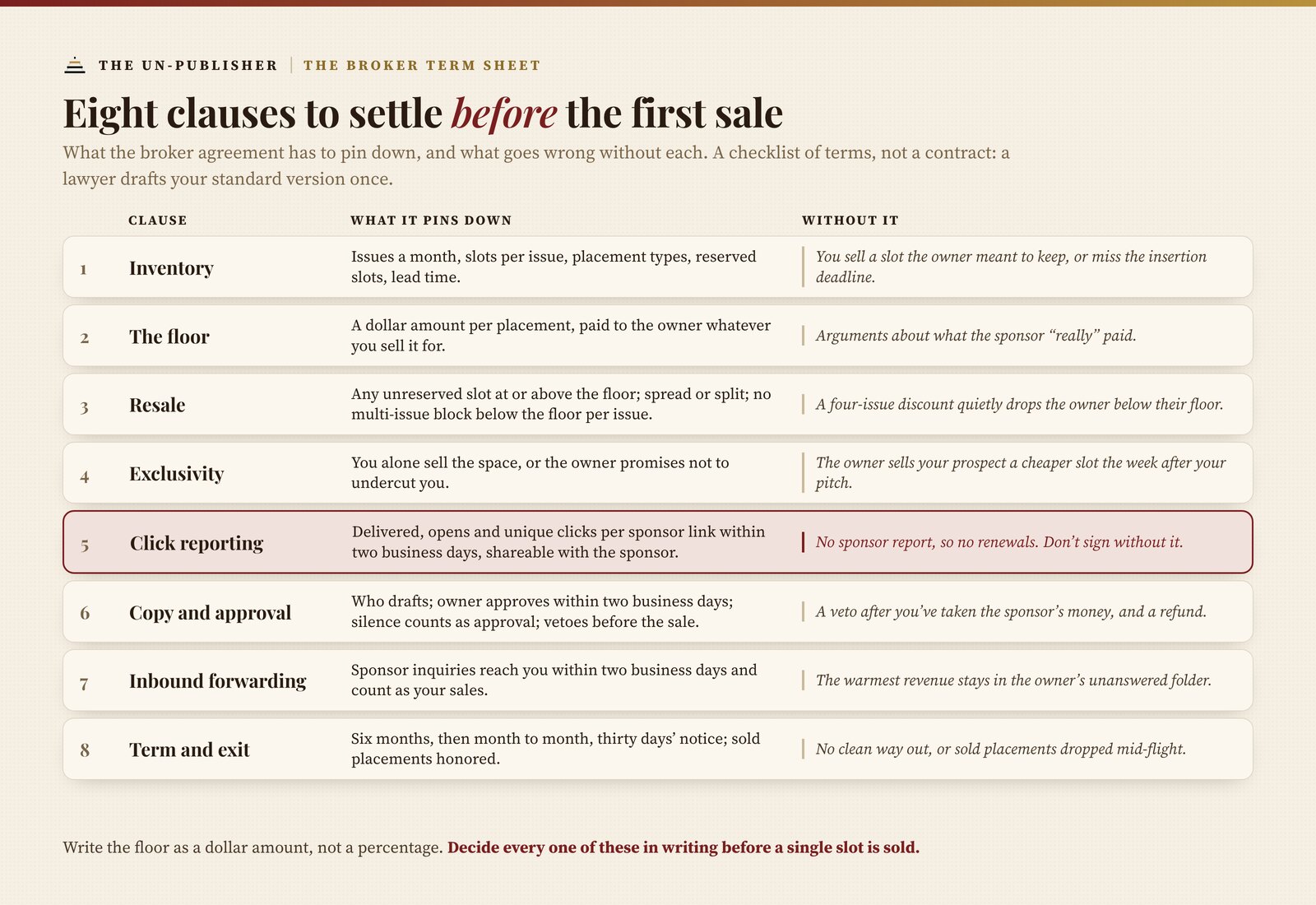
This is a checklist, not a contract. Have a lawyer draft the standard agreement, and an accountant look at sales tax on advertising in your state. Appendix B has the same kind of pattern for the sponsor order, the endorsed send, the back page, rights licenses, contributors, founding sponsors and auctions.
The Un-Publisher · Chapter 13
The sponsor report and the route book
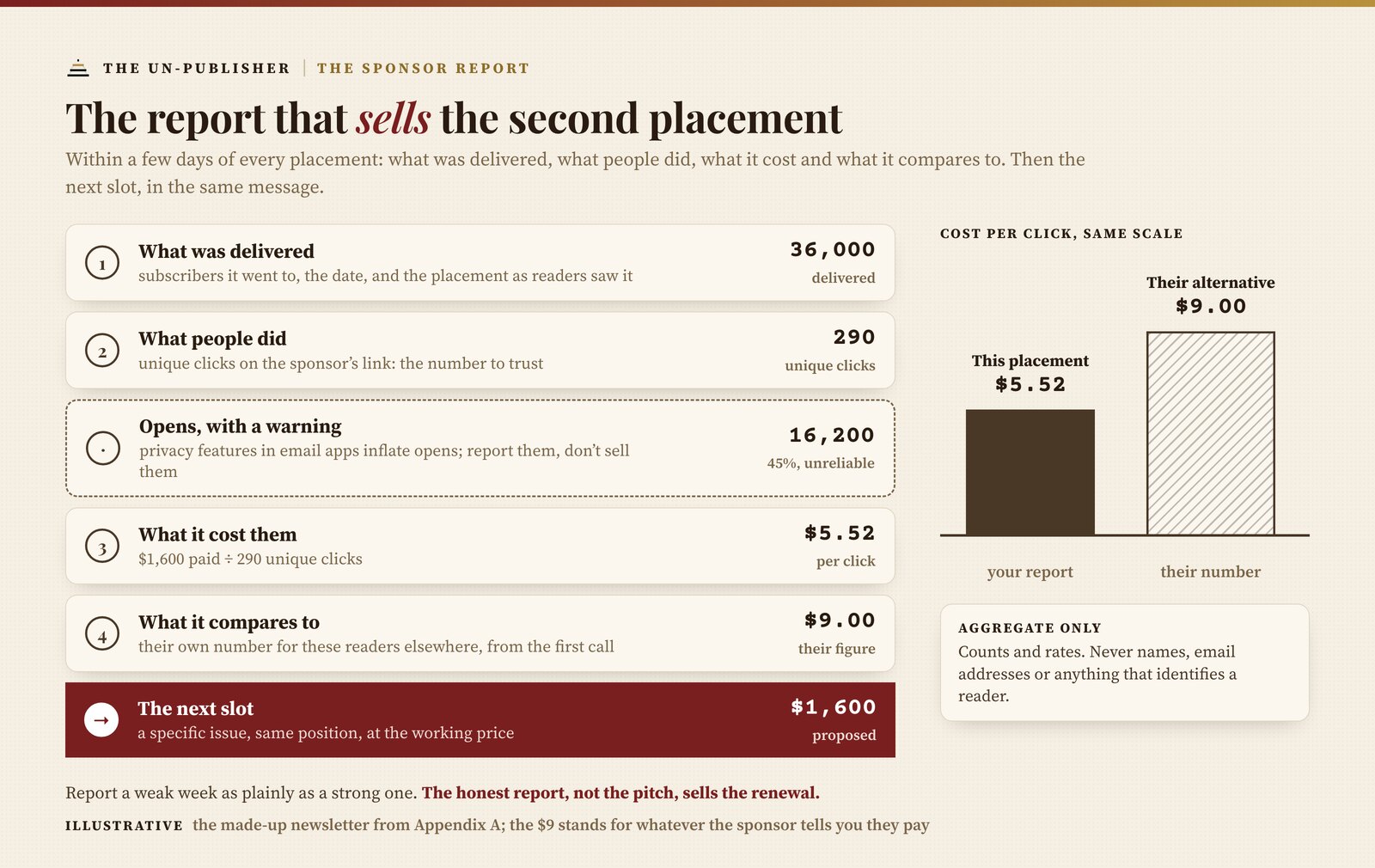
The first placement is a test. What the sponsor learns from it decides whether there's a second. Within a few days of every placement, send a short report. Not a thank-you note. A report.
Four things in every report, then the next slot
- What was delivered. How many people the issue or episode went to, on what date, and exactly what ran, with a copy or link to the placement as the audience saw it.
- What people did. Unique clicks on the sponsor's link. Opens if you have them, with a note that open counts are unreliable because email privacy features inflate them. Clicks are the number to trust.
- What it cost them. Their effective cost per click: what they paid divided by the unique clicks. Give it to them rather than making them work it out.
- What it compares to. Put your effective cost next to what they told you they pay elsewhere, in their own terms. If it came in worse, say that too, along with what you'll change next time.
- The next slot. End with a proposal: a specific next date, or a specific block, at the working price.
When they ask for a block discount
Hold the price. Offer things that make a block worth more instead: priority dates in the issues your data says perform best, first refusal on next quarter, a short results call after each send, a placement in a different position to test against the first.
When a send fails
Tell the sponsor before they notice, say what happened in one sentence, and deliver the make-good you agreed without being asked twice.
The route book: one line per sponsor
| Sponsor | |
|---|---|
| Started | |
| What they've run | Dates and positions. |
| Cost per click | Every placement, so you can see whether it's getting better or worse. |
| Pays elsewhere | What they told you. |
| Behind them | Who else they buy for: an agency's clients, an association, a buying group, a dealer network. |
| Next contact | The date, and what you'll mention. A sponsor who hasn't heard from you in ninety days has forgotten you. |
Sponsor reports contain aggregate numbers only: delivered, opens, unique clicks, cost per click. Never pass personal data about readers or listeners to a sponsor, and never let a sponsor have or rent the list. If your tracking touches personal data, get professional advice on what privacy laws require.
The Un-Publisher · Chapter 14
Walk the rights stack
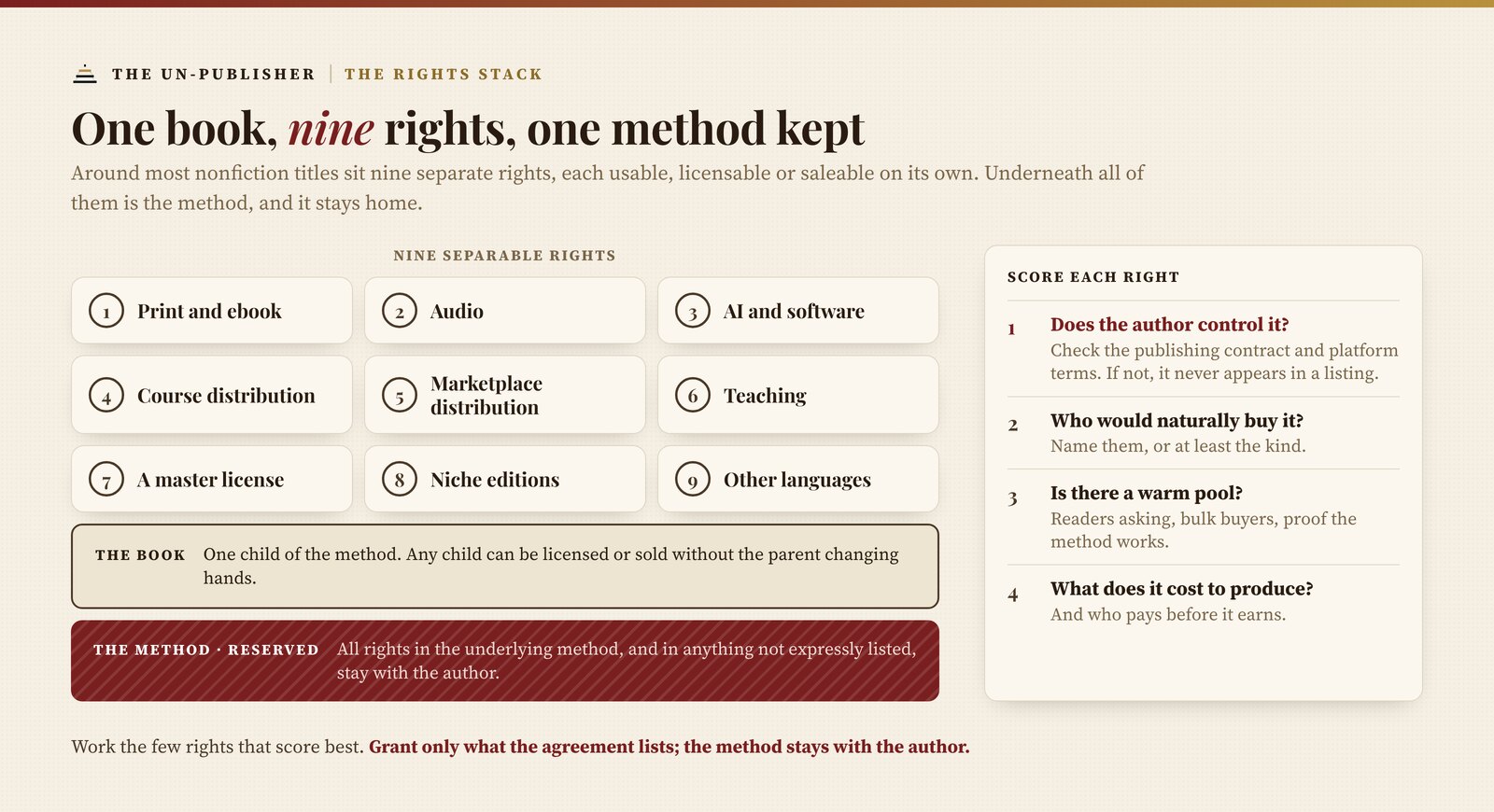
Block ninety minutes with the author. It's their land, so they're in the room. Start with two sentences: the method in one sentence, and this book in one sentence. If the author can't name the method in a sentence, stop. Nobody knows yet what's being kept.
The nine rights
- Print and ebook in the original language.
- Audio.
- AI and software rights: using the material inside an assistant, a tool, or a template product.
- Course distribution: adding the work to someone else's existing course catalog.
- Marketplace distribution on specific platforms and channels.
- Teaching rights: workshops, groups, one-to-one, live events.
- A master license with the power to appoint sub-licensees.
- Niche editions: the same book re-cut for dentists, or roofers, or financial planners.
- Other languages, including licensing to publishers abroad.
Four questions for each right
- Does the author control it? Check the publishing contract and any platform terms first. A right the author doesn't control never appears in a listing.
- Who would naturally buy it? Name them, or at least name the kind.
- Is there a warm pool? Readers who've already asked, a profession that buys the book in bulk, proof the method works.
- What does it cost to produce, and who pays? A translation costs real money before it earns any. A teaching license costs almost nothing to grant.
Score each right and work the few that score best. Before you produce anything, see whether you can pre-sell it.
The reservation line, in every agreement
All rights in the underlying method, and in anything not expressly listed here, stay with the author. Only the rights listed below are granted.
License only what the licensor actually owns, and confirm in writing that the author controls each right before you offer it. Agree your own share with the author in writing, right by right, before you approach any buyer, and make sure buyers know you're acting for the author. AI and software rights are a fast-changing area of law; treat any grant of them as something for a lawyer to draft.
The Un-Publisher · Chapter 17
Sponsors first: the validation checklist
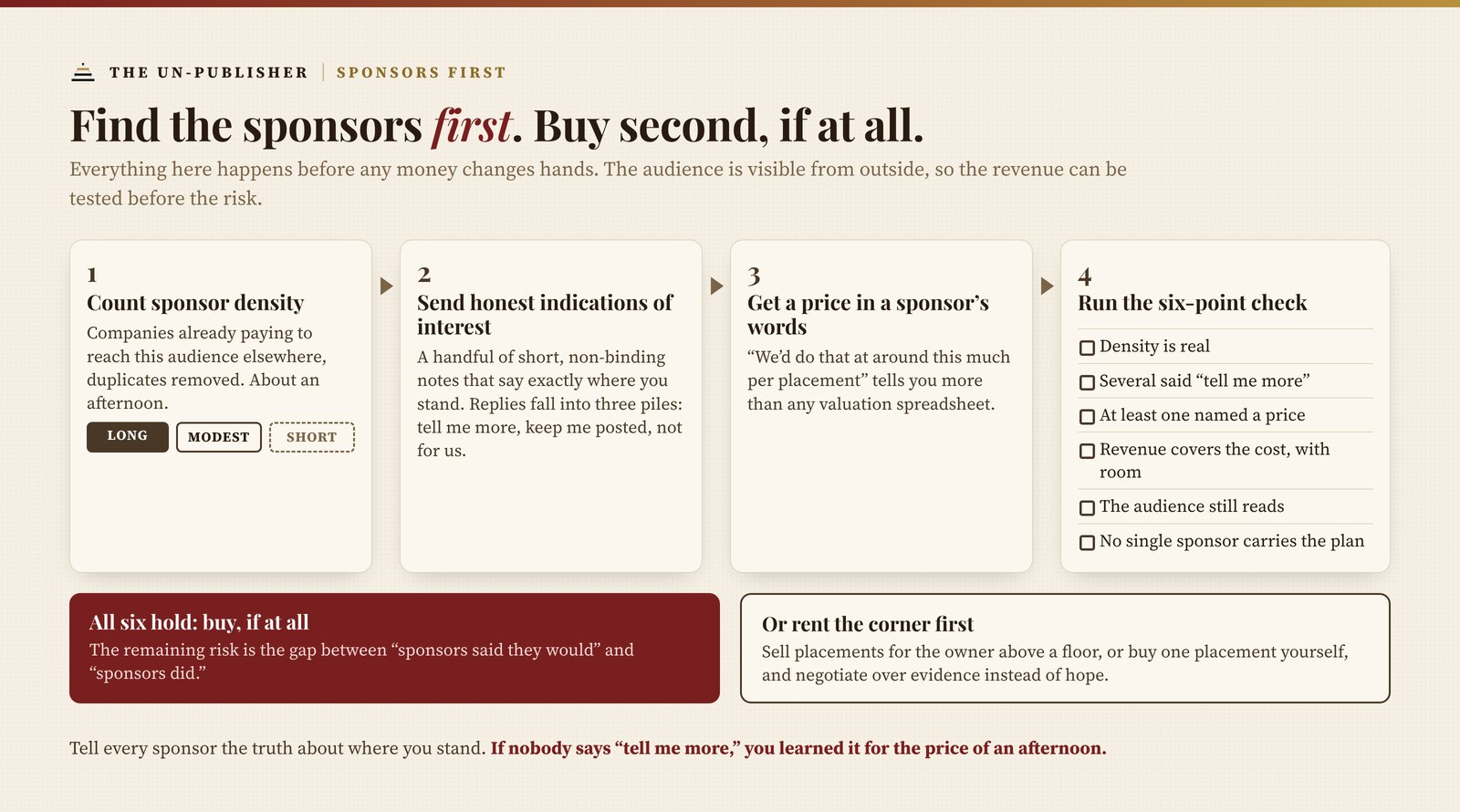
Before you buy or start a property, find out whether anybody pays to reach its audience at all, and talk to them plainly.
Count sponsor density
Similar newsletters and podcasts, conference exhibitors, trade-publication advertisers. Remove the duplicates and read the total in bands, as working bands rather than rules.
- A long list, dozens of companies: the audience is proven.
- A modest list: sponsorship is possible but will take more creativity, including sponsors from neighboring fields.
- A short list: be careful. Either businesses don't pay to reach this audience, or the field is too new for sponsors to have found it yet.
The honest indication of interest
Short, non-binding, and true. It leads with the audience, gives a real reason you're writing to this sponsor, and asks for a conversation. The book's example:
"I'm in conversations about taking over a newsletter that reaches about six thousand independent insurance agents; the owner reports roughly half open each issue. I noticed you sponsor a similar publication. If I go ahead, would a short call about sponsoring make sense?"
The six-point check, before any money changes hands
- Sponsor density is real. A meaningful list of companies already paying to reach this audience elsewhere.
- Several sponsors said "tell me more." Not one polite yes. Several.
- At least one gave you a price. In their own words, per placement.
- The revenue covers the cost with room. If the purchase is paid over time, validated sponsor revenue covers each payment comfortably, not barely.
- The audience is actually there. Recent opens, clicks, posts and replies, not member counts.
- No single sponsor carries the plan. If everything depends on one company's enthusiasm, you've found a customer, not a business.
Tell sponsors exactly where you stand: considering, or in talks, never "finalizing" unless you are. Quote only audience numbers the owner agreed you can share, labeled as theirs. If the deal falls through, tell anyone you spoke to. Don't raise money from other people by promising them a return; if you need outside money, talk to a lawyer before you talk to investors.
The Un-Publisher · Chapter 18
The comment gate
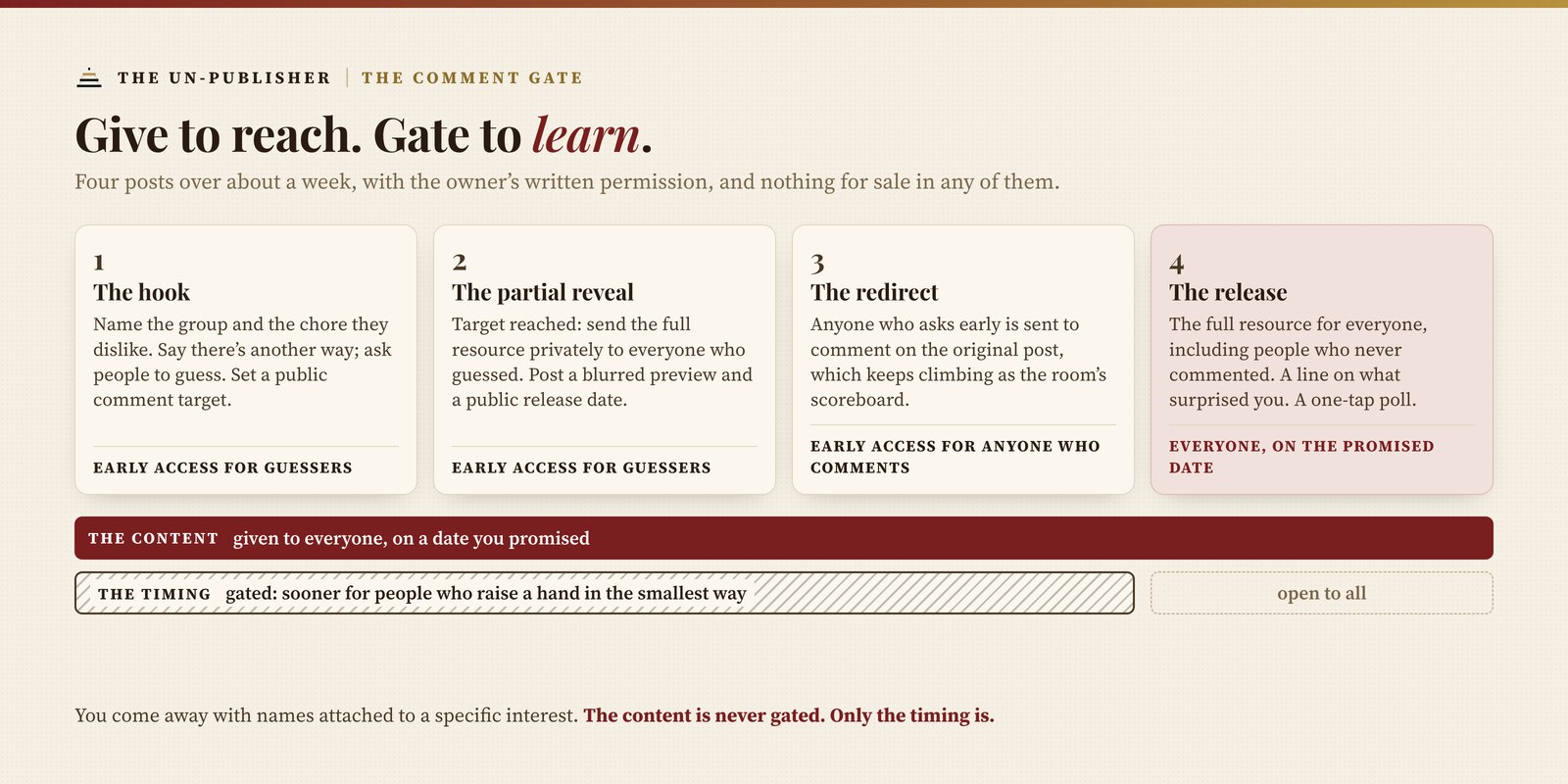
For a community or newsletter that went quiet: find out who's still in the room before you count sponsors. Get the owner's permission in writing first (a message is fine), and check the platform's rules on comment-gated posts.
Find the post they already answered
- Pull the last thirty to sixty posts and write down the response count for each.
- Find the outlier, and read every comment on it.
- Look for questions nobody answered, and for a chore the field treats as mandatory that a lot of people quietly hate. A strong want plus a disliked chore is a topic you can build on.
Four posts over about a week, nothing for sale
- The hook. Name the group, name the disliked chore, say there's another way, and ask people to guess. Set a public comment target a bit below what the archive's best post managed. Guessers get it first.
- The partial reveal. Once the target is reached, send the full resource privately to everyone who guessed. Then post a blurred preview with a public release date a few days out.
- The redirect. Anyone who asks for it early is sent to comment on the original post, not this one.
- The release. The full resource for everyone on the promised date, including people who never commented, with a one-tap poll: want a part two?
Engagement velocity: the go/no-go
New interactions in a week divided by the members you can reach. Working rules, not laws; watch the trend more than the starting point.
- Healthy: around a twentieth or more of reachable members interacting in the first couple of weeks. Go ahead with the editorial plan and start talking to sponsors.
- Middling: between a fiftieth and a twentieth. Build the publication, but wait on sponsors until the number rises.
- Weak: below that. Try a different topic from the archive before you spend anything more.
Call every hand back
Message every person who raised a hand, one at a time. Refer to their own guess or vote, and ask what they're trying to get to and what's in the way. No offer. No link. Log what each says in their own words, and every twenty conversations or so, count the phrases that keep coming back.
Those notes are personal information members shared in confidence. Keep them private, keep them only as long as you need them, and never pass names or individual comments to sponsors. What a sponsor can see is the aggregate: how many people, which themes, in what proportions.
Rules change · Last reviewed 25 October 2026
The lines the book sends to a lawyer move
Several questions in the book end with "ask a lawyer" or "ask an accountant," because the answers vary by place and change over time: how sponsored content and endorsements must be disclosed, the privacy laws in the EU, the UK and several US states that cover audience data and tracking links, anti-spam rules for outreach, sales tax on advertising, the rules for regulated sponsor categories, the rules that apply when outside money goes into a purchase, and AI and software rights, which the book calls a fast-changing area of law. Platforms change their own terms too, including whether they allow third-party sponsorship sales or comment-gated posts.
This page doesn't track those changes for you, and nothing on it is legal advice. It's a reminder that a rule you checked last year isn't checked this year. Before a deal that touches any of them, confirm the current rule with a lawyer or accountant licensed where you work.
When a change affects something the book says, we'll note it here with the date.
Kit updates
Get updates to the kit and the rules page, and hear when the next book is out. The kit stays free here either way, and the book is complete without it.
Signup opens soon.