Deal-Room Calculator
Before you sell a placement in someone else's newsletter or podcast, check that the deal has room for all three seats at the table: the owner, the sponsor and you. This works through the method one step at a time, from whether the owner's click numbers make sense to what an empty slot is costing them each month.
It's a sequence of questions and arithmetic, and you should be able to explain every line to the owner. Get recent figures from them first, from the last five or so issues, not lifetime averages.
Ask the sponsor for their cost per click elsewhere; don't quote market averages as fact. The default is the book's sponsor, who said "somewhere under ten dollars."
Inside that range, so it's plausible.
One to three percent of opens is a common working assumption, not a law. If the owner quotes a click-through rate, ask whether it's measured against opens or against delivered; the difference can be several times over. Opens are rough, so use them to sanity-check clicks, not as a selling point.
Sponsors buy people who arrive on their site. Use the low end of the click range, because that's the week that decides whether a sponsor renews.
At or below what the sponsor pays elsewhere, you're selling on price. Up to about 20% higher needs a quality argument with evidence behind it. Well above with no evidence of quality, the placement is worth more to the owner than to the buyer.
The rate card hasn't sold at $2,500 in a year, so it isn't a price.
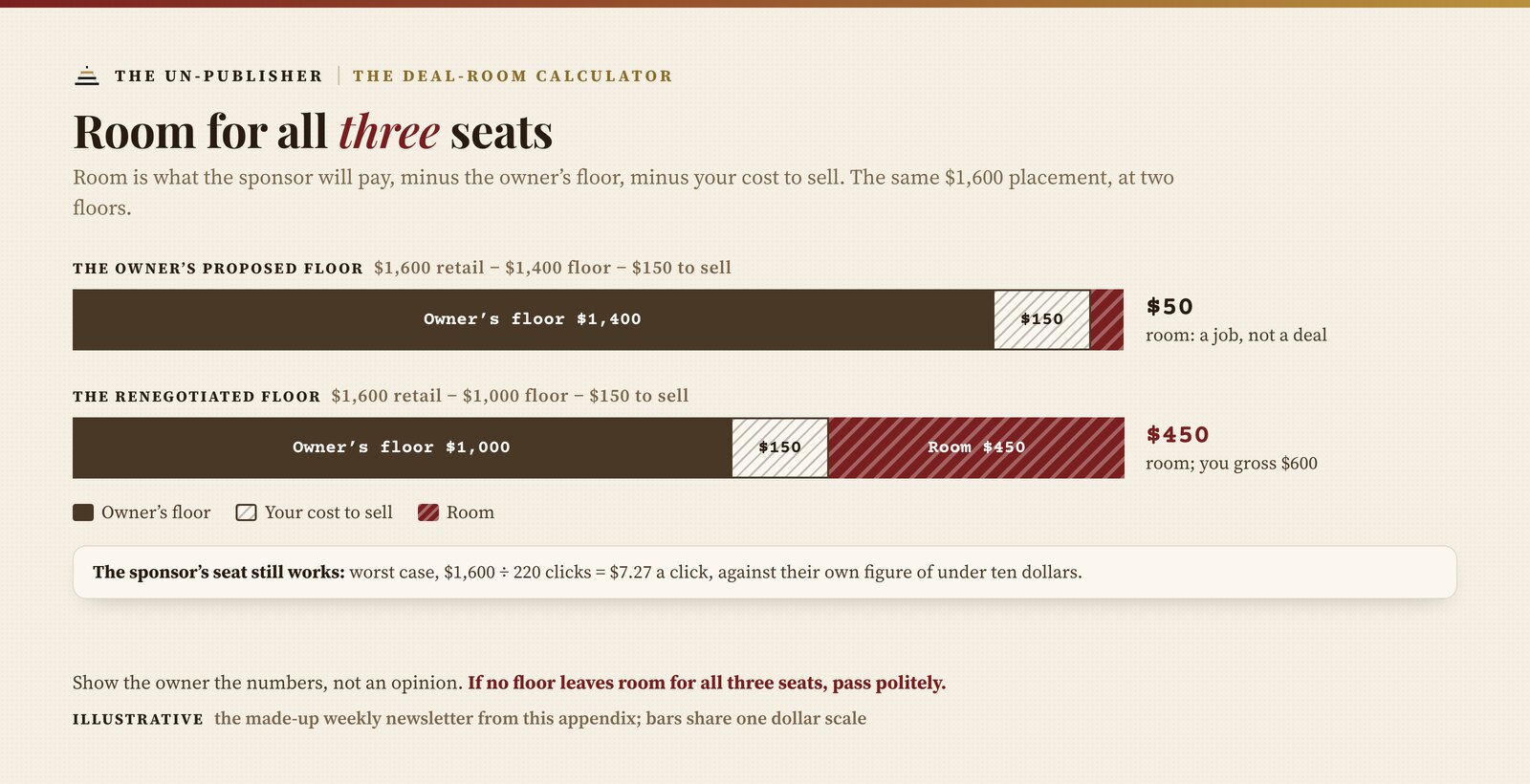
Room = retail the sponsor will pay − owner's floor − your cost to sell it.
Working rules, not laws: the floor usually needs to sit at or below about 60–70% of a retail price you can defend with the click math, and your take usually lands somewhere between a quarter and a half of retail. If the owner's floor is within about 15% of retail, there's no room for you. Your take here is retail minus the floor, before your costs.
The gap between what the owner imagines on paper and what they collect today is the most persuasive number you'll show them, and their share of the filled slots is real money they aren't getting now. These are illustrations of the arithmetic, not a forecast.
Only the floor is the problem. At the floor you'd propose, all three seats work.
After the first placement, rerun the whole calculation with the actual click count from the first send. Send the sponsor their delivered count, opens, clicks and effective cost per click, next to what they told you they pay elsewhere. That report, not the pitch, is what sells the second placement.
From The Un-Publisher
This calculator is Appendix A of The Un-Publisher: A Media Operator's Playbook by Bill Eisenhauer, from Toll Stack Press. The book covers where the numbers come from: why sponsors buy clicks rather than subscribers, how to talk about the split with an owner, and the term sheet to sign before the first sale.
Not legal, tax or financial advice. The numbers this produces are only as good as the ones you put in, and the working rules are starting points, not guarantees. Many people who try these methods earn little or nothing at first. Every paid placement gets labeled as paid, where readers will see it.