Finder's Fee Calculator
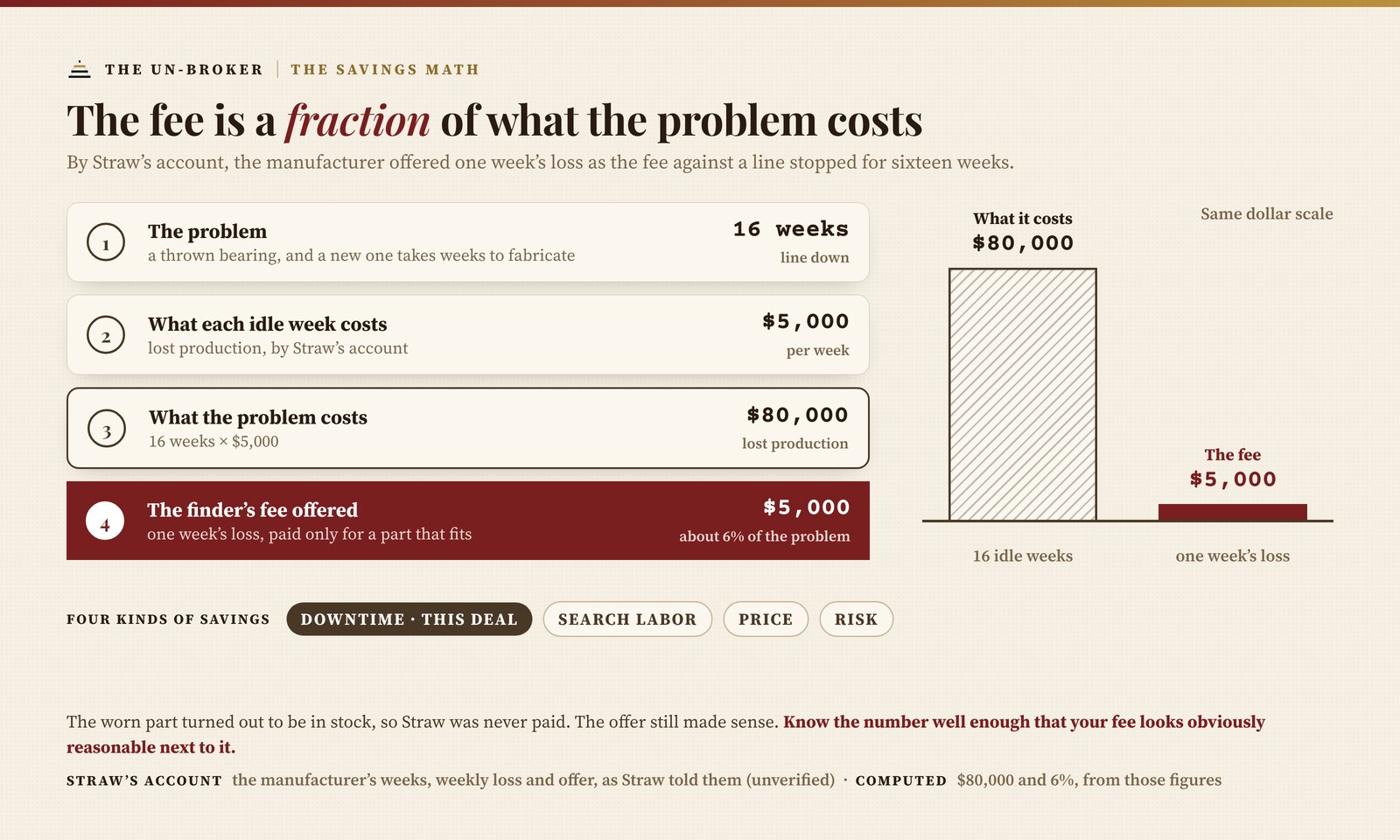
Companies pay finders to save money. A fee makes sense when it's a small slice of what the problem costs the person who has it, and that's easier to say in a letter if you've worked the number out first.
This page does three pieces of arithmetic from The Un-Broker: the savings math behind a single fee, the comparison between a one-time fee and a continuing one, and a fee paid on every unit delivered. The defaults are the book's own illustrative numbers, not rates anyone should expect. Put in your own.
The client pays $5,000 to get out of an $80,000 problem.
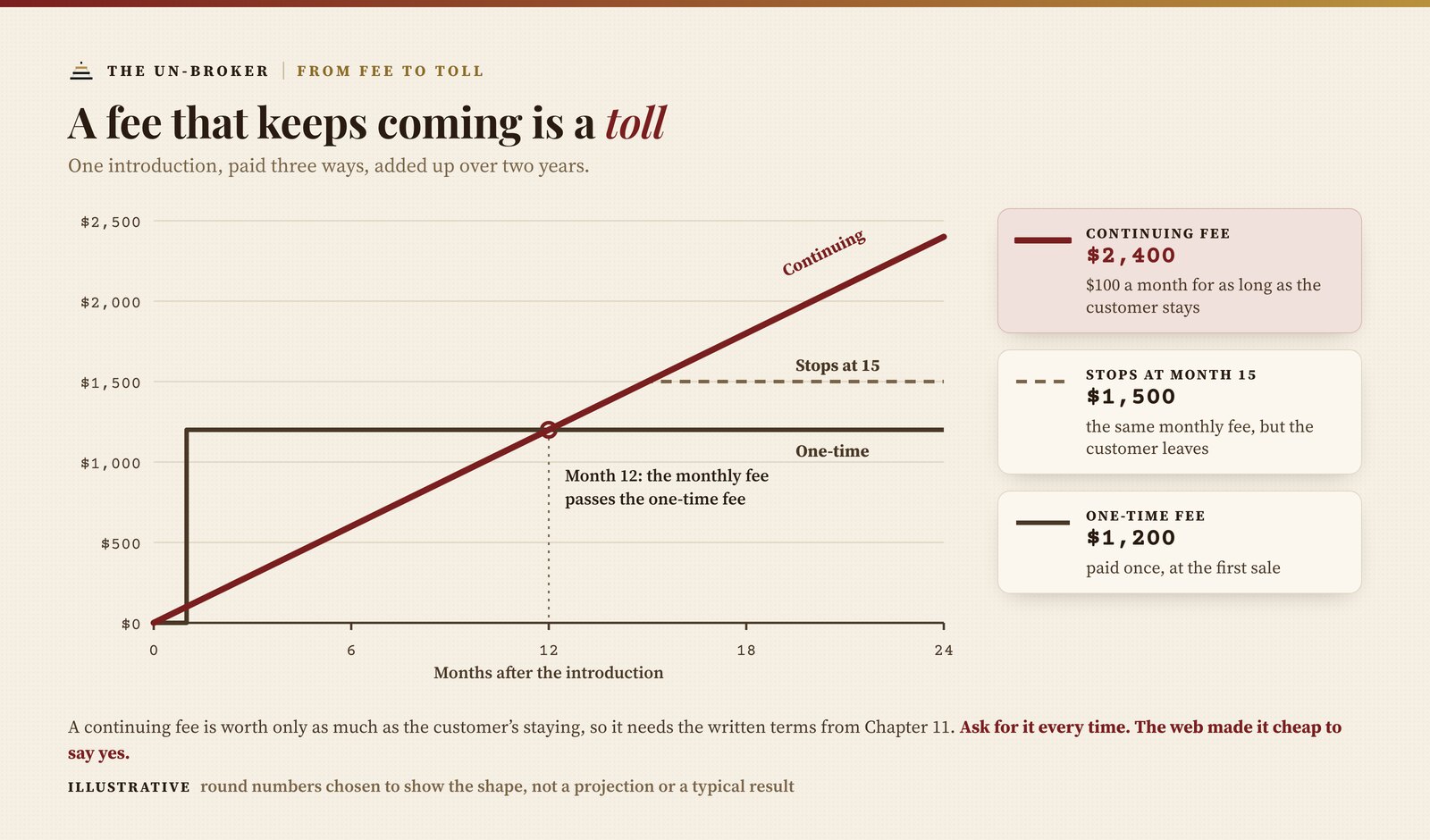
A continuing fee is only worth as much as the customer's staying, so it needs written terms: which customers count, what counts as revenue, the percentage, how long, how it's reported, and your right to see the numbers. Price it smaller per transaction than a one-time fee. Ask for it every time.
The defaults are the oilman from Straw's success stories, by his account: a quarter a barrel on ten thousand barrels a day, which he collected every month for five years. He'd spent his career in the oil business and knew exactly who to call. Crude oil is one of Straw's "exotics," a field for insiders and a favorite of advance-fee fraud. The arithmetic travels. The deal doesn't, unless you know the field cold.
- Who pays. Usually the seller, who receives the money and is used to paying commissions. Ask the seller, and accept what a buyer offers. Take money from both sides only with written disclosure to both.
- Less than a commission. You introduced a buyer; the seller still has to sell. If a client asks you to name a fee, ask what sales commission is customary in their trade and let them offer something in line with it, less their own sales cost.
- Mostly, the client sets the fee. They offer. You accept, decline to make the introduction, or counter with a reason you can say in one sentence.
- Pin it down in writing. A dollar amount or a percentage, and a percentage of what (gross sale, net of shipping, first order only), plus the trigger, the period, and whether repeat business pays again. All of it before you disclose the name. The fee-letter checklist is in the reader kit.
- Take the small fee. When the contact is already in your file, the next introduction costs a letter. A pound of feathers weighs as much as a pound of lead.
Some fields need a license to be paid for introductions, and calling yourself a finder won't change that. The book treats these as off-limits: securities and raising money, loans and mortgages, real estate (get licensed or refer to a licensed agent and expect no fee), insurance, healthcare referrals (off-limits for everyone), real-estate settlement services, and government purchasing. Business brokerage and staffing depend on the state and the deal. Never take a secret commission on your own employer's purchases.
This is not legal advice. The rules vary by state and by the facts of a deal, and this calculator only does arithmetic. Near any of these fields, talk to a lawyer licensed where you live before you accept a dime. Fees are taxable income, too; ask a tax adviser how to handle them.
This calculator follows The Un-Broker: A Finder's Playbook for the Age of AI by Bill Eisenhauer, from Toll Stack Press. The savings math is Chapter 3, who pays and how much is Chapter 13, the fee letter is Chapter 11, and the move from one-time fee to continuing fee is Chapter 21.