Reader kit
The Un-Broker
A Finder's Playbook for the Age of AI
The book's checklists and figures, set up to print and keep beside you while you work a deal: what to check before outreach, before you give up a name, and before you take a fee. Everything here is already in the book. This page just puts it on paper.
This page is for readers of the book. It's free, and you don't need to sign up to use it.
In the kit
- The Guardrails Checklist (Appendix C, its own printable page)
- What a fee letter has to pin down (Chapter 11)
- The inventory record (Chapter 4)
- Qualify the principal (Chapter 9)
- The disclosure sequence (Chapter 12)
- The ladder (Chapter 1)
- The finder's fee calculator (interactive)
- Rules change (dated note)
Each worksheet has its own print button. The book's disclaimer applies to all of it: nothing here is legal, tax or financial advice.
Appendix C
The Guardrails Checklist
The book's working positions in one place, to run at every stage of a deal: fields to stay out of, before outreach, before disclosing a name, before the introduction, before accepting a fee, before a snooper or option deal, and ongoing. If the answer to any question is "no" or "I'm not sure," stop until you've sorted it out.
The Un-Broker · Chapter 11
What a fee letter has to pin down
A checklist of things to cover before you disclose anything, not a form to fill in. A fee letter that says "we'll take care of you" is a thank-you note.
- The fee itself. A dollar amount or a percentage, and a percentage of what: gross sale, net of shipping, first order only.
- The trigger. What event earns it. A signed purchase order? A delivered and paid invoice? A closing?
- The introduced party. Who counts as your introduction, identified clearly enough that nobody can later claim they already knew them.
- The period. How long after the introduction a deal still earns the fee. Six months, a year, "any transaction arising from this introduction."
- Repeat business. Whether later purchases by the same party pay again. Ask, even when you expect a no.
- When and how you're paid. Net 30 is a common term; whatever you agree, say so.
- Telling you it closed. A line that the client will let you know when a deal with your introduction closes.
- Your role. That you're introducing only, not selling, negotiating, or representing anyone.
- Disputes. What happens if you disagree, and which state's law applies.
Keep everything
- One folder per deal, opened the day you find something, before you write to anyone.
- Save the original listing or post as it appeared, with the date. Listings vanish.
- Keep the whole thread, both directions, in order. Forward phone-call notes to yourself the same day so they're timestamped.
- The signed fee letter goes in as a PDF, alongside the e-signature record.
- Never delete anything from a deal folder, including the deals that died.
This is a checklist, not a contract. Have a lawyer licensed in your state draft your standard fee letter once, then look again whenever the money is large, the field is regulated, or the other side sends you their own paper.
The Un-Broker · Chapter 4
The inventory record
Seven fields turn a list of names into a two-sided inventory. A spreadsheet works to start; use these as your columns. Print a page per contact if you work on paper.
| Who | Company, the specific person, their role, how to reach them. The person matters more than the company. |
|---|---|
| Has | What they sell, produce, or have available, including surplus, closeouts and unused capacity. Be specific. |
| Wants | What they buy or need, now or regularly. The side most people leave blank. |
| Source | Where you found them: the listing, the post, the filing, or the person who referred you. |
| Referred by | If someone introduced you, who. |
| Last confirmed | The date you last verified the record was still true. The most important field. |
| Notes | Every conversation, every detail, every small personal thing they mentioned. |
Keep the stock fresh
- Before you use a record, confirm it. A record from last year is not qualified today.
- Active records, quarterly. Anyone in a live or recent opportunity gets a light touch every few months.
- Everything else, yearly. Sweep the whole inventory. Flag anything you can't confirm and mark it cold; don't delete it.
Your inventory holds information about real people. Keep what you need and no more, store it securely, and delete a record when someone asks. Don't paste confidential letters or a seller's private inventory into an AI tool that may keep or train on it.
The Un-Broker · Chapter 9
Qualify the principal
The three checks
- The buyer is a buyer.
- The seller is a seller.
- What the seller is offering is the specific thing the buyer needs.
Just ask
Jim Straw's question: "Are you the principal or are you acting as a broker?" Write down the answer. If they're a broker or a finder, ask for a copy of their agreement with their principal, with the name and address blanked out.
The verification stack, cheapest first
- 1. Ask the question. Principal or broker? Write down the answer.
- 2. Check the entity. Look the company up in the official business registry where it claims to be incorporated. Does it exist, is it active, does the registered address match?
- 3. Check the footprint. Domain registration date, how long the website has existed, trade publications, association directories, news older than this month.
- 4. Check the goods. Photos taken today with proof it's today; a serial or lot number you can verify; an inspection. For a buyer: what they buy now, from whom, in what volume.
- 5. Check a person. Talk to a human being, live, on the phone or on video.
- 6. Check a reference. One customer or supplier who has done business with them, found by you rather than supplied by them.
- 7. Check authority. Can this person commit the company to a deal?
The want
- Are you selling the whole lot, or looking for sales?
- Would you sell at a discount to clear it?
- By when?
- What would make you say no?
A research agent can help with steps two and three. It can't do steps five through seven for you. Never pay anything up front to be introduced to a deal.
The Un-Broker · Chapter 12
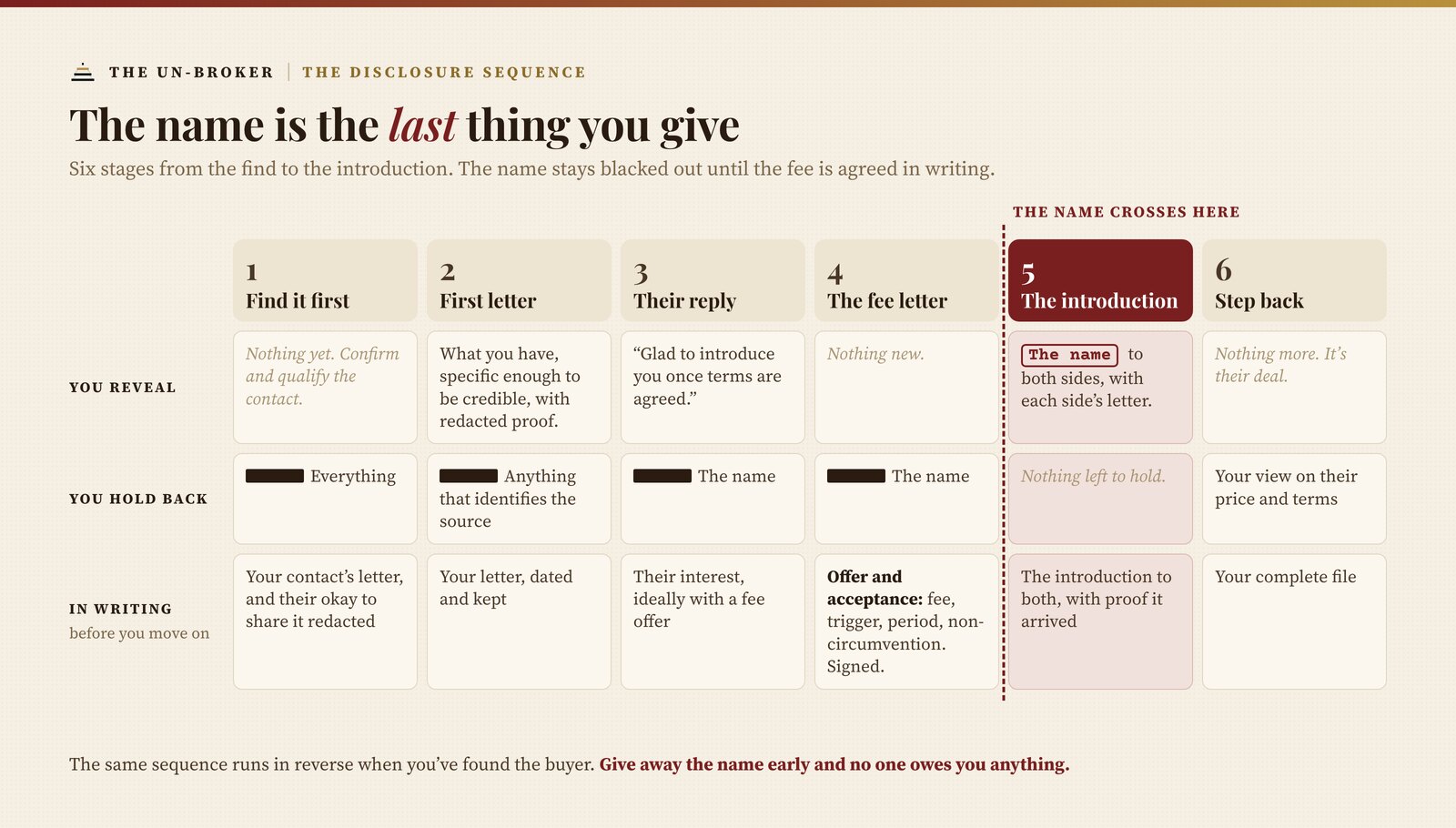
The disclosure sequence
What you reveal, what you hold back, and what must be in writing at each of six stages. The name crosses only after the fee letter is signed.
The Un-Broker · Chapter 1
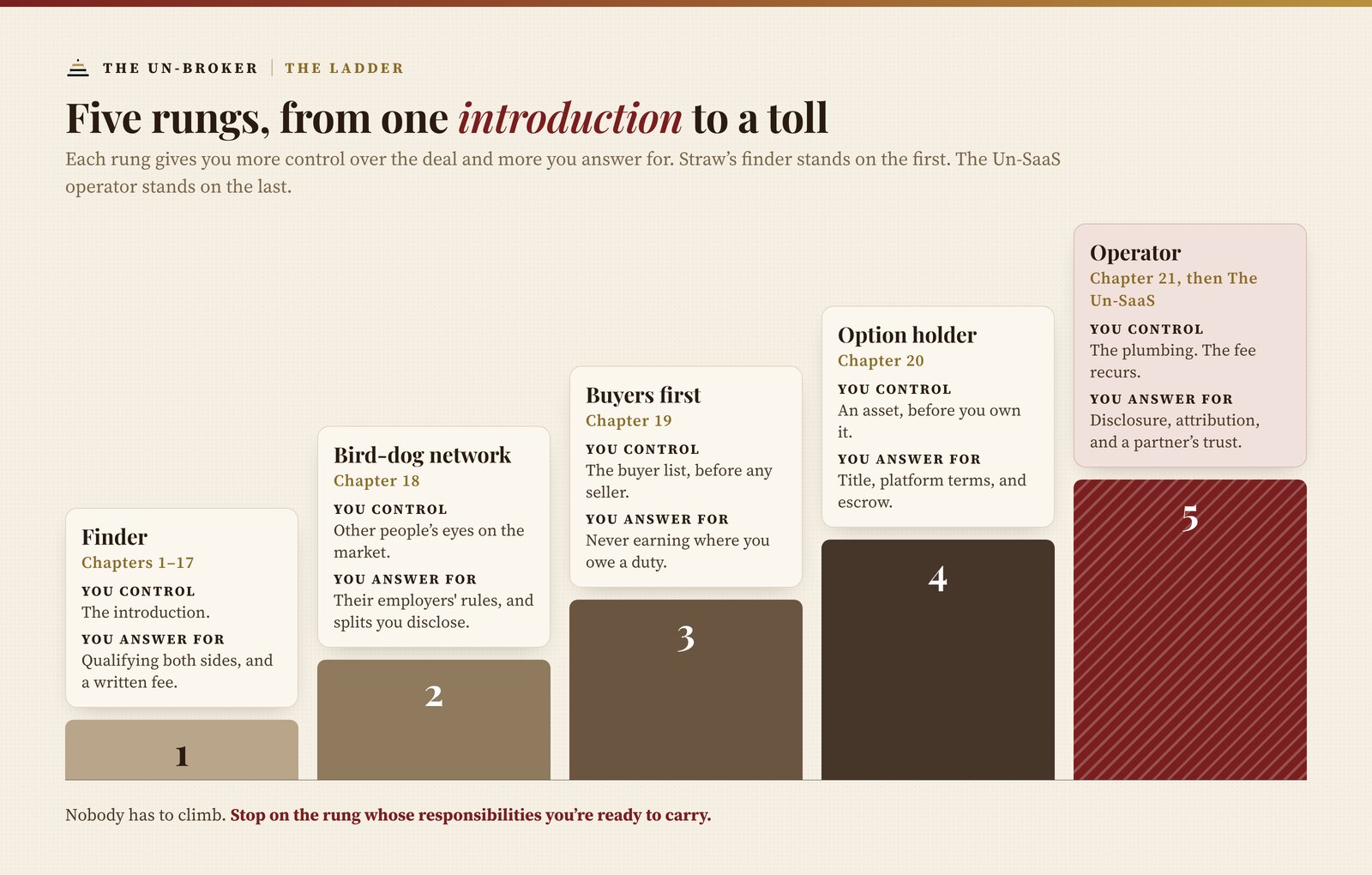
The ladder
Each rung gives you more control over the deal and asks more of you in return.
Rules change · Last reviewed 27 September 2026
The lines the book sends to a lawyer move
Several questions in the book end with "ask a lawyer," because the answers differ by state and change over time. Licensing (who may be paid for introductions in real estate, lending, insurance, business brokerage and staffing), securities (fees for bringing in investors or raising money), real-estate settlement and referral rules, and which agreements must be in writing, including how e-signature laws apply to them.
This page doesn't track those changes for you, and nothing on it is legal advice. It's a reminder that a rule you checked last year isn't checked this year. Before a deal in any field on the book's list, confirm the current rule with a lawyer licensed in your state.
When a change affects something the book says, we'll note it here with the date.
Toll Stack Press
More in The Un Series
Kit updates
Get updates to the kit and the rules page, and hear when the next book is out. The kit stays free here either way, and the book is complete without it.
Signup opens soon.