Monetize
Revenue Per Subscriber: What Good Looks Like (And What Great Looks Like)
Revenue per subscriber tells you whether a toll position is working. Here are the benchmarks, drivers, and levers that move it.
July 01, 2026 · 10 min read
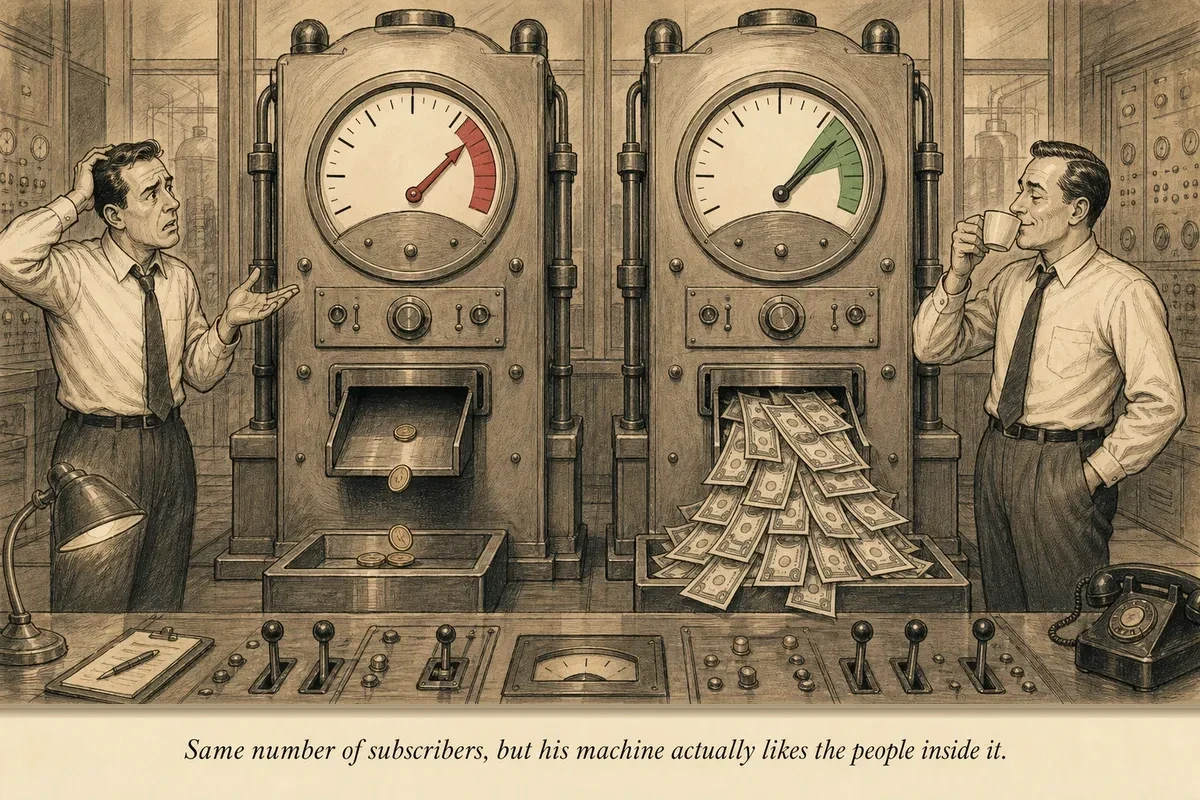
I was running two toll positions in the same niche. Same product category. Similar audiences. One had 8,000 subscribers. The other had 3,000.
Every month I’d look at the total revenue numbers and feel pretty good about the bigger list. More subscribers, more revenue, more proof the system was working. Right?
Then one afternoon I divided each position’s revenue by its subscriber count. And the smaller list was crushing the larger one. Not by a little. By almost 3x per person.
That one division problem — total revenue divided by total subscribers — changed how I evaluate everything. Revenue per subscriber per month (RPS). It collapses all your complexity — email sequences, product selections, broadcast cadence, conversion rates, commission structures — into one number that answers one question: is this system working?
The portfolios I’ve observed cluster in three bands:
| Band | RPS | What It Means |
|---|---|---|
| Broken | < $0.75 | System has a structural problem. Product mismatch, sequence failure, or dead list. |
| Healthy | $1.00-$2.00 | System is functional. Monetization is working but has significant upside. |
| Compounding | $2.50-$4.00+ | System is optimized. Experiment log is driving consistent improvement. |
Most operators never calculate RPS. They look at total revenue — “$3,400 this month, nice” — without dividing by subscriber count. That’s like a restaurant owner celebrating revenue without knowing how many customers walked in. The revenue number tells you how big the business is. The RPS number tells you how good the business is.
Worked example with default numbers:
A list with 3,000 active subscribers and $4,500 in monthly email revenue has a $1.50 RPS. At the same list size, $2.50 RPS would produce $7,500/month and $4.00 RPS would produce $12,000/month.
The calculator lets you change subscribers, monthly revenue, sends, product price, and conversion assumptions to see whether the system is broken, healthy, or compounding.
Run it with your own numbers: Revenue Per Subscriber Calculator
interactive calculator
Revenue Per Subscriber Calculator
Calculate your RPS and see what better numbers would mean for your bottom line.
Your RPS Breakdown
Current RPS
$1.50
Revenue per email (RPE)
$562
Projected monthly revenue at $2.50 RPS
$7,500
Projected monthly revenue at $4.00 RPS
$12,000
Your RPS:
$1.50
Why RPS matters more than list size
Two operators. Same niche. Same product category.
Operator A: 8,000 subscribers, $4,800/month revenue. RPS = $0.60. Operator B: 3,000 subscribers, $5,100/month revenue. RPS = $1.70.
Which operator has the better business?
Operator B. It’s not close.
Operator A is paying to host, mail, and maintain 8,000 subscriber relationships — and extracting less than a dollar per relationship per month. That suggests dead weight on the list, underperforming product selections, or email sequences that aren’t converting. Growing the list further won’t fix any of those problems. It’ll make them worse: more hosting costs, more deliverability risk, more unengaged subscribers dragging down open rates.
Operator B has a tight, monetized system. Every subscriber is generating meaningful revenue. Growing this list — adding more subscribers to this infrastructure — directly multiplies income. At 6,000 subscribers and the same RPS, Operator B hits $10,200/month without changing a single email.
The leverage is obvious: grow a high-RPS system and revenue scales linearly. Grow a low-RPS system and you’re scaling your problems.
This article continues for paid subscribers with the five drivers of RPS, the benchmark table by niche and product category, how to diagnose what’s suppressing your number, the optimization priority matrix, and the compounding math from RPS improvement over time.
Hybrid Content
This article continues for subscribers.
The full implementation — the steps, the templates, the math — is delivered via the newsletter.
Unsubscribe in one click. Useful operator material only. Promotions, sponsors, and partner links will be disclosed.
Monetize
Want to structure better deals?
This article covered one monetization pattern. The newsletter delivers deal structures and revenue mechanics every week.
Unsubscribe in one click. Useful operator material only. Promotions, sponsors, and partner links will be disclosed.