Free with the book
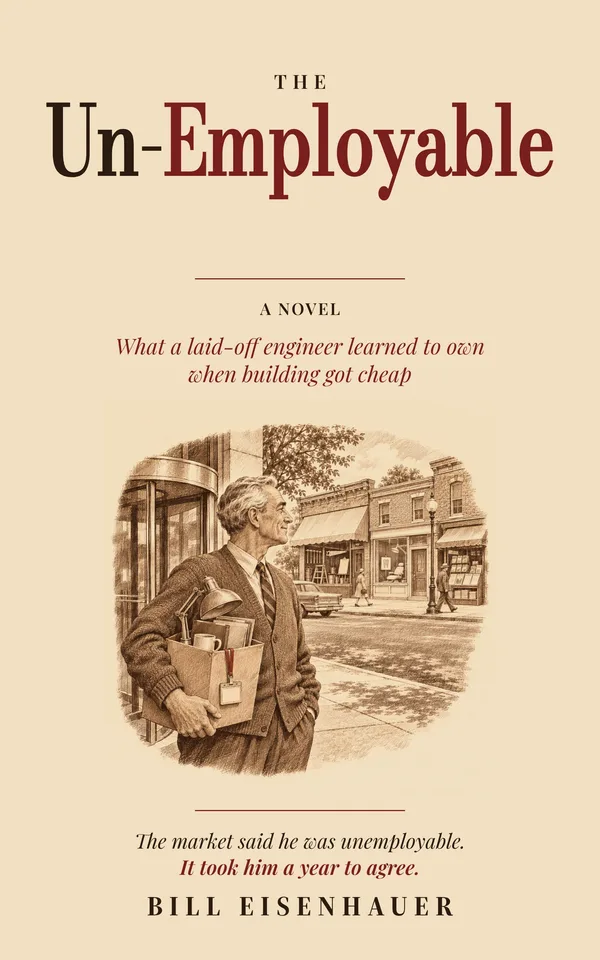
The Un-Employable
A Novel
The pages from the story that are worth keeping on paper: the one page Neil writes for Jonah, the question from his legal pad turned into a worksheet, and the map of where each road he finds is taught. Everything here is already in the book. This page just puts it on paper, and puts the sheets Neil keeps into a spreadsheet you can fill in.
This page is for readers of the book. It's free, and you don't need to sign up to use it.
On this page
- The one page Neil gives Jonah (Chapter 23)
- What still pays (Chapters 2 and 21)
- Neil's sheets, as a spreadsheet (Chapters 12, 16 and 21)
- The map (back of the book)
- Keep reading (free articles)
Each sheet has its own print button. This is a novel: its people, companies and numbers are invented, and nothing here is legal, tax or financial advice, or a promise of income.
The Un-Employable · Chapter 23
The one page
Neil's first version was four pages with a table of contents. The second was two. This is the third, after Delia crossed out the sentence he liked best.
If you stopped tomorrow.
- The zero test. Write down what would still pay you if you stopped tomorrow. If the answer is nothing, write 0 and underline it. That's where you start.
- Four questions, before you build anything.
- Who already listens to them, and did those people choose to?
- Who already knows your name?
- What will you learn by running it that you can't learn by reading about it? Keep a log from the first day. The log is yours; their customers stay theirs.
- What will you have in writing when it's done?
- The other side of the table. Ask what's leaking before you show anything. Bring something already built. Offer a two-week test at your cost. Ask what it's worth to them, and write down what you both say. Get paid from their own report; never hold their money. One click to stop.
- The quarter rule. Once there's enough to measure, no single owner more than a quarter of what you earn.
Apply for jobs if you want. A job is fine. This is for owning something too.
Neil's page is from the novel. The method behind each line is taught in The Un-SaaS and the other Un books; the map below says where.
The Un-Employable · Chapters 2 and 21
What still pays
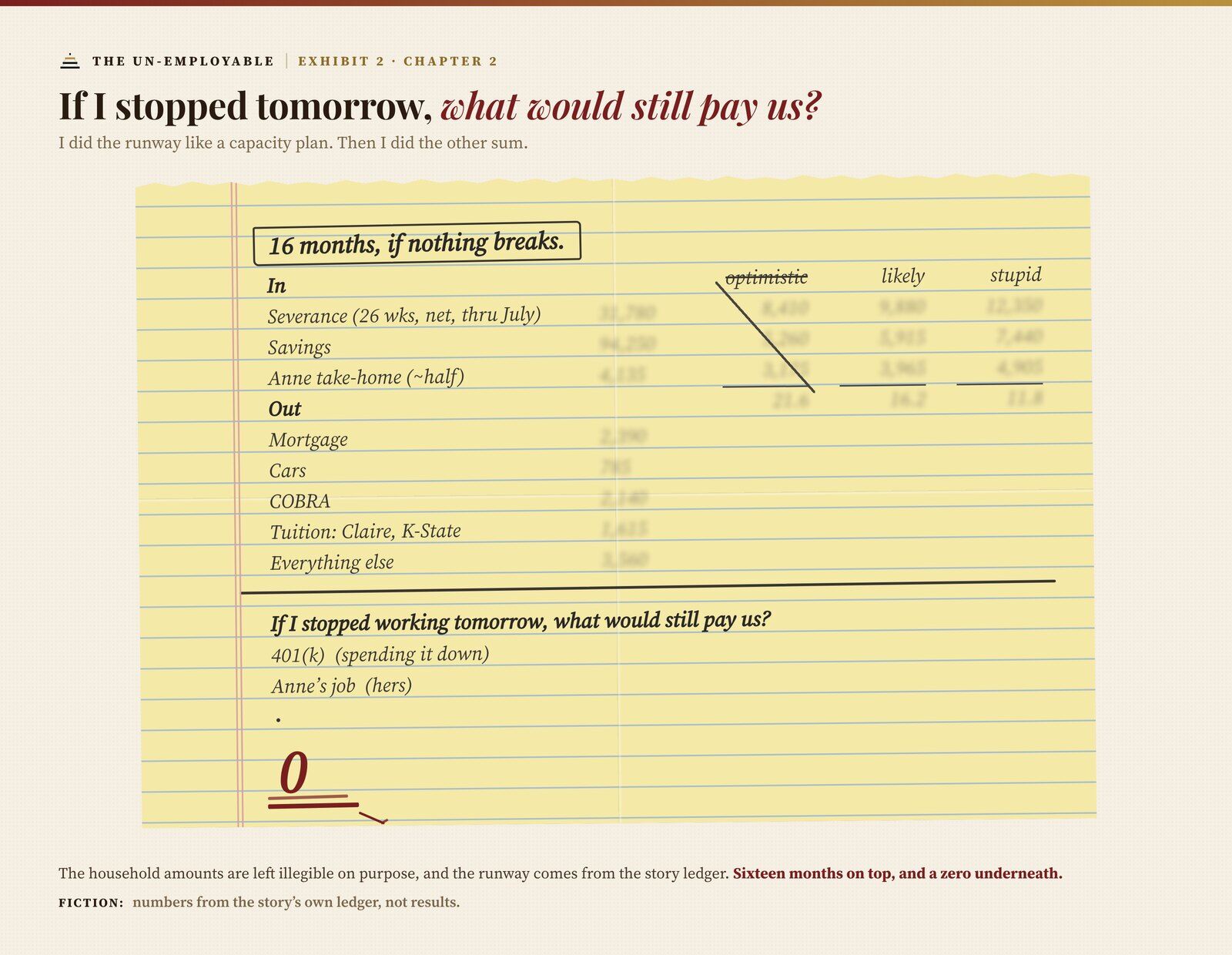
Two sittings, months apart. The first is the question Neil wrote on a legal pad at the kitchen table the week he was laid off. The second is the board he drew on butcher paper a year later.
Part 1. If I stopped working tomorrow, what would still pay us?
Not your runway. Whatever would keep arriving if you sat in this chair and never did another day's work for anybody. Savings you'd be spending down don't count, and neither does someone else's paycheck.
| What would still pay | |
|---|---|
| If nothing | Write 0 and underline it. That's a starting line, not a sentence. |
Part 2. The board: every position you hold
One row for each thing you're part of. Mark which of the four it adds to, then the column that matters most: what you'd keep if you stopped for ninety days.
- Distribution. Who already listens to them, and did those people choose to?
- Trust. Who already knows your name, and takes your call?
- Data. What will you learn by running it that you can't learn by reading about it? Kept with consent; the customers stay their owner's.
- Rights. What will you have in writing when it's done? A revenue share, a license, an option, a fee letter.
| Position | Adds to | What I'd keep if I stopped, in 90 days | Share from this owner (under a quarter?) | Next year's hours |
|---|---|---|---|---|
Reading the board
- Count what you'd keep, not what you made this month. Neil's board shows no total, on purpose.
- Put the next hour where it adds to one of the four and compounds. Work paid by the hour, with nothing kept, is still a job, however good.
- Control before ownership. A written right to run something, or an option to buy it, comes before spending savings on it.
- The quarter rule. No single owner, partner or client well over a quarter of what you earn, once there's enough to measure.
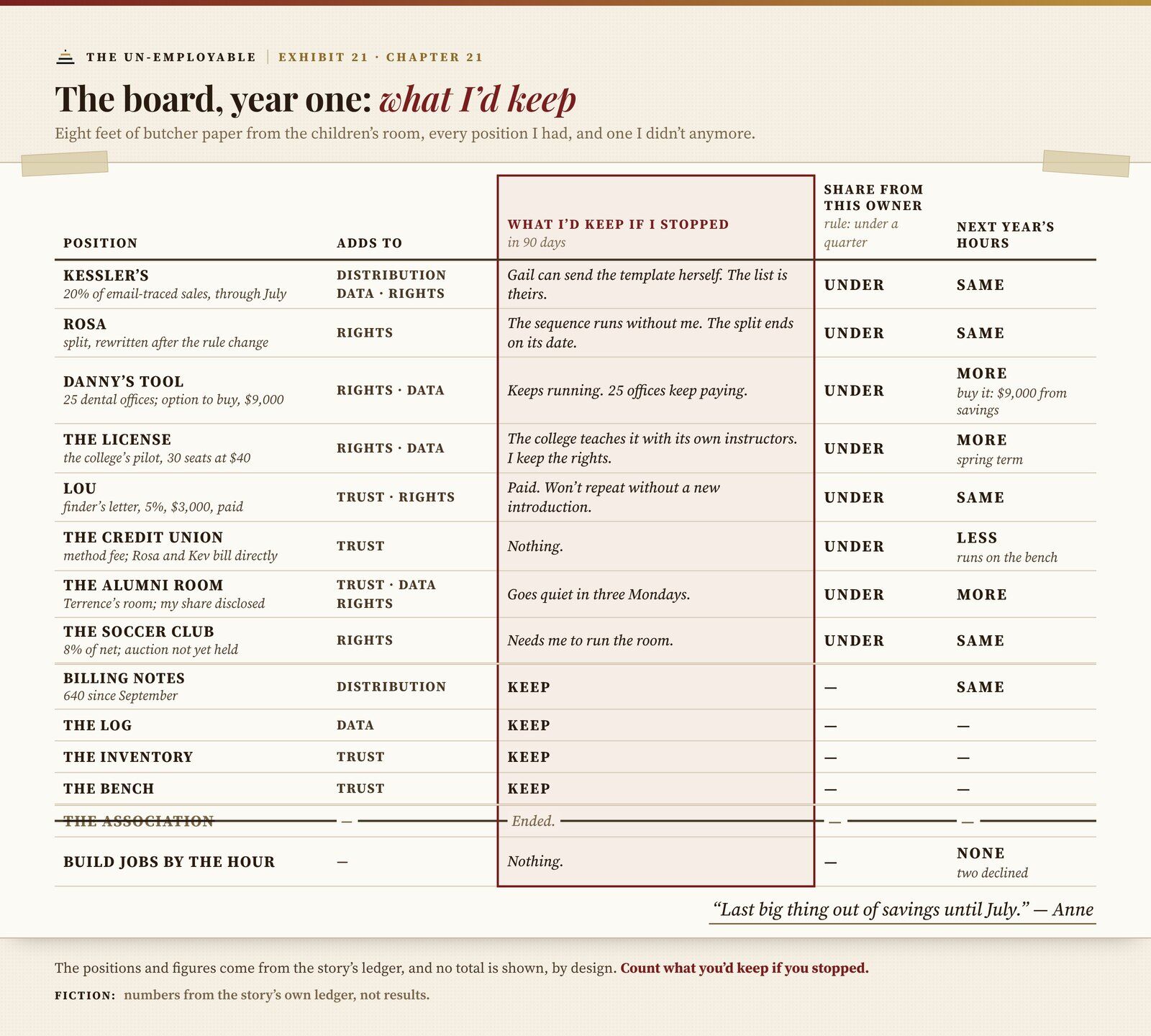
Neil's figures are story numbers from one ledger kept so the novel agrees with itself. They illustrate; they aren't results, projections or typical outcomes. Plenty of people who try what he tries earn very little for a long time, and some never do. Severance agreements, finder's fees and licenses depend on where you live and what you signed: when Neil needs a lawyer, he calls one.
The Un-Employable · Chapters 12, 16 and 21
Neil's sheets
In Chapter 3 Neil builds a very good spreadsheet of job applications, and it ends at two hundred and twelve rows and a zero. The sheets he keeps later count something else. Here they are as one spreadsheet, with the columns from the book, ready to fill in.
- The board. Every position you hold, which of the four it adds to, what you'd keep if you stopped for ninety days, and next year's hours. Give each owner's name and what they paid you, and the sheet flags any owner well over a quarter of what you earn. Ended positions stay on the board, struck through.
- Contacts. Who, what they need, what they have, how warm, and when you last confirmed it. Rows more than ninety days old turn amber.
- Bench. The people you'd bring onto a job, a second name for each, the paid trial and what you saw.
It also has a tab of Neil's own rows from the book, so you can see how a filled-in row reads.
The copy is yours, in your own Google Drive, and nobody else can see it. Google asks you to sign in first.
The Contacts and Bench tabs hold other people's names: use first names and companies only, and keep the file somewhere private. Neil's rows are story numbers, not results. Nothing here is legal, tax or financial advice, or a promise of income.
The Un-Employable · The Map
The map
Every road Neil finds is taught, step by step, in one of the Un books from Toll Stack Press. Some are out and some are still coming. Each link goes to that book's free reader kit.
- The zero at the bottom of the page (Chapters 2, 5, 21)
- The Un-SaaS, Chapter 1, Income Follows Assets.
- Seeing what's broken in other people's businesses (Chapter 8)
- The Un-SaaS, Chapter 2, The Toll Position.
- Where you're coming from (Chapters 9 and 10)
- The Un-Agency, Chapter 2, The Investor Stance. The Un-SaaS, Chapter 8, Finding Your First Partner.
- The first revenue share (Chapters 10 and 11)
- The Un-SaaS, Chapter 12, How the Money Moves. Asking a quiet list whether it wants to keep hearing from you: The Un-Founder, Chapter 6, Lists That Went Quiet.
- The experiment log (Chapters 11 and 13)
- The Un-SaaS, Chapter 13, The Experiment Log.
- Contacts as inventory, and the fee letter (Chapter 12)
- The Un-Broker, Chapter 4, Stock in Trade; Chapter 10, One Letter, One Deal. Phil as a bird dog (Chapter 21): The Un-Broker, Chapter 18, The Bird Dogs.
- Reading a marketplace's rules (Chapter 13)
- The Un-Seller, Chapter 2, How I Read a Marketplace; Chapter 3, Three Ways to Get Paid; Chapter 9, The Ladder.
- The tool under a sheet (Chapter 14)
- The Un-Founder, Chapter 9, Software Nobody Maintains; Chapter 14, What Actually Transfers; Chapter 16, Control Without Owning.
- The empty sponsor slot (Chapter 15)
- The Un-Publisher, Chapter 4, Three Seats at the Table; Chapter 7, The Buyers Already in the Building; Chapter 9, The Floor and the Spread.
- The bench and the paid diagnostic (Chapter 16)
- The Un-Agency, Chapter 11, The Bench; Chapter 14, The Paid Diagnostic.
- The license (Chapter 17)
- The Un-Course, Chapter 8, The Diagnostic Is the Product; Chapter 12, The Training Budget; Chapter 14, Seats, Sites and Shares.
- The alumni room (Chapter 18)
- The Un-Community, Chapter 2, Owner, Host, Operator; Chapter 7, The Exchange Board; Chapter 10, Paid for the Room.
- The auction in someone else's hall (Chapter 19)
- The Un-Auctioneer, still coming: Chapter 10, Gross Is Not Cash; Chapter 11, The Runner-Up Double; Chapter 13, Renting the Room.
- The board, and allocating like an investor (Chapter 21)
- The Un-SaaS, Chapter 21, Purchase the Cow; Chapter 22, The Portfolio Math.
- Teaching it (Chapter 23)
- The Un-SaaS, Chapter 24, When to Teach.
Keep reading
Three free articles that go further into this book's ground.
- Income Follows Assets — And Most Operators Have ZeroIf your income stops when you stop working, you have a job — not an asset. The 90-day test reveals which one you built.
- The Investor Stance — You Are Not a Service ProviderYou are not a service provider looking for clients. You are an investor evaluating where to deploy your infrastructure. That changes everything.
- The Experiment Log: Why the Moat Isn't the InfrastructureThe operator who runs one experiment per week for a year has 52 data points no competitor can see. The log is the moat.
A new free article goes out every Friday. Read the newsletter →